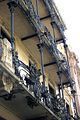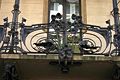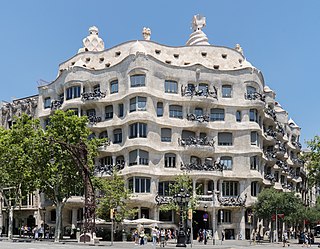
Casa Milà, popularly known as La Pedrera in reference to its unconventional rough-hewn appearance, is a Modernista building in Barcelona, Catalonia, Spain. It was the last private residence designed by architect Antoni Gaudí and was built between 1906 and 1912.

Wrought iron is an iron alloy with a very low carbon content in contrast to that of cast iron. It is a semi-fused mass of iron with fibrous slag inclusions, which give it a wood-like "grain" that is visible when it is etched, rusted, or bent to failure. Wrought iron is tough, malleable, ductile, corrosion resistant, and easily forge welded, but is more difficult to weld electrically.

The Casa Rosada is the office of the president of Argentina. The palatial mansion is known officially as Casa de Gobierno. Normally, the president lives at the Quinta de Olivos, the official residence of the president of Argentina, which is located in Olivos, Greater Buenos Aires. The characteristic color of the Casa Rosada is baby pink, and it is considered one of the most emblematic buildings in Buenos Aires. The building also houses a museum, which contains objects relating to former presidents of Argentina. It has been declared a National Historic Monument of Argentina.
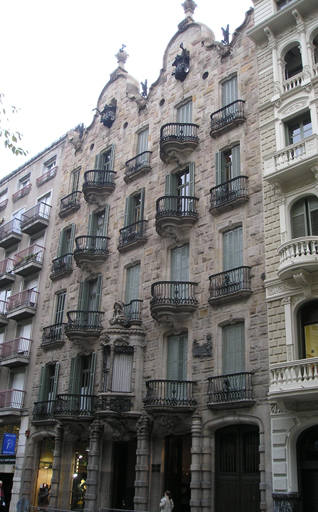
Casa Calvet is a building, designed by Antoni Gaudí for a textile manufacturer which served as both a commercial property and a residence. It is located at Carrer de Casp 48, Eixample district of Barcelona. It was built between 1898 and 1900.

Cast-iron architecture is the use of cast iron in buildings and objects, ranging from bridges and markets to warehouses, balconies and fences. Refinements developed during the Industrial Revolution in the late 18th century made cast iron relatively cheap and suitable for a range of uses, and by the mid-19th century it was common as a structural material, and particularly for elaborately patterned architectural elements such as fences and balconies, until it fell out of fashion after 1900 as a decorative material, and was replaced by modern steel and concrete for structural purposes.

Els Quatre Gats is a café in Barcelona, Catalonia, Spain that famously became a popular meeting place for famous artists throughout the modernist period in Catalonia, known as Modernisme. The café opened on 12 June 1897 in the famous Casa Martí, and served as a hostel, bar and cabaret until it eventually became a central meeting point for Barcelona’s most prominent modernist figures, such as Pablo Picasso and Ramon Casas i Carbó. The bar closed due to financial difficulties in June 1903, but was reopened and eventually restored to its original condition in 1989.
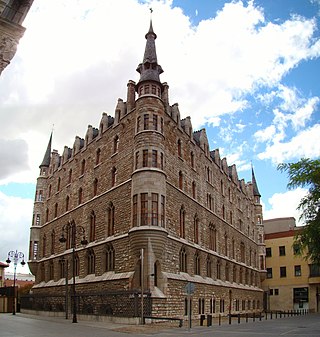
The Casa Botines is a Modernist building in León, Spain designed by Antoni Gaudí. It currently houses a museum dedicated to Gaudi, Spanish art of the 19th and 20th centuries, and the history of the building itself.
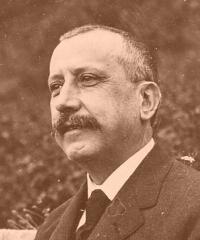
Joan Rubió y Bellver was a Spanish architect famous for his contributions to the Catalan Modernista movement.

The Casa Martí is a modernista building designed by Josep Puig i Cadafalch in 1896, having been commissioned by relatives of Francesc Vilumara, a textile magnate. It stands at Carrer Montsió, 3, Barcelona.

The Buenos Aires House of Culture is an architectural landmark in the Montserrat section of the Argentine capital.
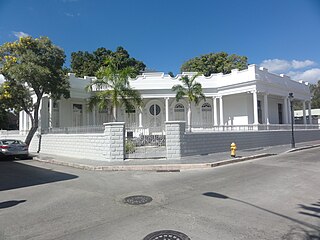
Casa Oppenheimer is a historic house in Ponce, Puerto Rico, designed in 1913 by famed Puerto Rican architect Alfredo B. Wiechers. The house is unique among other historic structures in historic Ponce for its skillful incorporation of front gardens in a very limited urban space. The historic building is located at 47 Salud Street, in the city's historic district, at the northwest corner of Salud and Aurora streets. The house is also known as Casa del Abogado. In April 2019, the house was turned into Casa Mujer by MedCentro, a women's health business concern.

Antoni Gaudí i Cornet was a Catalan architect from Spain known as the greatest exponent of Catalan Modernism. Gaudí's works have a highly individualized, sui generis style. Most are located in Barcelona, including his main work, the church of the Sagrada Família.

Casa Campanini is an art nouveau building in Milan, Italy, located at 11, Via Bellini. It was completed between 1903 and 1906 by architect Alfredo Campanini, who later inhabited the building.

The Gaudí House Museum, located within the Park Güell in Barcelona, is a historic home museum that houses a collection of furniture and objects designed by the Spanish architect Antoni Gaudí. It was the residence of Antoni Gaudí for almost 20 years, from 1906 till the end of 1925. On 28 September 1963 it opened as a historic home museum.

Casa Fenoglio-Lafleur is a historical building in the Liberty style located in Turin, Italy.

An iron railing is a fence made of iron. This may either be wrought iron, which is ductile and durable and may be hammered into elaborate shapes when hot, or the cheaper cast iron, which is of low ductility and quite brittle. Cast iron can also produce complicated shapes, but these are created through the use of moulds of compressed sand rather than hammering, which would be likely to damage the iron.

Casa Guazzoni is a building at via Malpighi 12 in Milan in the Liberty style, or Italian Art Nouveau.

The Plaza del Vapor was a covered market in Havana. Its name derives from its builder Francisco Martí who became later the impresario of the Tacón Theatre and who had a monopoly of fish trade in the city. Martí had a painting placed against a wall from a bar of the ship El Neptuno, the first vapor that made regular round trips between Havana and Matanzas. "It was the image of that ship that ended up naming the building." From the Plaza del Vapor, Martí sold 50% of all the lottery tickets. in Cuba.

Art Nouveau in Milan indicates the spread of such artistic style in the city of Milan between the early years of the 20th century and the outbreak of the First World War. In the Lombard capital, art nouveau, called StileLiberty in Italian, found—thanks to its close relationship with the rampant industrial bourgeoisie of the time—a fertile ground for its rapid development, during which it oscillated between the influences of French Art Nouveau, German Jugendstil and eclecticism.

Casa Vanoni is a historic Art Nouveau building located on via Spadari #7 in Milan, Italy.