Related Research Articles
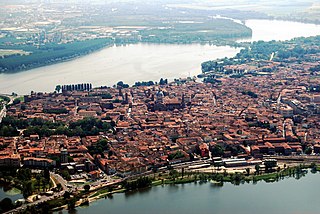
Mantua is a comune (municipality) in the Italian region of Lombardy, and capital of the province of the same name.

The House of Gonzaga is an Italian princely family that ruled Mantua in Lombardy, northern Italy from 1328 to 1708. They also ruled Monferrato in Piedmont and Nevers in France, as well as many other lesser fiefs throughout Europe. The family includes a saint, twelve cardinals and fourteen bishops. Two Gonzaga descendants became empresses of the Holy Roman Empire, and one became Queen of Poland and Grand Duchess of Lithuania in the Polish–Lithuanian Commonwealth.

Ludovico III Gonzaga of Mantua, known as the Turk, also spelled Lodovico was the ruler of the Italian city of Mantua from 1444 to his death in 1478.

Theodorus Gaza, also called Theodore Gazis or by the epithet Thessalonicensis and Thessalonikeus, was a Greek humanist and translator of Aristotle, one of the Greek scholars who were the leaders of the revival of learning in the 15th century.

Pisanello, born Antonio di Puccio Pisano or Antonio di Puccio da Cereto, also erroneously called Vittore Pisano by Giorgio Vasari, was one of the most distinguished painters of the early Italian Renaissance and Quattrocento. He was acclaimed by poets such as Guarino da Verona and praised by humanists of his time, who compared him to such illustrious names as Cimabue, Phidias and Praxiteles.
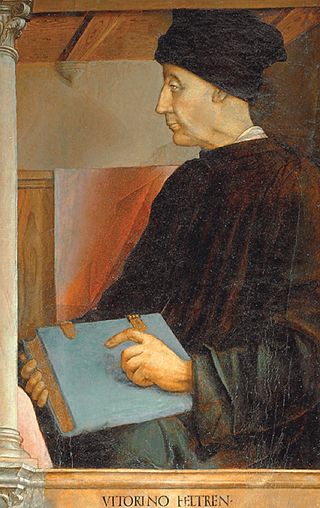
Vittorino da Feltre was an Italian humanist and teacher. He was born in Feltre, Belluno, Republic of Venice and died in Mantua. His real name was Vittorino Rambaldoni. It was in Vittorino that the Renaissance idea of the complete man, or l'uomo universale — health of body, strength of character, wealth of mind — reached its first formulation.

The Duchy of Mantua was a duchy in Lombardy, northern Italy. Its first duke was Federico II Gonzaga, member of the House of Gonzaga that ruled Mantua since 1328. The following year, the duchy also acquired the March of Montferrat, thanks to the marriage between Gonzaga and Margaret Paleologa, Marchioness of Montferrat.

Gasparino Barzizza was an Italian grammarian and teacher noted for introducing a new style of epistolary Latin inspired by the works of Cicero.

Gianfrancesco I Gonzaga was Captain of the People from 1407 to 1433 and Marquis of Mantua from 1433 to 1444. He was also a condottiere.

Federico I Gonzaga was marquis of Mantua from 1478 to 1484, as well as a condottiero.
Carlo I Malatesta was an Italian condottiero during the Wars in Lombardy and lord of Rimini, Fano, Cesena and Pesaro. He was a member of the powerful House of Malatesta. Carlo's wife was Elisabetta Gonzaga; they were married in November 1386. Francesco I Gonzaga married Carlo's sister Margherita Malatesta in 1393, cementing ties between the families. Carlo was the brother of Pandolfo III and Andrea Malatesta, with whom he fought in numerous occasions.
Battista Malatesta, also known as Battista di Montefeltro, forename also called Baptista, was an Italian Renaissance poet.

Barbara of Brandenburg was a Marchioness consort of Mantua, married in 1433 to Ludovico III Gonzaga, Marquis of Mantua. She was referred to as a virago because of her strong character and forceful nature, and served as Regent of Mantua several times during the absence of Ludivico III between 1445 and 1455. She is regarded as an important figure in the Italian Renaissance and was a student of Vittorino da Feltre.

Francesco Gonzaga was an Italian bishop and a Cardinal of the Roman Catholic Church during the reigns of Popes Pius II, Paul II and Sixtus IV.

Giovanni Tortellli, also known as Tortellius was a Renaissance humanist, largely responsible for the creation of the Vatican Library, together with scholars such as Bessarion and Poggio Bracciolini.
Gregorio Correr (Corraro) was an Italian humanist and ecclesiastic from Venice. In the last year of his life he was elected Patriarch of Venice.

Iacopo da San Cassiano, also known as Iacobus Cremonensis, was an Italian humanist and mathematician. He translated from Greek to Latin the writings of Archimedes and parts of Diodorus' Bibliotheca historica.
The following is a timeline of the history of the city of Mantua in the Lombardy region of Italy.
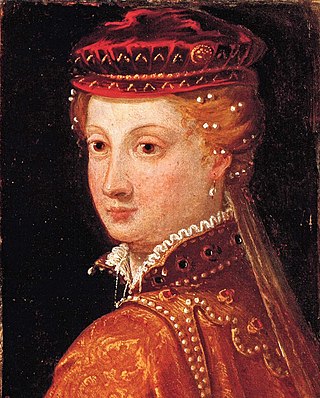
Paola Agnese Malatesta also Paola of Mantua was an Italian noblewoman of the noble family House of Malatesta, rulers of Rimini and Pesaro. She was born in Pesaro in 1393 to Malatesta IV Malatesta, lord of Pesaro and Fossombrone, and Elisabetta da Varano. On 22 August 1409 she married Gianfrancesco Gonzaga, leader of Mantua, in Pesaro. She was the first Marquesa of Mantua after her husband received the title. Paola had six children. This union introduced the genetic disease of kyphosis to the Gonzaga family which showed in subsequent generations.

Barbara Sanseverino was an Italian noblewoman.
References
- ↑ sageparnassus (2013-03-06). "La Casa Giocosa • Sage Parnassus". Sage Parnassus. Retrieved 2024-04-17.
- ↑ "Vittorino da Feltre – humanist and educator". The Italy on This Day. Retrieved 2024-04-17.
- ↑ "La Giocosa | Italian school | Britannica". www.britannica.com. Retrieved 2024-04-17.
- ↑ "Mantova: 600 anni della Ca' Zoiosa". Giornale Sentire. 2023-10-08. Retrieved 2024-04-17.
- ↑ "da Feltre, Vittorino - Esperienza educativa de La Giocosa". Skuola.net - Portale per Studenti: Materiali, Appunti e Notizie (in Italian). Retrieved 2024-04-17.