
Catonsville is a census-designated place (CDP) in Baltimore County, Maryland. The population was 44,701 at the 2020 US Census. The community is a streetcar suburb of Baltimore along the city's western border. The town is known for its proximity to the Patapsco River and Patapsco Valley State Park, making it a regional mountain biking hub. The town is also notable as a local hotbed of music, earning it the official nickname of "Music City, Maryland." Catonsville contains the majority of the University of Maryland, Baltimore County (UMBC), a major public research university with close to 14,000 students.

Westminster is a city in and the county seat of Carroll County, Maryland, United States. The city's population was 19,960 at the 2020 census. Westminster is an outlying community in the Baltimore metropolitan area, which is part of the greater Washington–Baltimore combined statistical area.

Green Mount Cemetery is a historic rural cemetery in Baltimore, Maryland, United States. Established on March 15, 1838, and dedicated on July 13, 1839, it is noted for the large number of historical figures interred in its grounds as well as many prominent Baltimore-area families. It retained the name Green Mount when the land was purchased from the heirs of Baltimore merchant Robert Oliver. Green Mount is a treasury of precious works of art, including striking works by major sculptors including William H. Rinehart and Hans Schuler.

Catonsville High School (CHS) is a four-year public high school in Catonsville, Maryland. It is located on the southwest side of Baltimore County, Maryland, close to the Baltimore border near Anne Arundel and Howard County, just outside the Baltimore Beltway.
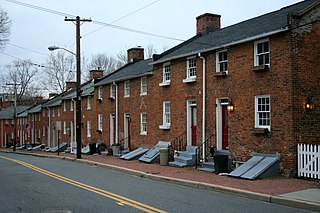
Oella is a mill town on the Patapsco River in western Baltimore County, Maryland, United States, located between Catonsville and Ellicott City. It is a 19th-century village of millworkers' homes.

Blandair, also known as Blandair Farm, Blandair Park, and Blandair Regional Park, is 300 acres of former slave plantation located in Columbia, Maryland. The Blandair Foundation estate of Mrs. Smith was purchased by Howard County, Maryland in the late 1990s and is in the process of being developed as a regional park.

St. Charles College was a minor seminary in Catonsville, Maryland, originally located in Ellicott City, Maryland.

Baltimore County Public Library (BCPL), established in 1948, is a public library system located in central Maryland and headquartered in Towson, Maryland BCPL serves Baltimore County, Maryland, which surrounds but does not include the city of Baltimore. Still, occasionally the two library systems share resources and expertise.

The Baltimore–Columbia–Towson Metropolitan Statistical Area, also known as Central Maryland, is a metropolitan statistical area (MSA) in Maryland as defined by the United States Office of Management and Budget (OMB). It is part of the larger Washington–Baltimore combined statistical area. As of 2022, the combined population of the seven counties is 2,985,871, making it the 20th-largest metropolitan statistical area in the nation.
Cheswolde is residential community in northwest Baltimore, Maryland. It is located along the Western Run. The main roads running through the area are Greenspring Avenue, Cross Country Boulevard, and Taney Road.

Security Square Mall is a mall in Woodlawn, Baltimore County, Maryland, a suburb of Baltimore, in the United States. The mall features over 100 stores and restaurants, as well as a food court. One section of the mall, Grand Village Plaza, previously included Korean shops and restaurants; however, most of these establishments had closed by 2010. Security Square Mall is located adjacent to the North American School of Trades. The anchor stores are Bayit Furniture, Set the Captives Free Outreach Center, Burlington, and Macy's. There is 1 vacant anchor store that was once Sears.
The District Court of Maryland for Baltimore County District Courthouses are located in Towson, Catonsville and Essex and serve as the courts of first impression for the majority of residents in the state of Maryland. Jurisdiction of the District Court includes most landlord- tenant cases, small claims for amounts up to $5,000, replevin actions, motor vehicle violations, misdemeanors, certain felonies, and peace and protective orders. The District Courts also have concurrent jurisdiction with the Circuit Court over civil lawsuits where the amount in controversy is between $5,001 and $30,000.
The Historical Ellicott City/Baltimore Trolley Line #9 Trail is a 1.25-mile (2.0 km) trail in western Baltimore County, Maryland. It begins at the west end of Edmondson Avenue and extends from Catonsville through Oella to Main Street, Ellicott City. The trail follows what was originally part of the Catonsville and Ellicott City Electric Railway Company trolley line that shuttled passengers between Ellicott City and Baltimore from the late 1890s to the mid-1950s.

Clark's Elioak Farm, located along Maryland Route 108 in Howard County, Maryland, is a historic farm covering 540 acres. All of the acreage is part of county or state farmland protection programs, barring use of the property for non-farm development. The Clarks, a family with a tradition of farming in Maryland spanning seven generations, have owned the Elioak farm since 1927.

The Historical Society of Baltimore County (HSBC) was founded in 1959 with the goal of preserving, interpreting, and illustrating the history of Baltimore County for the benefit of present and future generations of Marylanders, and is a resource for those interested in researching both local and family history. As the HSBC describes it, they "continually accomplish" their mission "through the production of presentations, lectures, workshops, entertaining educational publications, historical tours, and exhibits." Centrally located in Cockeysville, Maryland, the Society operates out of the Agriculture Building, the former Baltimore County Almshouse, which was built in 1872 and used to house the poor and mentally ill of Baltimore County until 1958.
Johnnycake Town, also called Journeycake Town, is a settlement settled in the 18th century. Currently unnamed, it is located in what is now Catonsville, Maryland.

Richard Caton was an Englishman who became a Baltimore merchant and real estate developer. Caton married into the Carroll family of Carrollton and was the father of four daughters, all of whom married prominent Europeans, including members of the British aristocracy.
A United States postage stamp and the names of a number of recreational and cultural facilities, schools, streets and other facilities and institutions throughout the United States have commemorated Benjamin Banneker's documented and mythical accomplishments throughout the years since he lived (1731–1806). Among such memorializations of this free African American almanac author, surveyor, landowner and farmer who had knowledge of mathematics, astronomy and natural history was a biographical verse that Rita Dove, a future Poet Laureate of the United States, wrote in 1983 while on the faculty of Arizona State University.
Thomas Henry Randall was an American architect known for his large country homes during the Gilded Age.

Bethlehem Key Highway Shipyard started as William Skinner & Sons in downtown Baltimore, Maryland in 1815. In 1899 the shipyard was renamed Skinner Shipbuilding & Dry Dock Company. Also at the site was Malster & Reanie started in 1870 by William T. Malster (1843–1907). In 1879 Malster partnered with William B. Reaney (1808-1883). In 1880 Malster & Reanie was sold and renamed Columbian Iron Works & Dry Dock Company. Malster & Reanie and Skinner Shipbuilding & Dry Dock Company merged in 1906, but remained as Skinner Shipbuilding. In 1914 the company was renamed Baltimore Dry Dock & Shipbuilding Company. Baltimore Dry Dock & Shipbuilding Company sold to Bethlehem Steel in 1922, becoming part of Bethlehem Shipbuilding Corporation. Bethlehem Steel operated the shipyard for ship repair, conversion and some ship construction. Bethlehem's main ship construction site was across the harbor at Bethlehem Sparrows Point. Bethlehem Key Highway Shipyard was known as the Bethlehem Upper Yard located north-east side of Federal Hill. Bethlehem Fort McHenry Shipyard located on the west side of Locust Point peninsula was known as the Lower Yard, near Fort McHenry.

