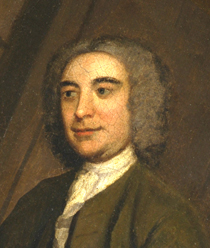
John Wood, the Elder was an English architect, working mainly in Bath.

The Aloft Liverpool Hotel, formerly the Royal Insurance Building, is a historic building located at 1-9 North John Street, Liverpool, Merseyside, England. It was built as the head office of the Royal Insurance company.

The Grade I listed buildings in Somerset, England, demonstrate the history and diversity of its architecture. The ceremonial county of Somerset consists of a non-metropolitan county, administered by Somerset County Council, which is divided into five districts, and two unitary authorities. The districts of Somerset are West Somerset, South Somerset, Taunton Deane, Mendip and Sedgemoor. The two administratively independent unitary authorities, which were established on 1 April 1996 following the breakup of the county of Avon, are North Somerset and Bath and North East Somerset. These unitary authorities include areas that were once part of Somerset before the creation of Avon in 1974.
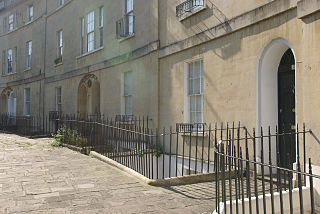
Widcombe is a district of Bath, England, immediately south-east of the city centre, across the River Avon.
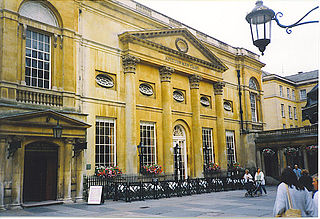
The Grand Pump Room is a historic building in the Abbey Churchyard, Bath, Somerset, England. It is adjacent to the Roman Baths and is named for water that is pumped into the room from the baths' hot springs. Visitors can drink the water or have other refreshments while there.
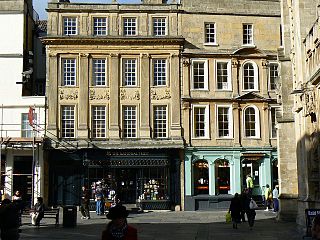
Marshal Wade's House or General Wade's House at 14 Abbey Church Yard, Bath, Somerset, England was built around 1700 and has been designated as a Grade I listed building.

Gay Street in Bath, Somerset, England, links Queen Square to The Circus. It was designed by John Wood, the Elder in 1735 and completed by his son John Wood, the Younger. The land was leased to the elder Wood by Robert Gay, MP for Bath, and the street is named after him. Much of the road has been designated as Grade I listed buildings.

North Parade in Bath, Somerset, England is a historic terrace built around 1741 by John Wood, the Elder. Several of the houses have been designated as Grade I listed buildings.

St James's Square in Bath, Somerset, England consists of 45 Grade I listed buildings. It was built in 1793 by John Palmer.

Stall Street in Bath, Somerset, England was built by John Palmer between the 1790s and the first decade of the 19th century. The buildings which form an architectural group have listed building status and are now occupied by shops and offices.

The Paragon in the Walcot area of Bath, Somerset, England is a street of Georgian houses which have been designated as listed buildings. It was designed by Thomas Warr Attwood. It now forms part of the A4.

Portland Place in Bath, Somerset, England was built around 1786 and many of the houses have been designated as listed buildings.

Bathwick Hill in Bath, Somerset, England is a street lined with historic houses, many of which are designated as listed buildings. It climbs south east from the A36 towards the University of Bath on Claverton Down, providing views over the city.

Grosvenor Place in Bath, Somerset, England was built around 1790 by John Eveleigh. It lies on the south side of the A4 London Road and many of the houses are listed buildings.

Trim Street in Bath, Somerset, England is an historic street, built in 1707, of shops and houses, many of which are listed buildings. It was named after George Trim who owned the land.
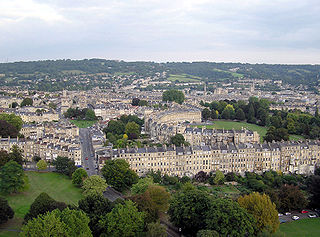
The buildings and architecture of Bath, a city in Somerset in the south west of England, reveal significant examples of the architecture of England, from the Roman Baths, to the present day. The city became a World Heritage Site in 1987, largely because of its architectural history and the way in which the city landscape draws together public and private buildings and spaces. The many examples of Palladian architecture are purposefully integrated with the urban spaces to provide "picturesque aestheticism". In 2021, the city was added to a second World Heritage Site, a group of historic spa towns across Europe known as the "Great Spas of Europe". Bath is the only entire city in Britain to achieve World Heritage status, and is a popular tourist destination.

122 Foregate Street is a building at the corner of the north side of Foregate Street and the east side of Bath Street, Chester, Cheshire, England. It is recorded in the National Heritage List for England as a designated Grade II listed building.

Chew Court is a Grade II* listed building next to St Andrew's church in Chew Magna, Somerset, England.

The Crescent is a street in Taunton, a town in the English county of Somerset. Construction began in 1807, during a period of extensive redevelopment in the town, driven by the Market House Society and the Member of Parliament Sir Benjamin Hammet. Lined on the eastern side by a Georgian terrace, the street follows a shallow crescent shape, broken in the middle by Crescent Way and a bit further south by St George's Place. It links Upper High Street, at its southern end, with Park Street and Tower Street to the north. On the western side, Somerset County Council have their offices in the County Hall, erected in 1935, and extended in the 1960s. The Georgian terrace, the Masonic Hall, and the County Hall are recorded in the National Heritage List for England as listed buildings.