
The Church of St. Ignatius of Loyola at Campus Martius is a Latin Catholic titular church, of deaconry rank, dedicated to Ignatius of Loyola, the founder of the Society of Jesus, located in Rome, Italy. Built in Baroque style between 1626 and 1650, the church functioned originally as the chapel of the adjacent Roman College, which moved in 1584 to a new larger building and was renamed the Pontifical Gregorian University. It is one of the great 17th century preaching churches built by Counter-Reformation orders in the Centro Storico.
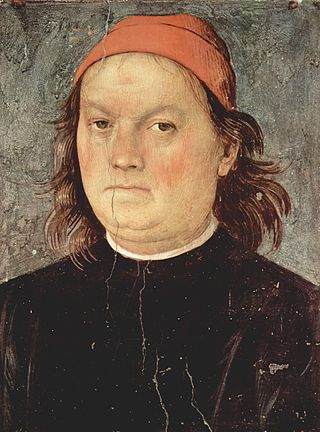
Pietro Perugino, an Italian Renaissance painter of the Umbrian school, developed some of the qualities that found classic expression in the High Renaissance. Raphael became his most famous pupil.

Sant'Andrea della Valle is a titular church and minor basilica in the rione of Sant'Eustachio of the city of Rome, Italy. The basilica is the seat of the general curia of the Theatines and is located on the Piazza Vidoni, at the intersection of Corso Vittorio Emanuele and Corso Rinascimento. It is one of the great 17th century preaching churches built by Counter-Reformation orders in the Centro Storico.

The Tempio della Beata Vergine della Ghiara, also known as Basilica della Madonna della Ghiara, is a church in Reggio Emilia, northern Italy. The building is the property of the comune (municipality) of the city.

Camillo Procaccini was an Italian painter. He has been posthumously referred to as the Vasari of Lombardy, for his prolific Mannerist fresco decoration.

The Basilica della Santissima Annunziata del Vastato is the Catholic cathedral of Genoa, northern Italy; its decoration employed the major baroque studios and artists in Genoa in the 17th century.

Ludovico Lana was an Italian painter of the Baroque period, mainly active in Modena, where he died in 1646. He is also known as Lodovico Lana. He was the director of the Accademia Ducale of Modena. He is said to have been born in Codigoro to a Ferrarese merchant, whose family was originally from Brescia. He appears to have trained with Scarsellino in Ferrara. He then spent some time in Bologna, where he may have worked under or learned the style of either Reni or Guercino.

The Basilica of Saint Nicholas of Tolentino is a Roman Catholic church and minor basilica that is part of the Augustinian monastery in the hill-town of Tolentino, province of Macerata, Marche, central Italy. The church is a former cathedral of the Roman Catholic Diocese of Tolentino, suppressed in 1586.

Giovanni Giacomo Barbelli was an Italian painter of the Baroque period, active in Lombardy. He was a canvas and fresco painter known for his religious and mythological scenes that decorated many churches and residences in Lombardy. He was a highly skilled draughtsman and a brilliant colorist. His work shows an inventive imagination and a thorough knowledge of perspective.

Jacopo Zoboli, also known by Giacomo, was an Italian painter of the Baroque style.

San Bartolomeo is a Baroque church in Modena.

The Basilica of San Prospero is a Renaissance-style, Roman Catholic church with a late Baroque-style facade, located on Piazza di San Prospero in central Reggio Emilia, Italy.
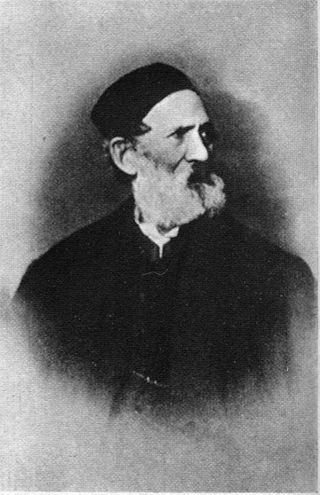
Adeodato Malatesta was an Italian painter, trained in a grand Neoclassical style, depicting mostly of sacred and historic subjects.

Cosroe Dusi was an Italian painter in the Neoclassical style, active for many years in St Petersburg, Russia, painting mainly sacred and historical subjects. Dusi was nicknamed by his contemporaries the "modern Tintoretto", for his liveliness of invention and rapidity at painting.

San Biagio is a Baroque architecture, Roman Catholic church, located on Via del Carmine #4 in central Modena, Italy.

The Church of Santa Sofia is a Roman Catholic church in the city of Lendinara, in the Province of Rovigo, region of Veneto, Italy.
The Sanctuary of the Madonna del Pilastrello is a Renaissance style, Roman Catholic minor basilica church in the city of Lendinara, in the province of Rovigo, region of Veneto, Italy.
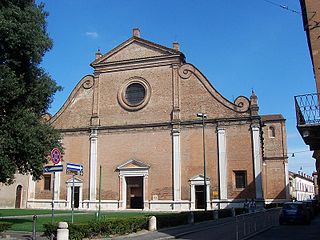
San Francesco is a late-Renaissance, Roman Catholic minor basilica church located on via Terranuova in Ferrara, Emilia-Romagna, Italy.
The Oratory of San Bovo is a Roman Catholic prayer hall located on via Del Torresino #4 in Padua, region of Veneto, Italy.
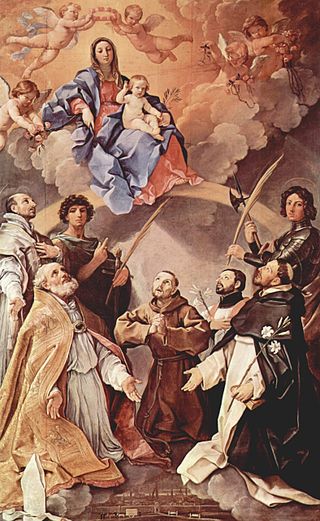
The Pala della Peste or Pallione del Voto is an oil on silk Baroque-style altarpiece by Guido Reni depicts the Madonna and Child in Glory with the Patron Saints of Bologna: Petronius, Francis, Ignatius, Francis Xavier, Proculus of Bologna, and Florian.


