 | |
| Author | Henryk Grynberg |
|---|---|
| Original title | Dzieci Syjonu |
Publication date | January 1988 |
The Children of Zion (The Path of Agony of the Tehran Children) is a book written by Henryk Grynberg about "the fate of the Polish Jews". [1] [2] [3] [4]
| | |
| Author | Henryk Grynberg |
|---|---|
| Original title | Dzieci Syjonu |
Publication date | January 1988 |
The Children of Zion (The Path of Agony of the Tehran Children) is a book written by Henryk Grynberg about "the fate of the Polish Jews". [1] [2] [3] [4]
The Children of Zion, published in January 1998, is considered as a documentary that was based on a collection of fragments of records compiled in the British Mandate of Palestine in 1943 by the Eastern Center for Information, a Polish government group. The book was a source of the testimonies of Jewish children who were evacuated from the Soviet Union to Palestine. Grynberg arranged the “collection of interviews” to serve as a reminder about the Holocaust experience. The Polish children’s experiences during World War II also provided a recollection of their lives before the war. Memories of when the war broke out were also discussed, apart from the “arrival of the Germans and the Russians”, the children’s journeys and life while in exile, and their condition after the so-called Sikorsky Agreement allowed them to leave the work camps. Many of the children had to cope as orphaned émigrés. The original document that had become the basis for Grynberg’s Children of Zion is at the Hoover Institution of Leland Stanford Junior University. [1] [2] [3]
Grynberg's Children of Zion contains the original list of the Polish children who arrived in Eretz Israel "on February 18th, 1943, those who arrived in August 1943, and those who gave the testimonies". These children escaped from occupied Poland to Russia prior to arriving at Eretz Israel (Land of Israel). [5]
Grynberg's book was originally published in Polish as Dzieci Syjonu (Warszawa: Karta) in 1994. It was later translated into Hebrew by Zeev Schuss (Yad Vashem, Jerusalem) in 1995. Grynberg’s Children of Zion was translated into English by Jacqueline Mitchell, a United Nations interpreter, and published by Northwestern University Press in 1998. [1] [2]
The Israeli Declaration of Independence, formally the Declaration of the Establishment of the State of Israel, was proclaimed on 14 May 1948 by David Ben-Gurion, the Executive Head of the World Zionist Organization, Chairman of the Jewish Agency for Palestine, and later first Prime Minister of Israel. It declared the establishment of a Jewish state in Eretz-Israel, to be known as the State of Israel, which would come into effect on termination of the British Mandate at midnight that day. The event is celebrated annually in Israel as Independence Day, a national holiday on 5 Iyar of every year according to the Hebrew calendar.

Aliyah is the immigration of Jews from the diaspora to, historically, the geographical Land of Israel or the Palestine region, which is today chiefly represented by the State of Israel. Traditionally described as "the act of going up", moving to the Land of Israel or "making aliyah" is one of the most basic tenets of Zionism. The opposite action — emigration by Jews from the Land of Israel — is referred to in the Hebrew language as yerida. The Law of Return that was passed by the Israeli parliament in 1950 gives all diaspora Jews, as well as their children and grandchildren, the right to relocate to Israel and acquire Israeli citizenship on the basis of connecting to their Jewish identity.

Żydowski Związek Wojskowy was an underground resistance organization operating during World War II in the area of the Warsaw Ghetto, which fought during the Warsaw Ghetto Uprising and 1944 Warsaw Uprising. It was formed, primarily of former officers of the Polish Army, in late 1939, soon after the start of the German occupation of Poland.
The Lovers of Zion, also Hovevei Zion or Hibbat Zion, were a variety of proto-Zionist organizations founded in 1881 in response to the anti-Jewish pogroms in the Russian Empire and were officially constituted as a group at a conference led by Leon Pinsker in 1884.
The Białystok Ghetto uprising was an insurrection in the Jewish Białystok Ghetto against the Nazi German occupation authorities during World War II. The uprising was launched on the night of August 16, 1943 and was the second-largest ghetto uprising organized in Nazi-occupied Poland after the Warsaw Ghetto Uprising of April–May 1943. It was led by the Anti-Fascist Military Organisation, a branch of the Warsaw Anti-Fascist Bloc.

Hatzor, officially Hatzor Ashdod, is a kibbutz in southern Israel. Located near Ashdod, it falls under the jurisdiction of Be'er Tuvia Regional Council. In 2022 it had a population of 690.

Zivia Lubetkin was one of the leaders of the Jewish underground in Nazi-occupied Warsaw and the only woman on the High Command of the resistance group Żydowska Organizacja Bojowa (ŻOB). She survived the Holocaust in German-occupied Poland and immigrated to Mandate Palestine in 1946, at the age of 32.

Henryk Grynberg is a Polish writer and actor who survived the Nazi occupation. He is a novelist, short-story writer, poet, playwright and essayist who had authored more than thirty books of prose and poetry and two dramas. Grynberg, known as the “chronicler of the fate of the Polish Jews”, tackled in his writings the Holocaust experience and the post-Holocaust trauma.
As an organized nationalist movement, Zionism is generally considered to have been founded by Theodor Herzl in 1897. However, the history of Zionism began earlier and is intertwined with Jewish history and Judaism. The organizations of Hovevei Zion, held as the forerunners of modern Zionist ideals, were responsible for the creation of 20 Jewish towns in Palestine between 1870 and 1897.

Israel Belkind was a Jewish educator, author, writer, historian and founder of the Bilu movement. A pioneer of the First Aliyah, Belkind founded the Biluim, a group of Jewish idealists aspiring to settle in the Land of Israel with the political purpose to redeem Eretz Yisrael and re-establish the Jewish State on it.

The Sosnowiec Ghetto was a World War II ghetto set up by Nazi German authorities for Polish Jews in the Środula district of Sosnowiec in the Province of Upper Silesia. During the Holocaust in occupied Poland, most inmates, estimated at over 35,000 Jewish men, women and children were deported to Auschwitz death camp aboard Holocaust trains following roundups lasting from June until August 1943. The ghetto was liquidated during an uprising, a final act of defiance of its Underground Jewish Combat Organization (ŻOB) made up of youth. Most of the Jewish fighters perished.
Joseph Kruk was a socialist and Jewish-nationalist activist from his youth in Russia and Poland, where he played a political role between-the-wars. In 1940 he saved his life moving from Poland to Eretz Israel. Utill his death he was known in Israel as a journalist.

The Central Committee of Polish Jews also referred to as the Central Committee of Jews in Poland and abbreviated CKŻP, was a state-sponsored political representation of Jews in Poland at the end of World War II. It was established on 12 November 1944, as the successor of the Provisional Central Committee of Polish Jews formed a month earlier under the umbrella of the communist Polish Committee of National Liberation (PKWN). The CKŻP provided care and assistance to Jews who survived the Holocaust. It legally represented all CKŻP-registered Polish Jews in their dealings with the new government and its agencies. It existed until 1950 when, together with the Jewish Cultural Society, representatives of CKŻP founded the Socio-Cultural Association of Jews in Poland.
Henryk (Tauber) Fuchsbrunner was a Polish Jewish prisoner at Auschwitz-Birkenau death camp during the Holocaust, who gave detailed testimony at the end of World War II. Tauber was his mother's maiden name. His parents were married by a rabbi and never filed for a civil licence due to quotas on the number of Jewish marriages in Galicia then under Austrian rule. Henryks father's name was Abraham Fuchsbrunner and Fuchsbrunner was the name by which he was known. Henryk Fuchsbrunner shortened his name to Henry Fuchs after he arrived in the United States in 1952.

Poale Zion was a movement of Marxist–Zionist Jewish workers founded in various cities of Poland, Europe and the Russian Empire at about the turn of the 20th century after the Bund rejected Zionism in 1901.
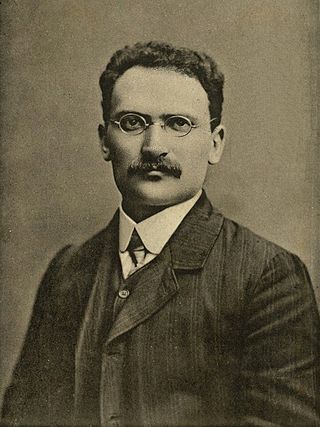
Dov Ber Borochov was a Marxist Zionist and one of the founders of the Labor Zionist movement. He was also a pioneer in the study of the Yiddish language.

Shmuel Zytomirski was a well-known figure of the Jewish community of Lublin before and during World War II and the father of Henio Zytomirski. He was murdered in the Holocaust at the end of the war, after almost all his family were killed by the Nazis. The letters Zytomirski had sent and received during the war document a lost struggle of a brave man who died shortly before the war ended. The information regarding the short life of his son Henio, who became an icon of the Holocaust in Poland, became known to the public from his father's letters. The circumstances of Shmuel Zytomirski's death remain mysterious and are unknown to this day.
Abraham Nahum Polak (sometimes referred to as A. N. Polak or Poliak; born 2 September 1910, died 5 March 1970) was an Israeli historian, a professor at the Tel Aviv University since its inception, professor of medieval history and founder of the department of Middle-Eastern History. His main areas of research were Jewish history, Arab history, nations of Islam and Africa and the history of the Khazars.

Tehran Children: A Holocaust Refugee Odyssey is a book by Mikhal Dekel published in 2019. In it Dekel reconstructs her father Hannan's journey as a child refugee fleeing Nazi-occupied Poland during World War II. Hannan was one of nearly 1,000 child refugees who travelled from Central Asia to the Middle East as they fled the conflict in the aftermath of the amnesty for Polish citizens in the Soviet Union which allowed for a large scale evacuation of Polish civilians from the USSR accompanying the Polish Anders' Army. The book includes archival research, memoir, and travel reportage from Poland, Russia, Uzbekistan, Iran and Israel.
