
Nefertiti was a queen of the 18th Dynasty of Ancient Egypt, the great royal wife of Pharaoh Akhenaten. Nefertiti and her husband were known for their radical overhaul of state religious policy, in which they promoted the earliest known form of monotheism, Atenism, centered on the sun disc and its direct connection to the royal household. With her husband, she reigned at what was arguably the wealthiest period of ancient Egyptian history. After her husband's death, some scholars believe that Nefertiti ruled briefly as the female pharaoh known by the throne name, Neferneferuaten and before the ascension of Tutankhamun, although this identification is a matter of ongoing debate. If Nefertiti did rule as pharaoh, her reign was marked by the fall of Amarna and relocation of the capital back to the traditional city of Thebes.
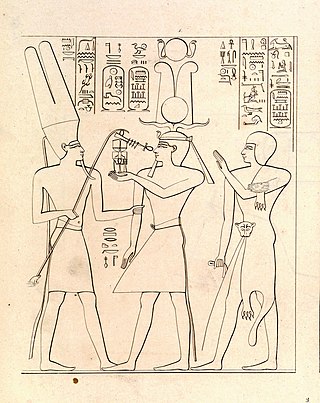
Hedjkheperre Setepenre Shoshenq I —also known as Shashank or Sheshonk or Sheshonq I—was a pharaoh of ancient Egypt and the founder of the Twenty-second Dynasty of Egypt.

The Museo Egizio or Egyptian Museum is an archaeological museum in Turin, Italy, specializing in Egyptian archaeology and anthropology. It houses one of the largest collections of Egyptian antiquities, with more than 30,000 artifacts, and is considered the second most important Egyptological collection in the world, after the Egyptian Museum of Cairo. In 2019, it received 853,320 visitors, making it one of the most visited museums in Italy.

Herihor was an Egyptian army officer and High Priest of Amun at Thebes during the reign of Pharaoh Ramesses XI.

Usermaatre Setepenamun Osorkon II was the fifth king of the Twenty-second Dynasty of Ancient Egypt and the son of King Takelot I and Queen Kapes. He ruled Egypt from approximately 872 BC to 837 BC from Tanis, the capital of that dynasty.
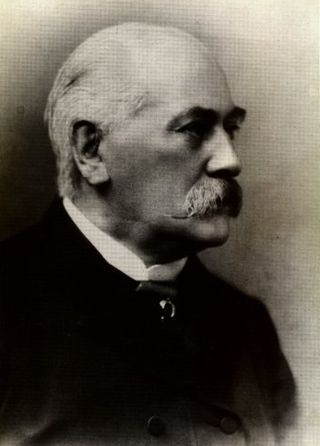
Heinrich Karl Brugsch was a German Egyptologist. He was associated with Auguste Mariette in his excavations at Memphis. He became director of the School of Egyptology at Cairo, producing numerous very valuable works and pioneering the decipherment of Demotic, the simplified script of the later Egyptian periods.

The necropolis of Draʻ Abu el-Naga' is located on the West Bank of the Nile at Thebes, Egypt, just by the entrance of the dry bay that leads up to Deir el-Bahari and north of the necropolis of el-Assasif. The necropolis is located near the Valley of the Kings.

The Royal Cache, technically known as TT320, is an Ancient Egyptian tomb located next to Deir el-Bahari, in the Theban Necropolis, opposite the modern city of Luxor.

Georges Albert Legrain was a French Egyptologist.

Helmut Satzinger is an Austrian Egyptologist and Coptologist. He studied Egyptology, Arabic Philology and African Languages at the university of Vienna and, for 1 year, at Cairo University. Immediately after obtaining his PhD degree in 1964, he became commissioned to catalogue and publish Coptic papyri in the West Berlin section of the Egyptian Museum of Berlin.

The Great Karnak Inscription is an ancient Egyptian hieroglyphic inscription belonging to the 19th Dynasty Pharaoh Merneptah. A long epigraph, it was discovered at Karnak in 1828–1829. According to Wilhelm Max Müller, it is "one of the famous standard texts of Egyptology... [and has been] ... one of the greatest desiderata of scholars for many years."

The August Kestner Museum, previously Kestner-Museum, is a museum in Hanover, Germany. Founded in 1889, the museum was renamed in December 2007 to avoid confusion with the Kestnergesellschaft, a local art gallery.

Campana reliefs are Ancient Roman terracotta reliefs made from the middle of the first century BC until the first half of the second century AD. They are named after the Italian collector Giampietro Campana, who first published these reliefs (1842).

Maatkare B was a wife of pharaoh Osorkon I and the mother of the High Priest of Amun Shoshenq C. Maatkare was the daughter of Psusennes II.
Susanne Bickel is a Swiss Egyptologist. She studied Egyptology in Geneva and then worked at the French Institute of Oriental Archaeology in Cairo and the Swiss Institute of Egyptian Antiquity. She has worked as an archaeologist on multiple sites in Middle and Upper Egypt. Since 2000 she has been a lecturer at the University of Freiburg and since 2006, professor of Egyptology at the University of Basel where she is an expert on Ancient Egyptian deities and demons. Susanne Bickel's research focuses on religion and Egyptian archaeology, particularly the documentation of Egyptian temples. Bickel is director of the University of Basel Kings' Valley Project and was a member of the team that excavated the KV64 tomb, containing the burial of Nehmes Bastet, in 2011.
Mamdouh Mohamed Gad Eldamaty is an Egyptian Egyptologist who has served in the government of Egypt as Minister of Antiquities from 2014 until 2016. He has also worked as Professor of Egyptology at the Department of Archaeology, Faculty of Arts, Ain Shams University in Cairo. On 15 May 2011, he became Cultural Counselor and Head of the Educational Mission at the Embassy of Egypt in Berlin. On 16 June 2014, it was announced that he was to be appointed as Minister of Antiquities, a position he held until March 2016 when he was replaced by Khaled al-Anani after a cabinet reshuffle.

The Book of the Dead of Nehem-es-Rataui is, along with the Papyrus Brocklehurst, the most important papyrus in the collection of the Museum August Kestner in Hanover, Germany. It contains one of the many traditional versions of the Egyptian Book of the Dead, which differs most significantly from similar papyri in the style of the central scene of the Judgement of the dead.
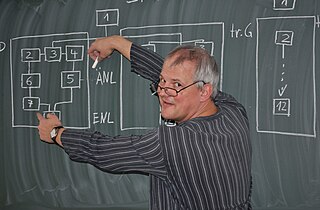
Raiko Krauss, born 1973 in Friedrichshain, Berlin is a German archaeologist of prehistory.
Georg Möller (1876–1921) was a German Egyptologist.
Sha-Amun-en-su was an Egyptian priestess and singer who lived in Thebes during the first half of the 8th century B.C., responsible for ceremonial duties at the Temple of Karnak, dedicated to the god Amun. Sha-Amun-en-su was a Heset, i.e., a member of the foremost group of singers with ritualistic functions active in the temple of Amun. After her death, which is estimated to have occurred around the age of 50, the singer was mummified and placed in a sarcophagus made of stucco and polychrome wood. Since its sealing, more than 2700 years ago, Sha-Amun-en-su's sarcophagus had never been opened, throughout its history, conserving inside the singer's mummy, a feature that gave it extreme rarity.

