Related Research Articles

June 19 - Eastern Orthodox Church calendar - June 21
July 7 - Eastern Orthodox Church calendar - July 9
August 4 - Eastern Orthodox liturgical calendar - August 6
August 15 - Eastern Orthodox liturgical calendar - August 17

Ambrose Edward Barlow, O.S.B. was an English Benedictine monk who is venerated as a saint in the Catholic Church. He is one of a group of saints canonized by Pope Paul VI who became known as the Forty Martyrs of England and Wales.
November 6 - Eastern Orthodox liturgical calendar - November 8
February 14 - Eastern Orthodox liturgical calendar - February 16
March 1 - Eastern Orthodox liturgical calendar - March 3
March 2 - Eastern Orthodox liturgical calendar - March 4
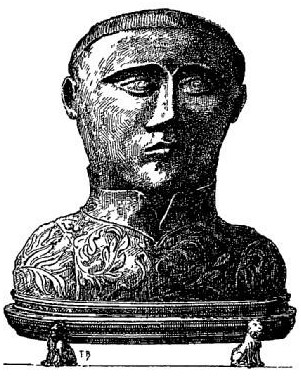
Winwaloe was the founder and first abbot of Landévennec Abbey, also known as the Monastery of Winwaloe. It was just south of Brest in Brittany, now part of France.

Penmachno is a village in the isolated upland Machno valley, 4 miles (6 km) south of Betws-y-Coed in the county of Conwy, North Wales. The B4406 road runs through part of the village. The village is at the confluence of the Glasgwm and Machno rivers. It has a five-arched, stone bridge dating from 1785. The village has been referred to as Pennant Machno, Llandudclyd and Llan dutchyd in historical sources.

John Forest was an English Franciscan friar and martyr. Confessor to Queen Catherine of Aragon, Forest was burned to death at Smithfield for heresy, in that he refused to acknowledge the King as head of the church.
October 25 - Eastern Orthodox liturgical calendar - October 27
November 12 - Eastern Orthodox liturgical calendar - November 14
Caffo was a sixth-century Christian in Anglesey, north Wales, who is venerated as a saint and martyr. The son of a king from northern Britain who took shelter in Anglesey, Caffo was a companion of St Cybi, and is mentioned as carrying a red-hot coal in his clothes to Cybi without his clothes getting burnt. After leaving Cybi, Caffo was killed by shepherds in the south of Anglesey, possibly acting in retaliation for insults Caffo's brother had paid to the local ruler. The area where he died has a village, Llangaffo, named after him, as well as the parish church of St Caffo, Llangaffo.
Isfael or Ismael, often anglicised as Ishmael, was a 6th-century medieval Welsh bishop of Rhos and saint. He was allegedly also a Breton prince of Armorica.

Saint Einion Frenin was a late 5th- and early 6th-century Welsh confessor and saint of the Celtic Church. His feast day was originally given as 9 February, although this had moved to the 10th or 12th by the 16th century and is no longer observed by either the Anglican or Catholic church in Wales.

Tetha, also known as Teath, Tecla, and by a variety of other names, was a 5th-century virgin and saint in Wales and Cornwall. She is associated with the parish church of St Teath in Cornwall. Baring-Gould gives her feast day as 27 October, but this has been called a mistaken conflation with Saint Ia. In 1878, it was held on the movable feast of Whit Tuesday. Other sources place it on 1 May, 6 September, and (mistakenly) 15 January. It is no longer observed by either the Anglican or Catholic church in Wales.

Saint Dyfan is a highly obscure figure who was presumably the namesake of Merthyr Dyfan and therefore an early Christian saint and martyr in southeastern Wales in Roman or Sub-Roman Britain. He is sometimes styled the protomartyr of Wales. The erection of his martyrium was credited to the 6th-century St Teilo. In the 19th century, Edward Williams conflated him with St Deruvian, a figure in the legendary accounts of the baptism of King Lucius of Britain. The discovery of Williams's alterations and forgeries have since discredited this connection. Partially based on this connection, however, the church of Merthyr Dyfan dates his martyrdom to c. 180.
Clydog was a sixth-century Welsh king of Ergyng who became a saint. His feast day is traditionally held on 3 November but is also celebrated on 19 August.
References
- ↑ The Lives of British Saints.
- ↑ Baring-Gould, Sabine. The Lives of the Saints, Vol. XVI, "The Celtic Church and its Saints", Longmans, Green, & Co. (New York), 1898.Vol. I, p. 75.
- ↑ Eve Nicholson. "St Clydawg the Martyr and his Church Today".
- ↑ "A history of Saint Tudclud's Church". parish.churchinwales.org.uk. The Parish of Betws-y-Coed, Capel Curig, Penmachno & Dolwyddelan. Retrieved 19 January 2015.
- ↑ November 1. Latin Saints of the Orthodox Patriarchate of Rome..