The Codex Vaticanus (in Latin, "Vatican's codex") is one of the oldest and most valuable extant manuscripts of the Greek Bible (Gregory number: B/03). The term, however, may refer to any other of the (thousands of) manuscripts preserved in the Vatican Library.
The Codex Vaticanus is regarded as the oldest extant manuscript of the Greek Bible, one of the four great uncial codices. The Codex is named after its place of conservation in the Vatican Library, where it has been kept since at least the 15th century. It is written on 759 leaves of vellum in uncial letters and has been dated palaeographically to the 4th century.

The Vatican Apostolic Library, more commonly known as the Vatican Library or informally as the Vat, is the library of the Holy See, located in Vatican City. Formally established in 1475, although it is much older, it is one of the oldest libraries in the world and contains one of the most significant collections of historical texts. It has 75,000 codices from throughout history, as well as 1.1 million printed books, which include some 8,500 incunabula.
Codex Vaticanus 253 is one of the most important manuscripts of the treatise On the Soul by Aristotle. It is designated by the symbol L. Paleographically it had been assigned to the 13th century. It is written in Greek minuscule letters. The manuscript is not complete, it contains only III Book, I-II Books were lost. It belongs to the textual family λ, together with the manuscripts: E Fc Lc Kd P.
On the Soul is a major treatise written by Aristotle c. 350 BC. Although its topic is the soul, it is not about spirituality but rather a work in what might best be described as biopsychology, a description of the subject of psychology within a biological framework. His discussion centres on the kinds of souls possessed by different kinds of living things, distinguished by their different operations. Thus plants have the capacity for nourishment and reproduction, the minimum that must be possessed by any kind of living organism. Lower animals have, in addition, the powers of sense-perception and self-motion (action). Humans have all these as well as intellect.
Codex Vaticanus 260 is one of the most important manuscripts of the treatise On the Soul by Aristotle. It is designated by the symbol U. Paleographically it had been assigned to the 11th century. It is written in Greek minuscule letters. The manuscript contains the complete text of the treatise. It belongs to the textual family ν, together with the manuscripts X v Ud Ad Q.
Codex Vaticanus Ottobonianus Latinus 1829 is one of the three most important manuscripts preserving the poems of Catullus. Among students of the matter it is commonly known as Codex Romanus.
Codex Vaticanus, designated by S or 028, ε 1027, formerly called Codex Guelpherbytanus, is a Greek manuscript of the four Gospels which can be dated to a specific year instead of an estimated range. The colophon of the codex lists the date as 949. This manuscript is one of the four oldest New Testament manuscripts dated in this manner, and the only dated uncial.
Codex Vaticanus Graecus 2061, usually known as Uncial 048, α1 (Soden), is a Greek uncial manuscript on parchment. It contains some parts of the New Testament, homilies of several authors, and Strabo's Geographica. Formerly it was known also as the Codex Basilianus 100, earlier as Codex Patriniensis 27. It was designated by ב a, p.
Codex Vaticanus 2066, designed by 046 (in the Gregory-Aland numbering), α 1070 (von Soden), formerly it was known also as Codex Basilianus, previously it was designated by Br or B2. It is a Greek uncial manuscript of the New Testament written on vellum. The manuscript Paleographically has been assigned to the 10th century by the INTF, though some palaeographers proposed the 9th century. Scrivener proposed even the 8th century.
The Vergilius Augusteus is a manuscript from late antiquity, containing the works of the Roman author Virgil, written probably around the 4th century. There are two other collections of Virgil manuscripts, the Vergilius Vaticanus and the Vergilius Romanus. They are early examples of illuminated manuscripts; the Augusteus is not illuminated but has decorated initial letters at the top of each page. These letters do not mark divisions of the text, but rather are used at the beginning of whatever line happened to fall at the top of the page. These decorated initials are the earliest surviving such initials.
The Vergilius Vaticanus or Vatican Virgil is a Late Antique illuminated manuscript containing, in its form today, fragments of Virgil's Aeneid and Georgics. It was made in Rome in about 400 A.D., and is one of the oldest surviving sources for the text of the Aeneid and is the oldest and one of only three ancient illustrated manuscripts of classical literature. The two other surviving illustrated manuscripts of classical literature are the Vergilius Romanus and the Ambrosian Iliad.
The Vergilius Romanus, also known as the Roman Vergil, is a 5th-century illustrated manuscript of the works of Virgil. It contains the Aeneid, the Georgics, and some of the Eclogues. It is one of the oldest and most important Vergilian manuscripts. It is 332 by 323 mm with 309 vellum folios. It was written in rustic capitals with 18 lines per page.
Lorenzo Valla was an Italian humanist, rhetorician, educator and Catholic priest. He is best known for his textual analysis that proved that the Donation of Constantine was a forgery.
The Donation of Constantine is a forged Roman imperial decree by which the 4th-century emperor Constantine the Great supposedly transferred authority over Rome and the western part of the Roman Empire to the Pope. Composed probably in the 8th century, it was used, especially in the 13th century, in support of claims of political authority by the papacy. Lorenzo Valla, an Italian Catholic priest and Renaissance humanist, is credited with first exposing the forgery with solid philological arguments in 1439–1440, although the document's authenticity had been repeatedly contested since 1001.
| This disambiguation page lists articles associated with the title Codex Vaticanus. If an internal link led you here, you may wish to change the link to point directly to the intended article. |
Codex Claromontanus, symbolized by Dp or 06, δ 1026, is a Greek-Latin diglot uncial manuscript of the New Testament, written in an uncial hand on vellum. The Greek and Latin texts are on facing pages, thus it is a "diglot" manuscript, like Codex Bezae Cantabrigiensis. The Latin text is designated by d or by 75 in Beuron system.
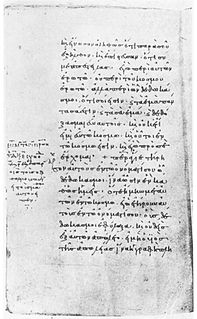
Uspenski Gospels, Minuscule 461, ε 92 (Soden), are a New Testament minuscule manuscript written in Greek, dated at 835 AD. They are the oldest known dated manuscript of the New Testament; it was not customary for Greek scribes to date their work at the time.
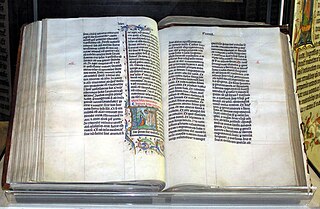
A biblical manuscript is any handwritten copy of a portion of the text of the Bible. The word Bible comes from the Greek biblia (books); manuscript comes from Latin manu (hand) and scriptum (written). Biblical manuscripts vary in size from tiny scrolls containing individual verses of the Jewish scriptures to huge polyglot codices containing both the Hebrew Bible (Tanakh) and the New Testament, as well as extracanonical works.
Codex Mutinensis designated by Ha or 014, α 6, is a Greek uncial manuscript of the Acts of Apostles, dated paleographically to the 9th century. The codex contains 43 parchment leaves.
Uncial 053 (in the Gregory-Aland numbering), A4 (Soden), is a Greek uncial manuscript of the New Testament, dated paleographically to the 9th century.
Uncial 056 (in the Gregory-Aland numbering), O7 (von Soden), is a Greek uncial manuscript of the New Testament, dated paleographically to the 10th century.
Minuscule 33, δ 48 (Soden), before the French Revolution was called Codex Colbertinus 2844. It is a Greek minuscule manuscript of the New Testament on parchment, dated palaeographically to the 9th century. The manuscript is lacunose. It has marginalia. According to the textual critics it is one of the best minuscule manuscripts of the New Testament.
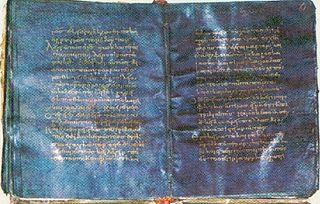
Minuscule 565, ε 93 (Soden), also known as the Empress Theodora's Codex, is a Greek minuscule manuscript of the New Testament, written on purple parchment, dated palaeographically to the 9th century. It was labelled by Scrivener as 473. The manuscript is lacunose. It has marginalia.
Uncial 0141, CL13 (Soden), is a Greek uncial manuscript of the New Testament, dated palaeographically to the 10th century.
Uncial 0142 (in the Gregory-Aland numbering), O6 (Soden), is a Greek uncial manuscript of the New Testament, dated paleographically to the 10th century. Formerly it was classified as a minuscule manuscript of New Testament under numbers 46a 55p (Scrivener).
Minuscule 38, δ 355. It is a Greek minuscule manuscript of the New Testament, written on vellum. Palaeographically it has been assigned to the 12th century. Formerly it was labelled by 38e, 19a, 377p. The manuscript is lacunose. It has marginalia.
Minuscule 131, δ 467 (Soden), is a Greek minuscule manuscript of the New Testament, on parchment leaves. Palaeographically it has been assigned to the 15th-century. It has marginalia.
Lectionary 3, designated siglum ℓ 3, is a Greek manuscript of the New Testament on vellum. Palaeographically it has been assigned to the 11th century. Scrivener dated to the 10th century.
Codex Ottobonianus, refers to codices that are housed at the Vatican Library in the Ottobonianus collection. The manuscripts formerly belonged to the private collection of Cardinal Ottoboni. Codex Ottobonianus may specifically refer to a variety of documents in Latin and Greek:
The great uncial codices or four great uncials are the only remaining uncial codices that contain the entire text of the Greek Bible.