Telecommunications in Uruguay includes radio, television, telephones, and the Internet.

Mario Orlando Hardy Hamlet Brenno Benedetti Farrugia , known as Mario Benedetti, was a Uruguayan journalist, novelist, and poet as well as being an integral member of the Generación del 45. Despite publishing more than 80 books and being published in twenty languages he was not well known in the English-speaking world, but in the Spanish-speaking world he was considered one of Latin America's most important writers of the latter half of the 20th century.

Candombe is an Uruguayan music and dance that comes from African slaves. It is considered an important aspect of the culture of Uruguay and was recognized by UNESCO as a World Cultural Heritage of humanity. To a lesser extent, Candombe is practiced in Argentina, Paraguay and Brazil. In Argentina, it can be found in Buenos Aires, Santa Fe, Paraná, and Corrientes. In Paraguay is continued this tradition in Kamba Kua in Fernando de la Mora near to Asuncion. Also in Brazil, it still retains its religious character and can be found in Minas Gerais State.

China Zorrilla was an Uruguayan theater, film, and television actress, also director, producer and writer. An immensely popular star in the Rioplatense area, she is often regarded as a "Grand Dame" of the South American theater stage.
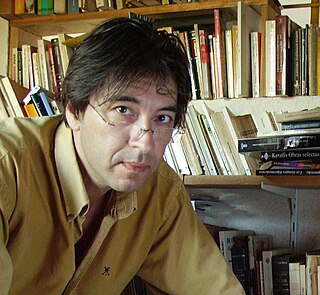
Carlos Rehermann is a Uruguayan novelist and playwright, active since 1990. He has published four novels and staged five plays. He writes weekly columns on the arts. He won the Florencio Prize in 2002 for his play "A la guerra en taxi". Florencio-Nominated, 2006, winner, "Solos en el escenario"-Prize—Centro Cultural de España—for "Basura" ("Filth"). Premio Nacional de Letras for "El examen", based on an episode of the life of Primo Levi, 2008. COFONTE Prize of Dramaturgy for "El examen", 2008.
The Plan Ceibal is a Uruguayan initiative to implement the "One laptop per child" model to introduce Information and Communication Technologies (ICT) in primary public education and is beginning with the expansion into secondary schools.

The Rambla of Montevideo is an avenue that goes all along the coastline of Montevideo, Uruguay, and also the longest continuous sidewalk in the world. At a length of over 22.2 uninterrupted kilometres (13.7 mi), the promenade runs along the Río de la Plata and continues down the entire coast of Montevideo. Since all the southern departments of Uruguay are against either the Río de la Plata or the Atlantic Ocean, they all have ramblas as well. The Rambla is an integral part of Montevidean identity and has been proposed as a World Heritage site.
El País is a Uruguayan newspaper, first published on September 14, 1918, and distributed nationwide. It previously belonged to the same media group as the television channel Teledoce. Its website is ranked 6th in Uruguay according to Alexa.

The Uruguayan railway network has approximately 2900 km (1802 mi) of lines, all of 1,435 mm gauge, diesel traction with only 11 km (7 mi) of double track. Only half of the network is currently active. All the Uruguayan lines start from Montevideo, connecting the cities of Paysandú, Salto, Rivera and Río Branco. The rest of the lines (closed) connected the capital city with Fray Bentos, Cuareim, Artigas, Km. 329, Melo, La Paloma and Colonia del Sacramento.

Renée Pietrafesa Bonnet is a French/Uruguayan composer, pianist, organist, harpsichordist and conductor. Her compositions spanned both popular and classical genres which included Electroacoustic music.
Tristán Narvaja was an Argentine judge, professor, theologian, and politician.
Indian Uruguayans form a small expatriate community consisting mostly of businessmen, Indian employees of TCS and some Catholic nuns. As of January 2016, about 83 Indians hold permanent residency in Uruguay. A further 733 Indians reside in the country on long-term visas, most of whom are employed by TCS in Montevideo. A small number of Indians from the Gujarati and Sindhi communities work as importers and run retail outlets of Indian textiles and handicrafts in Uruguay.
Julio Vilamajó Echaniz was one of the best known Uruguayan architects. He was a member of the Board of Design Consultants for the construction of the United Nations headquarters together with Le Corbusier and Oscar Niemeyer.

Daoiz Gerardo Uriarte Araújo is a lawyer, professor and Uruguayan politician member of the moderate sector Vertiente Artiguista, Frente Amplio coalition, the party ruling Uruguay since 2005.
Walter Reyno was a Uruguayan actor and theater director. He was known for his roles in 25 Watts and El aura.
Alas Uruguay was an airline from Uruguay. It was founded by former employees of the defunct Uruguayan flag carrier, PLUNA, which closed in 2012. PLUNA had been a state-owned enterprise most of its life, and a mixed-ownership enterprise in later years, but Alas Uruguay was started as a private company, owned and managed by its own workers. Its bases were Carrasco International Airport in Montevideo and Capitán de Corbeta Carlos A. Curbelo International Airport in Punta del Este. The company first adopted the name Alas-U, but in October 2013 was renamed Alas Uruguay. It started operations in January 2016 but, mired in debt, it stopped flying in October the same year and was eventually declared bankrupt.

Gerardo González Valencia is a Mexican suspected drug lord and high-ranking leader of the Jalisco New Generation Cartel (CJNG), a criminal group based in Jalisco. He is part of a clan that heads a CJNG money laundering branch known as Los Cuinis. He was allegedly responsible for coordinating international money laundering schemes by using shell companies to purchase assets in Latin America, Europe, and Asia. His wife Wendy Dalaithy Amaral Arévalo was reportedly working with him on this large money laundering scheme when the couple moved from Mexico to Uruguay in 2011.

Dumas Oroño was a Uruguayan artist, cultural manager, and teacher. His artistic work spanned several disciplines, including painting, engraving, ceramics, murals, and jewelry design.

Gabriela Onetto is a Uruguayan writer and philosopher.