
Henry Rich, 1st Earl of Holland, was an English courtier and politician executed by Parliament after being captured fighting for the Royalists during the Second English Civil War. Younger brother of Robert Rich, 2nd Earl of Warwick, a Puritan activist and commander of the Parliamentarian navy during the Wars of the Three Kingdoms, Henry was better known as an "extravagant, decorative, quarrelsome and highly successful courtier".

William Cavendish, 1st Duke of Newcastle upon Tyne, KG, KB, PC, who after 1665 styled himself as Prince William Cavendish, was an English courtier and supporter of the arts. He was a renowned horse breeder, as well as being patron of the playwright Ben Jonson and the intellectual group known as the Welbeck Circle.
George Goring, 1st Earl of Norwich was an English soldier and politician who sat in the House of Commons between 1621 and 1628 when he was raised to the peerage.

Sir Kenelm Digby was an English courtier and diplomat. He was also a highly reputed natural philosopher, astrologer and known as a leading Roman Catholic intellectual and Blackloist. For his versatility, he is described in John Pointer's Oxoniensis Academia (1749) as the "Magazine of all Arts and Sciences, or the Ornament of this Nation".
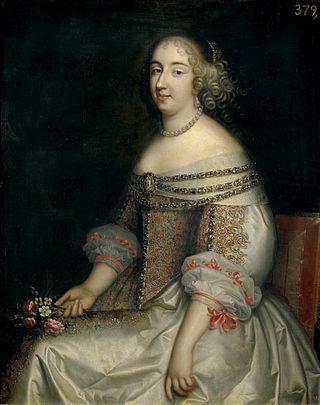
Anne Marie Louise d'Orléans, Duchess of Montpensier, known as La Grande Mademoiselle, was the only daughter of Gaston d'Orléans with his first wife, Marie de Bourbon, Duchess of Montpensier. One of the greatest heiresses in history, she died unmarried and childless, leaving her vast fortune to her cousin Philippe I, Duke of Orléans. After a string of proposals from various members of European ruling families, including Charles II of England, Afonso VI of Portugal, and Charles Emmanuel II of Savoy, she eventually fell in love with the courtier Antoine Nompar de Caumont and scandalised the court of France when she asked Louis XIV for permission to marry him, as such a union was viewed as a mésalliance. She is best remembered for her role in the Fronde and her role in bringing the famous composer Jean-Baptiste Lully to the king's court, and her Mémoires.

MonsieurPhilippe I, Duke of Orléans, was the younger son of King Louis XIII of France and his wife, Anne of Austria. His elder brother was the "Sun King", Louis XIV. Styled Duke of Anjou from birth, Philippe became Duke of Orléans upon the death of his uncle Gaston in 1660. In 1661, he also received the dukedoms of Valois and Chartres. Following Philippe's victory in battle in 1671, Louis XIV granted his brother the dukedom of Nemours, the marquisates of Coucy and Folembray, and the countships of Dourdan and Romorantin.

Mary, Princess Royal, was an English princess, a member of the House of Stuart, and by marriage Princess of Orange and Countess of Nassau. She acted as regent for her minor son from 1651 to 1660. She was the first holder of the title Princess Royal.
James de la Cloche is an alleged would-be-illegitimate son of Charles II of England who would have first joined a Jesuit seminary and then gave up his habit to marry a Neapolitan woman. His existence has not been proven, and the parentage with Charles II is unlikely if 1644 is his correct birth date, since the king was only 14 years old then. James de la Cloche is mainly known through studies of British historian Lord Acton.
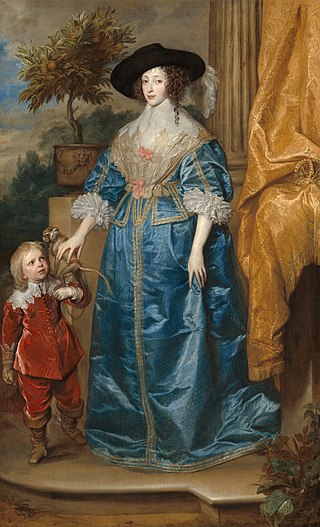
Jeffrey Hudson was a court dwarf of the English queen Henrietta Maria of France. He was famous as the "Queen's dwarf" and "Lord Minimus" and was considered one of the "wonders of the age" because of his extreme but well-proportioned smallness. He fought with the Royalists in the English Civil War and fled with the Queen to France but was expelled from her court when he killed a man in a duel. He was captured by Barbary pirates and spent 25 years enslaved in North Africa before being ransomed back to England.
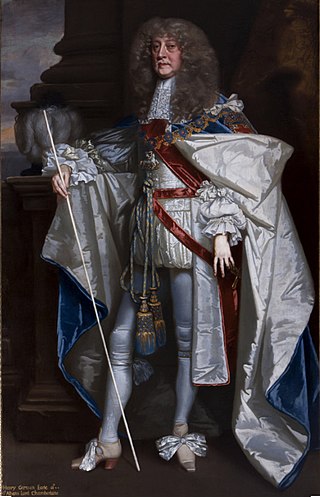
Henry Jermyn, 1st Earl of Saint Albans was an English Royalist politician, diplomat and courtier.

Henry Stuart, Duke of Gloucester was the youngest son of Charles I, King of England, Scotland, and Ireland, and his wife, Henrietta Maria of France. He is also known as Henry of Oatlands.

Sir Richard Wynn, 2nd Baronet was a Welsh courtier and politician who sat in the House of Commons at various times between 1614 and 1649.

Sir Théodore Turquet de Mayerne was a Genevan-born physician who treated kings of France and England and advanced the theories of Paracelsus.
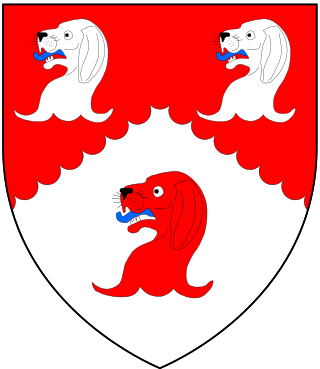
Sir Charles Duncombe of Teddington, Middlesex and Barford, Wiltshire, was an English banker and Tory politician who sat in the English and British House of Commons between 1685 and 1711. He served as Lord Mayor of London from 1708 to 1709. He made a fortune in banking and was said to be worth £400,000 later in life, and the richest commoner in England on his death.

Henrietta Maria of France was Queen of England, Scotland and Ireland from her marriage to King Charles I on 13 June 1625 until Charles was executed on 30 January 1649. She was mother of his sons Charles II and James II and VII. Contemporaneously, by a decree of her husband, she was known in England as 'Queen Mary', but she did not like this name and signed her letters "Henriette R" or "Henriette Marie R".
Walter Montagu was an English courtier, secret agent and Benedictine abbot.
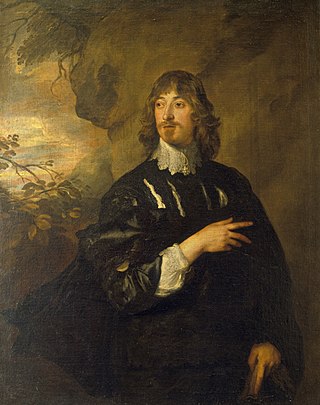
Henry Percy, Baron Percy of Alnwick, son of Henry Percy, 9th Earl of Northumberland, sat in the Short Parliament as the member for Portsmouth, and in the Long Parliament an M.P. for Northumberland; an originator of the "first army plot" in 1641, after which he retired to France. He was appointed general of the ordnance of the king's army and created baron, 1643; but fell in disgrace in 1644 through his desire for peace. In 1648 he resigned his command and went to France where he joined Queen Henrietta Maria's party. He died in France around March 1659.
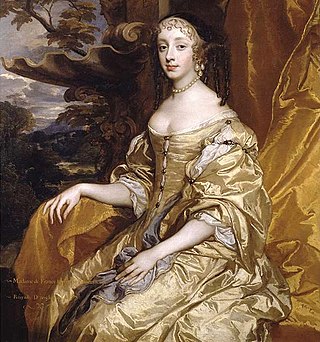
Henrietta Anne of England was the youngest daughter of King Charles I of England and Queen Henrietta Maria.
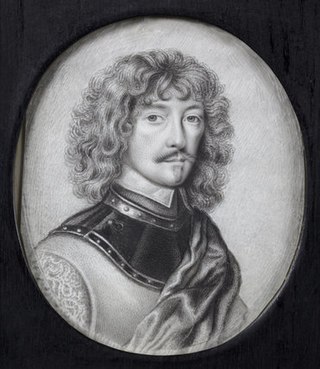
William Murray, 1st Earl of Dysart was a Scottish peer and courtier. During his childhood, he served as the whipping boy of Charles I of England before subsequently serving as an advisor to the king.
Jane Whorwood was a Royalist agent during the English Civil War. She managed circulation of intelligence, as well as smuggling of funds to sustain the Royalist faction. Whorwood was a close confidante of King Charles I, having helped to co-ordinate his attempts to escape captivity in the late 1640s.


