
Tatar is a Turkic language spoken by the Volga Tatars mainly located in modern Tatarstan, as well as Siberia. It should not be confused with Crimean Tatar or Siberian Tatar, which are closely related but belong to different subgroups of the Kipchak languages.
The Mari language, formerly known as the Cheremiss language, spoken by approximately 400,000 people, belongs to the Uralic language family. It is spoken primarily in the Mari Republic of the Russian Federation as well as in the area along the Vyatka river basin and eastwards to the Urals. Mari speakers, known as the Mari, are found also in the Tatarstan, Bashkortostan, Udmurtia, and Perm regions.

Bashkir is a Turkic language belonging to the Kipchak branch. It is co-official with Russian in Bashkortostan. It is spoken by approximately 1.6 million native speakers in Russia, as well as in Ukraine, Belarus, Kazakhstan, Uzbekistan, Estonia and other neighboring post-Soviet states, and among the Bashkir diaspora. It has three dialect groups: Southern, Eastern and Northwestern.
Three scripts are currently used for the Tatar language: Arabic, Cyrillic and Latin.
Central Siberian Yupik, is an endangered Yupik language spoken by the indigenous Siberian Yupik people along the coast of Chukotka in the Russian Far East and in the villages of Savoonga and Gambell on St. Lawrence Island. The language is part of the Eskimo-Aleut language family.

The Volga Tatars or simply Tatars are a Turkic ethnic group native to the Volga-Ural region of Russia. They are subdivided into various subgroups. Volga Tatars are the second-largest ethnic group in Russia after ethnic Russians. Most of them live in the republics of Tatarstan and Bashkortostan. Their native language is Tatar, a language of the Kipchak-Bolgar subdivision of the Turkic language family. Majority religion is Sunni Islam.

Jovan Ajduković is a Serbian linguist.

The Mulyanka, also referred as Upper Mulyanka, is a small river in Perm Krai, Russia which flows in the city of Perm and nearby Permsky District and is a left tributary of the Kama. The proximity of city's industry has a heavy influence on the river ecology.
Baraba or Baraba Tatar, is spoken by at least 8,000 Baraba Tatars in Siberia. It is a dialect of Siberian Tatar language. While middle aged individuals and the young generation speak Russian and Volga-Ural Tatar languages, Baraba dialect is used by the older generation.
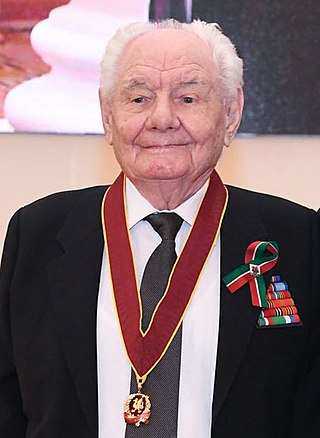
Mirfatyh Zakievich Zakiev was a Soviet and Russian controversial academic in the domain of Turkology scholar.
The Russian National Corpus is a corpus of the Russian language that has been partially accessible through a query interface online since April 29, 2004. It is being created by the Institute of Russian language, Russian Academy of Sciences.

Vatanym Tatarstan is the main Tatar language newspaper, published in Kazan.
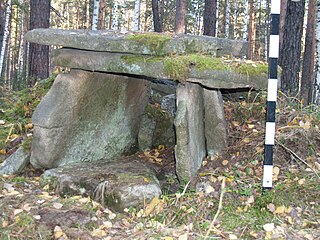
In recent years, many megaliths have been discovered in the Urals: dolmens, menhirs and a large megalithic cultic complex on Vera Island.

Alexander Vladimirovich Bykov is a Russian historian and ethnographer, one of the leading Russian specialists in numismatics. Publisher, founder of the first Russian private museum of political history, the Museum of Diplomatic Corps in Vologda, Russia; he is the author of multiple articles, books, and popular science publications.

Tatiana Valerianovna Dorofeeva was a Russian linguist, orientalist and translator.
The Bashkir alphabet is a writing system used for the Bashkir language. Until the mid-19th century, Bashkir speakers wrote in the Türki literary language using the Arabic script. In 1869, Russian linguist Mirsalikh Bekchurin published the first guide to Bashkir grammar, and the first Cyrillic Bashkir introductory book was published by Vasily Katarinsky in Orenburg in 1892. Latinisation was first discussed in June 1924, when the first draft of the Bashkir alphabet using the Latin script was created. More reforms followed, culminating in the final version in 1938.

Gayane Gagik Yeganyan, Candidate of Pedagogical Sciences. Gayane Yeganyan is the first to carry out research on pedagogical diagnostics in Armenian, as a result of which she has published 21 scientific articles.
Kolpashevo State Teacher's Institute is a higher educational institution in Kolpashevo, which existed from 1940 to 1956 to train teachers.
Valentin Ivanovich Rassadin was a Soviet and Russian linguist. He is best known for his documentation and studies of the Tofa language and Soyot-Tsaatan language.
A finnicism or fennicism is a word or grammatical feature borrowed from Finnic languages into a non-Finnic one. Most often they occur in the contacting languages: Indo-European, other Ugric languages, as well as Turkic.


