The United States Forest Service (USFS) is an agency within the U.S. Department of Agriculture that administers the nation's 154 national forests and 20 national grasslands covering 193 million acres (780,000 km2) of land. The major divisions of the agency are the Chief's Office, National Forest System, State and Private Forestry, Business Operations, as well as Research and Development. The agency manages about 25% of federal lands and is the sole major national land management agency not part of the U.S. Department of the Interior.

Smokejumpers are specially trained wildland firefighters who provide an initial attack response on remote wildfires. They are inserted at the site of the fire by parachute. This allows firefighters to access remote fires in their early stages without needing to hike long distances carrying equipment and supplies. Traditional terrestrial crews can use only what they can carry and often require hours and days to reach fire on foot. The benefits of smokejumping include the speed at which firefighters can reach a burn site, the broad range of fires a single crew can reach by aircraft, and the larger equipment payloads that can be delivered to a fire compared to pedestrian crews.

Rangelands are grasslands, shrublands, woodlands, wetlands, and deserts that are grazed by domestic livestock or wild animals. Types of rangelands include tallgrass and shortgrass prairies, desert grasslands and shrublands, woodlands, savannas, chaparrals, steppes, and tundras. Rangelands do not include forests lacking grazable understory vegetation, barren desert, farmland, or land covered by solid rock, concrete and/or glaciers.

Fire ecology is a scientific discipline concerned with the effects of fire on natural ecosystems. Many ecosystems, particularly prairie, savanna, chaparral and coniferous forests, have evolved with fire as an essential contributor to habitat vitality and renewal. Many plant species in fire-affected environments use fire to germinate, establish, or to reproduce. Wildfire suppression not only endangers these species, but also the animals that depend upon them.
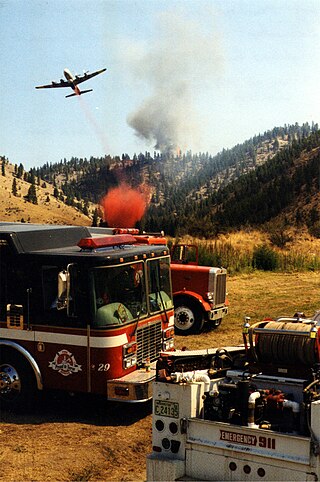
Wildfire suppression is a range of firefighting tactics used to suppress wildfires. Firefighting efforts depend on many factors such as the available fuel, the local atmospheric conditions, the features of the terrain, and the size of the wildfire. Because of this wildfire suppression in wild land areas usually requires different techniques, equipment, and training from the more familiar structure fire fighting found in populated areas. Working in conjunction with specially designed aerial firefighting aircraft, fire engines, tools, firefighting foams, fire retardants, and using various firefighting techniques, wildfire-trained crews work to suppress flames, construct fire lines, and extinguish flames and areas of heat in order to protect resources and natural wilderness. Wildfire suppression also addresses the issues of the wildland–urban interface, where populated areas border with wild land areas.
The Rocky Mountain Research Station (RMRS) is one of five regional units that make up the United States Forest Service Research and Development organization — the most extensive natural resources research organization in the world. The station headquarters are located in Fort Collins, Colorado. Research is structured within eight science program areas. The Station employs over 400 permanent full-time employees, including roughly 100 research scientists.

Wildfire modeling is concerned with numerical simulation of wildfires to comprehend and predict fire behavior. Wildfire modeling aims to aid wildfire suppression, increase the safety of firefighters and the public, and minimize damage. Wildfire modeling can also aid in protecting ecosystems, watersheds, and air quality.
Wildfire suppression in the United States has had a long and varied history. For most of the 20th century, any form of wildland fire, whether it was naturally caused or otherwise, was quickly suppressed for fear of uncontrollable and destructive conflagrations such as the Peshtigo Fire in 1871 and the Great Fire of 1910. In the 1960s, policies governing wildfire suppression changed due to ecological studies that recognized fire as a natural process necessary for new growth. Today, policies advocating complete fire suppression have been exchanged for those who encourage wildland fire use, or the allowing of fire to act as a tool, such as the case with controlled burns.
Thomas Thorstein Veblen is an American forest ecologist and physical geographer known for his work on the ecology of Nothofagus forests in the Southern Hemisphere and on the ecology of conifer forests in the southern Rocky Mountains of the U.S.A. He is an Arts and Sciences College Professor of Distinction at University of Colorado at Boulder, USA (2006).

Wildfires can happen in many places in the United States, especially during droughts, but are most common in the Western United States and Florida. They may be triggered naturally, most commonly by lightning, or by human activity like unextinguished smoking materials, faulty electrical equipment, overheating automobiles, or arson.
Yufang Jin is an assistant professor of remote sensing and ecosystem change at UC Davis's Department of Land, Air and Water Resources, and associate environmental scientist at the UC Davis College of Agricultural and Environmental Sciences. Her research uses satellite imaging and other techniques to track and model how landscapes and ecosystems change.
Jill Johnstone was a professor in the Department of Biology at the University of Saskatchewan, where she started the Northern Plant Ecology Lab (NPEL) which she still runs. She primarily conducts research on plant ecology and environmental biology with an emphasis on how boreal forest and tundra are responding to rapid rates of climate change.
Sarah B. Henderson is a senior environmental health scientist at the British Columbia Centre for Disease Control and a public health professor at the University of British Columbia.
Janice Coen is a Project Scientist at the National Center for Atmospheric Research in Boulder, Colorado. Her work focuses on understanding and predicting wildland fire behavior through the use of wildfire modeling software. She has made major contributions to the field through her coupled weather—wildland fire computer simulation models.
Paige Fischer is an environmental scientist from the Pacific Northwest whose research focuses mainly on the human dimensions of environmental changes. She is especially interested in forest ecology and conservation. She is currently an assistant professor at the University of Michigan's School for Environment and Sustainability, teaching upper level classes about analysis methods and social vulnerability to climate change.
Sarah E. Gergel is an American ecologist and professor in the Department of Forest and Conservation Sciences at the University of British Columbia (UBC), Canada. She is a landscape ecologist, known for her research linking landscapes and rivers, and her role in enhancing training in the practice of landscape ecology.
Susan G. Conard is an American scientist whose expertise focuses on wildland fires in Northern California and Taiga. During the 1980s and 1990s, Conard worked as a research and project leader for the United States Forest Service, publishing pieces on fire management and carbon sequestration. She is currently the editor for the International Journal of Wildland Fire.
Fire deficit or fire debt is the reduction in acreage burned in wildfires over a long period of time due to fire suppression, leading to fuel buildup and consequently increasing the risk of large, catastrophic wildfires.

Roger Dale Rosentreter is a botanist, plant ecologist, naturalist, and conservationist. He was the president of the American Bryological and Lichenological Society from 2011 to 2013.
Emily Fairfax is an ecohydrologist, beaver researcher, and assistant professor of geography at the University of Minnesota. She is best known for her research describing how beavers create drought and wildfire resistant patches in the landscape. Fairfax and her research have been featured internationally in numerous written, radio, and television media programs about beavers.


