Kapellmeister is a German word designating a person in charge of music-making. The word is a compound, consisting of the roots Kapelle and Meister ("master"). Originally used to refer to somebody in charge of music in a chapel, the term has evolved considerably in its meaning in response to changes in the musical profession.

Wolfenbüttel is a town in Lower Saxony, Germany, the administrative capital of Wolfenbüttel District. It is best known as the location of the internationally renowned Herzog August Library and for having the largest concentration of timber-framed buildings in Germany. It is an episcopal see of the Evangelical Lutheran Church in Brunswick. It is also home to the Jägermeister distillery, houses a campus of the Ostfalia University of Applied Sciences, and the Landesmusikakademie of Lower Saxony.
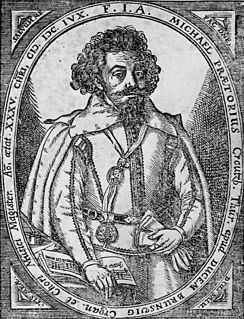
Michael Praetorius was a German composer, organist, and music theorist. He was one of the most versatile composers of his age, being particularly significant in the development of musical forms based on Protestant hymns.

Ringelheim with 1,964 inhabitants is the sixth biggest quarter of Salzgitter in Lower Saxony, Germany, located on the Innerste River at the very far south-western end of the urban area. The Salzgitter-Ringelheim train station is the most important station of the city, as the Brunswick Southern Railway and the line from Hildesheim to Goslar cross here.

The University of Helmstedt, was a university in Helmstedt in the Duchy of Brunswick-Wolfenbüttel that existed from 1576 until 1810.

Julius of Brunswick-Lüneburg, a member of the House of Welf, was Duke of Brunswick-Lüneburg and ruling Prince of Brunswick-Wolfenbüttel from 1568 until his death. From 1584, he also ruled over the Principality of Calenberg. By embracing the Protestant Reformation, establishing the University of Helmstedt, and introducing a series of administrative reforms, Julius was one of the most important Brunswick dukes in the early modern era.
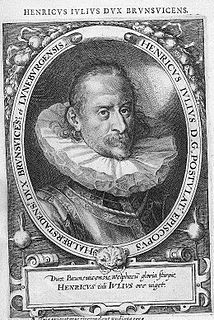
Henry Julius, a member of the House of Welf, was Duke of Brunswick-Lüneburg and ruling Prince of Brunswick-Wolfenbüttel from 1589 until his death. He also served as administrator of the Prince-Bishopric of Halberstadt from 1566 and of the Prince-Bishopric of Minden between 1582 and 1585.

Johann Theile was a German composer of the Baroque era, famous for the opera Adam und Eva, Der erschaffene, gefallene und aufgerichtete Mensch, first performed in Hamburg on 2 January 1678.

Wolfgang Carl Briegel was a German organist, teacher, and composer.

Francis II of Saxe-Lauenburg, was the third son of Francis I of Saxe-Lauenburg and Sybille of Saxe-Freiberg, daughter of Duke Henry IV the Pious of Saxony. From 1581 on he ruled Saxe-Lauenburg as duke.

Elisabethenburg Palace is a Baroque palace located on the northwestern edge of Meiningen in Germany. Until 1918 it was the residence of the Dukes of Saxe-Meiningen. The castle now houses the Meininger Museum as well as the Max Reger archives, the Thuringian State Archives, the Max Reger music school, the Johannes Brahms concert hall, a restaurant, the tower Cafe, and the ceremonial rooms of the Meinigen City Council and Registry Office.

Hessen, also Hessen am Fallstein, is a village in the Harz district of Saxony-Anhalt, Germany. Formerly part of the Aue-Fallstein municipal association, it was merged into the Osterwieck municipality on 1 January 2010.
Manfred Cordes is a German conductor of early music, musicologist and teacher. He is professor at the Hochschule für Künste Bremen and was its rector from 2007 to 2012.
Maria of Brunswick-Wolfenbüttel was a princess of Brunswick-Wolfenbüttel by birth and by marriage Duchess of Saxe-Lauenburg.
Hans Nielsen (1580–1626) was a Danish composer. He was sent with Melchior Borchgrevinck, Truid Aagesen, Wilhelm Egbertsen, and Mogens Pedersøn to study with Giovanni Gabrieli in Venice 1599–1600. A result of his studies was his Opus 1 madrigal collection of 1606, published under his Italianized name Giovanni Fonteio. This set of 21 madrigals was the first such collection by a Danish composer, two years before Pedersøn's. He served as lutenist at the court of Christian IV as after Pedersøn's death in 1623 Nielsen was promoted to Deputy Kapellmeister, but left the court the following year.

Hermann Korb was a German architect who worked mainly in the Principality of Brunswick-Wolfenbüttel.

The Akademie Rudolph-Antoniana was an early modern Ritterakademie sited in Wolfenbüttel in what was then the Duchy of Brunswick-Lüneburg in Germany. It was founded on 18 July 1687 by Rudolph Augustus and Anthony Ulrich, brothers and co-dukes of the Duchy. It was housed in the Kleines Schloss in Wolfenbüttel, right next to the Schloss Wolfenbüttel and its Herzog August Library, meaning students could borrow books from there but also get to know court-life, such as operas, plays and hunting in the Harz and Elm.

Schloss Wolfenbüttel is a castle in Wolfenbüttel, Lower Saxony, Germany. An extensive four-wing complex, it originated as a moated castle (Wasserburg). It is the second-largest surviving schloss in Lower Saxony and served as the main residence of the rulers of the Principality of Brunswick-Wolfenbüttel from 1432 to 1753. It now houses a gymnasium secondary school, the Federal Academy of Arts Education, and a museum with its historic rooms on display. Its immediate vicinity is home to several historically significant buildings including the Herzog August Bibliothek, the Lessinghaus, the Zeughaus, and the Kleines Schloss.
Paul Francke was a German Renaissance architect, most notable as director of works for the Duchy of Brunswick-Lüneburg from 1564 until his death in 1615. His works include the Juleum Novum in Helmstedt, the Marienkirche in Wolfenbüttel and the Burganlage in Erichsburg.
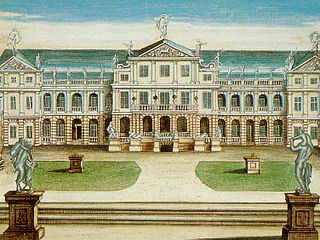
Johann Balthasar Lauterbach was a German mathematician, architect and master builder at the Court in Braunschweig, from 1688 until his death.


