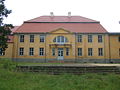
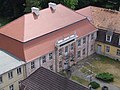
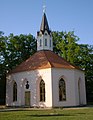
Mecklenburg is a historical region in northern Germany comprising the western and larger part of the federal-state Mecklenburg-Western Pomerania. The largest cities of the region are Rostock, Schwerin, Neubrandenburg, Wismar and Güstrow.

The House of Mecklenburg, also known as Nikloting, is a North German dynasty of Polabian origin that ruled until 1918 in the Mecklenburg region, being among the longest-ruling families of Europe. Queen Juliana of the Netherlands (1909–2004), former Queen of the Netherlands (1948–1980), was an agnatic member of this house.

The Treaty of Templin was concluded on 24/25 November 1317, ending a war between the Margraviate of Brandenburg and Denmark, the latter leading a North German alliance. During this war, Brandenburgian margrave Waldemar and his troops were decisively defeated in the 1316 Battle of Gransee, fought at Schulzendorf between Rheinsberg and Gransee. After the battle, Brandenburg was forced to negotiate a truce. The treaty of Templin was signed a year later by Danish king Erich VI Menved, his ally duke Henry II of Mecklenburg, and Waldemar.

Adolphus Frederick V was reigning grand duke of Mecklenburg-Strelitz from 1904 to 1914.
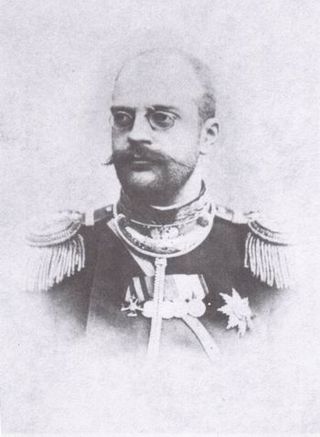
Charles Michael, Duke of Mecklenburg was an officer in the Imperial Russian Army, heir presumptive to the throne of Mecklenburg-Strelitz and from 1918 head of the Grand Ducal House.
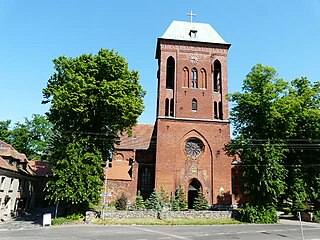
The Bishopric of Cammin was both a former Roman Catholic diocese in the Duchy of Pomerania from 1140 to 1544, and a secular territory of the Holy Roman Empire (Prince-Bishopric) in the Kołobrzeg area from 1248 to 1650.

By the Hamburg Agreement on 8 March 1701, Mecklenburg was separated into two duchies with limited autonomy, which formed a collective state–as of 1815, the Grand Duchies of Mecklenburg-Schwerin and Mecklenburg-Strelitz. Since 1755, they had the same constitution and were under the control of the same parliament. In 1815, both parts became Grand Duchies by the Congress of Vienna.

Duchess Therese Mathilde Amalie of Mecklenburg-Strelitz was a member of the House of Mecklenburg-Strelitz and a Duchess of Mecklenburg. Through her marriage to Karl Alexander, 5th Prince of Thurn and Taxis, Therese was also a member of the House of Thurn and Taxis.
Duchy of Pomerania-Barth was a feudal duchy of the Holy Roman Empire located in Western Pomerania that existed in the Middle Ages between 1376 and 1478, and between 1569 and 1625. The state consisted of its capital, Barth, and nearby areas. Duchy had separated from Pomerania-Wolgast in 1376 and was incorporated into Duchy of Pomerania in 1478. It was reestablished in 1569 by separation from Pomerania-Wolgast-Stolp and existed until 1625, when it was incorporated into Duchy of Pomerania.
Kyra T. Inachin was a German historian.

Otto Piper (1841–1921) was a German architectural historian who, with August von Cohausen (1812–1896), is regarded as one of the two founders of scientific research into castles.

Schauenburg Castle is a ruined hilltop castle located in Oberkirch, Germany, atop a 367-metre-high (1,204 ft) (NN) hill spur overlooking the Rench river valley above the town of Gaisbach, Baden-Württemberg. The castle was built by Duke Berthold II of Zähringen.

Schloss Kunreuth is situated on the northwestern edge of the eponymous village of Kunreuth which is part of the collective municipality of Gosberg in the county of Forchheim, in the province of Upper Franconia in the south German state of Bavaria.

Remplin Palace is located in the village of Remplin, part of the municipality of Malchin in Mecklenburg-Vorpommern, Germany. The palace was one of the residences of the Grand Ducal family of Mecklenburg-Strelitz until it was destroyed by fire in 1940. Only the northern wing of the complex is remaining.

The Neustrelitz Palace in Neustrelitz in Mecklenburg-Western Pomerania, Germany was a princely palace, which mostly served as the main residence of the Grand Dukes of Mecklenburg-Strelitz. The palace was destroyed during World War II and was not reconstructed, although possible. Only the park remains today.

Georg Adolph Demmler was a German architect, socialist and politician; originally with the German People's Party (DtVP), then the Socialist Worker's Party of Germany (SAP).
The Thomas Helms Verlag is a specialist publisher for North German culture, monument preservation, local and regional history, history, church and art history and is based in Schwerin in Mecklenburg-Western Pomerania.

Adolf Friedrich von Olthof was a Swedish Pomeranian councilor, and patron of the arts.

The flag that serves as the symbol of the historical and geographical region of the Mecklenburg is divided horizontally into two stripes: light blue on the top and white on the bottom. It originated as the flag of the Grand Duchy of Mecklenburg-Schwerin, adopted in 1813. Since 1996, it is officially recognized as the symbol of the historical region of Mecklenburg within Mecklenburg-Vorpommern, Germany.

Putbus Palace is a former neoclassical palace in Putbus, on the isle of Rügen in Germany. It was the seat of the princes of Putbus and the Putbus family in the city they founded in 1810, Putbus, which is also known as the White city of Rügen. During the communist period in East Germany, the palace was demolished in 1962 due to political reasons, and the remains were removed by 1964.