Related Research Articles
Moroccan music varies greatly between geographic regions and social groups. It is influenced by musical styles including Arab, Berber, Andalusi, Mediterranean, Saharan, West African, and others.
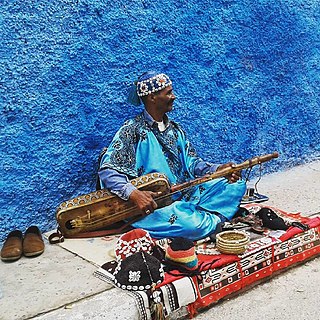
The Gnawa are an ethnic group inhabiting Morocco.

Mahmoud Guinia was a Moroccan Gnawa musician, singer and guembri player, who was traditionally regarded as a Maâllem, i.e. master. The family name is Gania, which also was the spelling in the passport of the artist.
Axiom was a record label founded by musician Bill Laswell in 1990 with the support of Chris Blackwell, founder of Island Records.
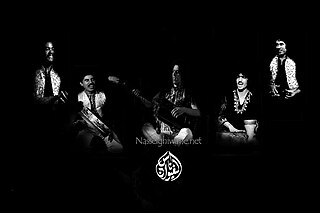
Nass El Ghiwane are a musical group established in 1970 in Casablanca, Morocco. The group, which originated in avant-garde political theater, has played an influential role in Moroccan chaabi.
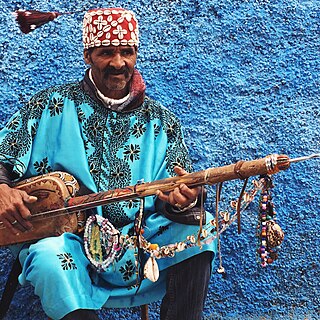
Gnawa music is a body of Moroccan religious songs and rhythms. Its well-preserved heritage combines ritual poetry with traditional music and dancing. The music is performed at lila, communal nights of celebration dedicated to prayer and healing guided by the Gnawa maalem, or master musician, and their group of musicians and dancers. Though many of the influences that formed this music can be traced to West African kingdoms, its traditional practice is concentrated in Morocco. Gnawa music has spread to many other countries in Africa and Europe, such as France.
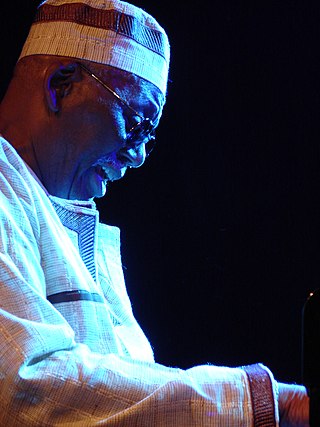
Randolph Edward "Randy" Weston was an American jazz pianist and composer whose creativity was inspired by his ancestral African connection.
Nass Marrakesh is a Gnawa music group formed in 1991. They introduced instruments foreign to Gnawa music such as the djembe, tam-tam, mandolin, tabla and Afro-Cuban percussion.

The sintir, also known as the guembri (الكمبري), gimbri, hejhouj in Hausa language, is a three stringed skin-covered bass plucked lute used by the Gnawa people. It is approximately the size of a guitar, with a body carved from a log and covered on the playing side with camel skin. The camel skin has the same acoustic function as the membrane on a banjo. The neck is a simple stick with one short and two long goat strings that produce a percussive sound similar to a pizzicato cello or double bass.

Qraqeb or garagab, in English often transliterated as krakeb, are a large iron castanet-like musical instrument primarily used as the rhythmic aspect of Gnawa music. Gnawa today is part of the North African culture and is inherent in the Maghrebi soundscape. The word qraqeb is a plural form, with an unclear etymology, as the word does not occur in Standard Arabic with this meaning.
Jil Jilala is a Moroccan musical group which rose to prominence in the 1970s among the movement created by Nass El Ghiwane and Lem Chaheb. Jil Jilala was founded in Marrakech in 1972 by performing arts students Mohamed Derhem, Moulay Tahar Asbahani, Sakina Safadi, Mahmoud Essaadi, Hamid Zoughi and Moulay Abdelaziz Tahiri. In 1974, they released their first record Lyam Tnadi on the Atlassiphone label. The songs "Leklam Lemrassaa," "Baba Maktoubi," "Ha L'ar a Bouya," "ah ya Jilala" and "Chamaa" quickly achieved the status of popular 'classics.'

The Gnaoua World Music Festival is a festival for mainly Gnawa music artists, held annually in Essaouira, Morocco. It was founded in 1998 by Moroccan entrepreneur Neila Tazi and her A3 Groupe, a private event-organizing company located in Casablanca.

Hoba Hoba Spirit is a musical fusion band based in Casablanca, Morocco that was formed in 1998. It is composed of Adil Hanine (drummer), Anouar Zehouani (guitarist), Saâd Bouidi, Reda Allali - and Othmane Hmimar(percussionist). The name of the group is based on a song by Bob Marley.

Hassan Hakmoun is a Moroccan musician who specializes in the Gnawa style.
Moroccan pop or abbreviated as Morocco-pop music is a genre of the new Moroccan music generation along the hip hop, rap music in Morocco.

Hamid El Kasri is a Moroccan Gnawa musician traditionally considered a maâlem, or "master musician". Born in Ksar El Kebir, Morocco, he now lives in Rabat. His last name is an artist name simply meaning "from Ksar El Kebir". He began training at age seven, taught by the Tangier Maâlem Abdelouahed Stitou and Maâlem Alouane initially in the special Chemeli or Northern style of Gnawa music, which is distinctly different from the usual styles of Marrakech. El Kasri is famed for his deep, intense voice, which has made him one of the most sought-after maâlems, both in Morocco and abroad. In addition to singing, he performs on the guembri (الكمبري), a three-stringed bass instrument. He is noted for having blended the Gnawa rhythms of the north and south of the Morocco.

Aziz Sahmaoui is a Moroccan musician specialized in the modern Gnawa music.

Majid Bekkas, also known as Abdelmajid Bekkas, is a Moroccan musician on guembri, oud, guitar and vocals, who is internationally known for his contributions to World music and Ethno jazz with North African roots.
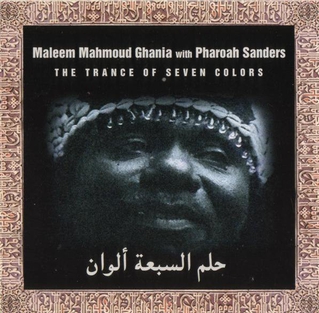
The Trance of Seven Colors is an album by Gnawa musician Maleem Mahmoud Ghania released by Axiom and Island Records in 1994. The music, which was recorded on June 1–3, 1994 at the house of the Caid Khoubane in the Medina of Essaouira, District Chbanat, Morocco, also features tenor saxophonist Pharoah Sanders, along with a group largely consisting of members of Mahmoud's family.

Bab L' Bluz is a Moroccan-French rock band that was formed in Marrakesh in 2018. The band consists of lead vocalist Yousra Mansour, gimbri player and multi-instrumentalist Brice Bottin. As an exponent of the "Nayda" artistic movement in Morocco which places emphasis on local heritage, Mansour provides vocals in the Moroccan Arabic dialect of Darija. Bab L' Bluz take inspiration from a wide range of musical styles such as Gnawa music, blues, Chaâbi, and Afrobeat.
References
- ↑ "Darga y Marcelo D2 sustituyen a Circus Baobab en Pirineos Sur". El Periódico de Aragón. 27 June 2006. Retrieved 22 December 2010.[ permanent dead link ]
- ↑ "Morocco taps African roots with Gnawa music revival". Reuters.com . 13 September 2008. Retrieved 22 December 2010.
