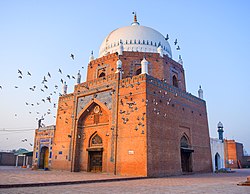
A Sufi shrine or dargah[a] is a shrine or tomb built over the grave of a revered religious figure, often a Sufi saint or dervish. Sufis often visit the shrine for ziyarat, a term associated with religious visitation and pilgrimages. Dargahs are often associated with Sufi eating and meeting rooms and hostels, called khanqah or hospices. They usually include a mosque, meeting rooms, Islamic religious schools (madrasas), residences for a teacher or caretaker, hospitals, and other buildings for community purposes.
Dargah is derived from a Persian word which literally means "portal" or "threshold."[1] The Persian word is a composite of dar (در) meaning "door, gate" and gah (گاه) meaning "place". It may have a connection or connotation with the Arabic word darajah (دَرَجَة) meaning "stature, prestige, dignity, order, place" or may also mean "status, position, rank, echelon, class".[citation needed]
The same structure, carrying the same social meanings and sites of the same kinds of ritual practices, is called maqam in the Arabic-speaking world.
Sufi shrines are found in many Muslim communities throughout the world and are called by many names. The term dargah is common in the Persian-influenced Islamic world, notably in Iran, Turkey and South Asia.[2]
In South Africa, the term is used to describe shrines in the Durban area where there is a strong Indian presence, while the term kramat is more commonly used in Cape Town, where there is a strong Cape Malay culture.[3]
In China, the term gongbei is usually used for shrine complexes centered around a Sufi saint's tomb.[4]
Some Sufi and other Muslims believe that dargahs are portals by which they can invoke the deceased saint's intercession and blessing, as per tawassul, also known as dawat-e qaboor[5]دعوتِ قبور, "invocations of the graves or tombs" or ‘ilm-e dawatعِلمِ دعوت, "knowledge of invocations". Still others hold a less important view of dargahs, and simply visit as a means of paying their respects to deceased pious individuals or to pray at the sites for perceived spiritual benefits.
However, dargah is originally a core concept in Islamic Sufism and holds great importance for the followers of Sufisaints. Many Muslims believe their wishes are fulfilled after they offer prayer or service at a dargah of the saint they follow. Devotees tie threads of mannat (منّت, "grace, favour, praise") at dargahs and contribute to langar and pray at dargahs.
Over time, musical offerings of dervishes and sheikhs in the presence of the devout at these shrines, usually impromptu or on the occasion of Urs, gave rise to musical genres like Qawwali and Kafi, wherein Sufi poetry is accompanied by music and sung as an offering to a murshid, a type of Sufi spiritual instructor. Today they have become a popular form of music and entertainment throughout South Asia, with exponents like Nusrat Fateh Ali Khan and Abida Parveen taking their music to various parts of the world.[6][7]
In South Asia, dargahs are often the site of festivals (milad) held in honor of the deceased saint on the anniversary of his death (urs). The shrine is illuminated with candles or strings of electric lights at this time.[8] Dargahs in South Asia, have historically been a place for all faiths since the medieval times; for example, the Ajmer Sharif Dargah was a meeting place for Hindus and Muslims to pay respect and even to the revered Saint Mu'in al-Din Chishti.[9][10]
There are many active dargahs open to the public worldwide where aspirants may go for a retreat. The following is a list of dargahs open to the public.
↑KafiSouth Asian folklore: an encyclopedia: Afghanistan, Bangladesh, India, Nepal, Pakistan, Sri Lanka, by Peter J. Claus, Sarah Diamond, Margaret Ann Mills. Taylor & Francis, 2003. ISBN0-415-93919-4. p. 317.
↑KafiCrossing boundaries, by Geeti Sen. Orient Blackswan, 1998. ISBN8125013415. p. 133.
↑Currim, Mumtaz; Michell, George (1 September 2004). Dargahs, Abodes of the Saints. Mumbai: Marg Publications. ISBN978-8185026657.
↑"Shrine". The Islamic World: Past and Present (Oxford Islamic Studies Online). Archived from the original on February 24, 2021. Retrieved 2018-08-10. Many modern Islamic reformers criticize visits to shrines as mere superstition and a deviation from true Islam.
12Ondrej, Beranek; Tupek, Pavel (2009). Naghmeh, Sohrabi (ed.). From Visiting Graves to Their Destruction: The Question of Ziyara through the Eyes of Salafis(PDF). Crown Paper (Crown Center for Middle East Studies/Brandeis University). Brandeis University. Crown Center for Middle East Studies. p.19. Archived(PDF) from the original on 10 August 2018. Relying mainly on hadiths and the Qur'an, Ibn 'Abd al-Wahhab's most famous work, The Book of God's Unicity (Kitab al-tawhid), describes a variety of shirk practices, such as occultism, the cult of the righteous (salih), intercession, oaths calling on other than God himself, sacrifices or invocational prayers to other than God, and asking other than Him for help. Important things about graves are remarked on in a chapter entitled "About the Condemnation of One Who Worships Allah at the Grave of a Righteous Man, and What if He Worships [the Dead] Himself."72 Ibn 'Abd al-Wahhab starts by quoting a hadith: "Umm Salama told the messenger of Allah about a church she had seen in Abyssinia in which there were pictures. The Prophet said: 'Those people, when a righteous member of their community or a pious slave dies, they build a mosque over his grave and paint images thereon; they are for God wicked people.' They combine two kinds of fitna: the fitna of graves and the fitna of images." He then continues with another hadith: "When the messenger of Allah was close to death, he ... said: 'May Allah curse the Jews and Christians who make the graves of their prophets into places of worship; do not imitate them.'" From this hadith Ibn 'Abd al-Wahhab derives the prohibition of building places of worship over graves, because that would mean glorification of their inhabitants, which would amount to an act of worship to other than Allah.
Further reading
Ernst, Carl W. (2022). Chapter 9: "The Spirituality of the Sufi Shrine". The Wiley Blackwell Companion to Islamic Spirituality. pp. 165–179. doi:10.1002/9781118533789.ch9.
This page is based on this Wikipedia article Text is available under the CC BY-SA 4.0 license; additional terms may apply. Images, videos and audio are available under their respective licenses.