
German literature comprises those literary texts written in the German language. This includes literature written in Germany, Austria, the German parts of Switzerland and Belgium, Liechtenstein, Luxembourg, South Tyrol in Italy and to a lesser extent works of the German diaspora. German literature of the modern period is mostly in Standard German, but there are some currents of literature influenced to a greater or lesser degree by dialects.

Hanns Eisler was a German-Austrian composer. He is best known for composing the national anthem of East Germany, for his long artistic association with Bertolt Brecht, and for the scores he wrote for films. The Hochschule für Musik Hanns Eisler Berlin is named after him.
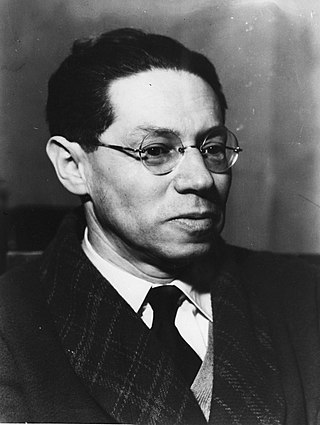
Lion Feuchtwanger was a German Jewish novelist and playwright. A prominent figure in the literary world of Weimar Germany, he influenced contemporaries including playwright Bertolt Brecht.

Mikhail Mikhailovich Bakhtin was a Russian philosopher, literary critic and scholar who worked on literary theory, ethics, and the philosophy of language. His writings, on a variety of subjects, inspired scholars working in a number of different traditions and in disciplines as diverse as literary criticism, history, philosophy, sociology, anthropology and psychology. Although Bakhtin was active in the debates on aesthetics and literature that took place in the Soviet Union in the 1920s, his distinctive position did not become well known until he was rediscovered by Russian scholars in the 1960s.

The New Objectivity was a movement in German art that arose during the 1920s as a reaction against expressionism. The term was coined by Gustav Friedrich Hartlaub, the director of the Kunsthalle in Mannheim, who used it as the title of an art exhibition staged in 1925 to showcase artists who were working in a post-expressionist spirit. As these artists—who included Max Beckmann, Otto Dix, George Grosz, Christian Schad, Rudolf Schlichter and Jeanne Mammen—rejected the self-involvement and romantic longings of the expressionists, Weimar intellectuals in general made a call to arms for public collaboration, engagement, and rejection of romantic idealism.

Paul Dessau was a German composer and conductor. He collaborated with Bertolt Brecht and composed incidental music for his plays, and several operas based on them.

Slatan Theodor Dudow was a Bulgarian born film director and screenwriter who made a number of films during the Weimar Republic and in East Germany.

Herwarth Walden was a German expressionist artist and art expert in many disciplines. He is broadly acknowledged as one of the most important discoverers and promoters of German avant-garde art in the early twentieth century. He was best known as the founder of the Expressionist magazine Der Sturm and its offshoots.

Hans Mayer was a German literary scholar. Mayer was also a jurist and social researcher and was internationally recognized as a critic, author and musicologist.
East German literature is the literature produced in East Germany from the time of the Soviet occupation in 1945 until the end of the communist government in 1990. The literature of this period was heavily influenced by the concepts of socialist realism and controlled by the communist government. As a result, the literature of the German Democratic Republic was for decades dismissed as nothing more than "Boy meet Tractor literature", but its study is now considered a legitimate field. Because of its language, the literature is more accessible to western scholars and is considered to be one of the most reliable, if not the most reliable, sources about East Germany.
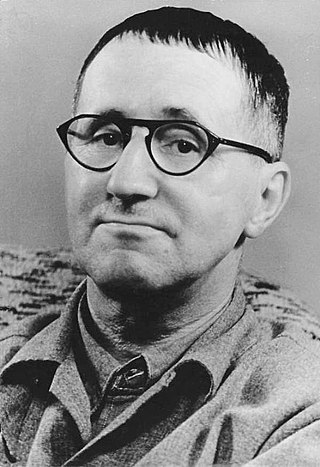
Eugen Berthold Friedrich Brecht, known professionally as Bertolt Brecht, was a German theatre practitioner, playwright, and poet. Coming of age during the Weimar Republic, he had his first successes as a playwright in Munich and moved to Berlin in 1924, where he wrote The Threepenny Opera with Kurt Weill and began a life-long collaboration with the composer Hanns Eisler. Immersed in Marxist thought during this period, he wrote didactic Lehrstücke and became a leading theoretician of epic theatre and the Verfremdungseffekt.

Die Sammlung was a monthly literary magazine, first published in September 1933 in Amsterdam, and primarily affiliated with a number of influential German writers who fled from the Hitler regime during the first years of the establishment and consolidation of Nazi rule.
German Exilliteratur is the name for works of German literature written in the German diaspora by refugee authors who fled from Nazi Germany, Nazi Austria, and the occupied territories between 1933 and 1945. These dissident writers, poets and artists, many of whom were of Jewish ancestry or held anti-Nazi beliefs, fled into exile in 1933 after the Nazi Party came to power in Germany and after Nazi Germany annexed Austria by the Anschluss in 1938, abolished the freedom of press, and started to prosecute authors and ban works.

Marta Feuchtwanger was the irrepressible and somewhat eccentric third child of a prosperous Munich businessman who in 1912 married the author Lion Feuchtwanger. Although they married only after Marta became pregnant with Feuchtwanger's child, the marriage lasted forty-six years and she became both a devoted wife and a huge influence on his work. The Jewish couple were forced to emigrate during the Hitler period. After her husband died in 1958 Marta Feuchtwanger spent nearly three decades as a high-profile widow in Los Angeles.
Hans-Joachim Bunge was a German Dramaturg, Director and Author. Bunge became famous through his conversations with Hanns Eisler about Brecht.

Ventseslav Konstantinov was a Bulgarian writer, aphorist and translator of German and English literature.

The Deutsche Zentral-Zeitung was the German-language newspaper published in Moscow by the German-speaking section of the Communist International. The newspaper's type was set in Fraktur and contained translations of Russian articles and speeches, reviews, articles from and about other countries, and it publicized pronouncements and information from the Communist Party. Published for little over a decade, the newspaper ceased publication in 1939 after Soviet secret police (NKVD) arrested so many of the staff that it no longer had enough people to continue operation. The newspaper remained without a successor until 1957.

The Akademie der Künste der DDR was the central art academy of the German Democratic Republic (DDR). It existed under different names from 1950 to 1993. Then it merged with the "Akademie der Künste Berlin (West)" to become the Academy of Arts, Berlin.
