
David Veronese (17th century) was an Italian economist from Genoa.
David Veronese (17th century) was an Italian economist from Genoa.
Veronese's works were considered milestones for the merchant business. [1]

Paolo Caliari, known as Paolo Veronese, was an Italian Renaissance painter based in Venice, known for extremely large history paintings of religion and mythology, such as The Wedding at Cana (1563) and The Feast in the House of Levi (1573). Included with Titian, a generation older, and Tintoretto, a decade senior, Veronese is one of the "great trio that dominated Venetian painting of the cinquecento" and the Late Renaissance in the 16th century. Known as a supreme colorist, and after an early period with Mannerism, Paolo Veronese developed a naturalist style of painting, influenced by Titian.

LodovicoZacconi was an Italian composer and musical theorist of the late Renaissance and early Baroque eras. He worked as a singer, theologian, and writer on music in northern Italy and Austria; for a time he was in the employ of Archduke Karl of Graz, and worked in Graz and Vienna.

The Wedding Feast at Cana, by Paolo Veronese, is a representational painting that depicts the biblical story of the Marriage at Cana, at which Jesus miraculously converts water into red wine. Executed in the Mannerist style (1520–1600) of the late Renaissance, the large-format oil painting comprehends the stylistic ideal of compositional harmony, as practised by the artists Leonardo, Raphael, and Michelangelo.

Unione Sportiva Dilettantistica 1913 Seregno Calcio is an Italian association football club located in Seregno, Lombardy. It currently plays in Serie D.

Monte Veronese is an Italian cheese made from cow's milk which is produced in the northern part of the Province of Verona, more specifically in the Lessini mountains or the Veronese prealps. Like Asiago it comes in two varieties, one fresh and one matured.
Cavaion Veronese is a comune (municipality) in the Province of Verona in the Italian region Veneto, located about 120 kilometres (75 mi) west of Venice and about 20 kilometres (12 mi) northwest of Verona. As of 31 December 2004, it had a population of 4,459 and an area of 12.9 square kilometres (5.0 sq mi).
Roveré Veronese is a comune (municipality) in the Province of Verona in the Italian region Veneto, located about 100 kilometres (62 mi) west of Venice and about 20 kilometres (12 mi) northeast of Verona. It is part of the Thirteen Communities, a group of villages which historically speak the Cimbrian language.

The Feast in the House of Levi or Christ in the House of Levi is a 1573 oil painting by Italian painter Paolo Veronese and one of the largest canvases of the 16th century, measuring 560 cm × 1,309 cm. It is now in the Gallerie dell'Accademia in Venice. It was painted by Veronese for a wall of a Dominican friary called the refectory of the Basilica di Santi Giovanni e Paolo. This painting was intended to be a Last Supper, to replace an earlier work by Titian of this subject destroyed in the fire of 1571. The painting is directly tied to Luke, chapter 5, of the Bible which is clear from the inscription the artist added. The painting shows a banquet taking place in which Christ is the focal point at the center of the image. However, the painting led to an investigation by the Tribunal of the Holy Inquisition in Venice. Veronese was called to answer for irreverence and indecorum, and the serious offense of heresy was mentioned.
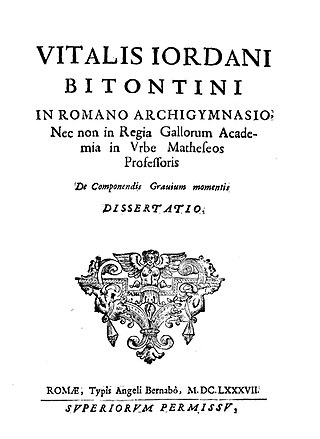
Giordano Vitale or Vitale Giordano was an Italian mathematician. He is best known for his theorem on Saccheri quadrilaterals. He may also be referred to as Vitale Giordani, Vitale Giordano da Bitonto, and simply Giordano.
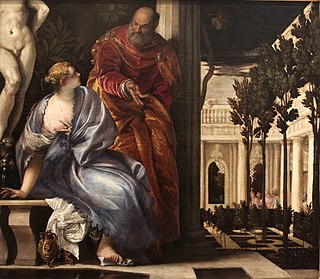
Bathsheba at her Bath is an oil-on-canvas painting by Italian Renaissance painter Paolo Veronese, dated around 1575 and now in the Musée des Beaux-Arts de Lyon, France.
Ippolito Baccusi was an Italian composer of the late Renaissance, active in northern Italy, including Venice, Mantua, and Verona. A member of the Venetian School of composers, he had a strong reputation as a master of counterpoint, and wrote both sacred and secular vocal music.
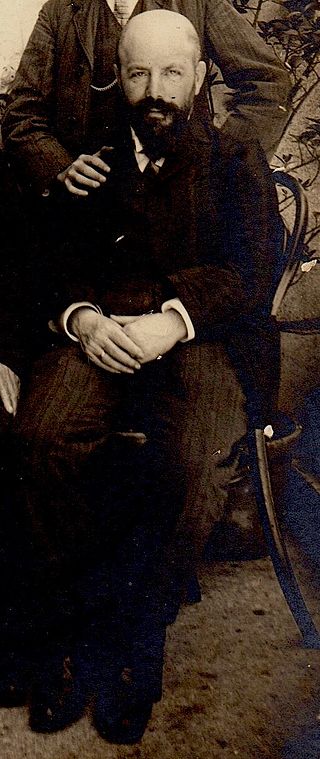
Vittorio Grünwald was an Italian professor of mathematics and German language. His father Guglielmo (Willhelm) Grünwald was Hungarian, his mother Fortuna Marini was Italian. In 1861 he moved to Hungary with his family, then came back in 1877 to Verona, later in November 1885 they moved to Brescia, and then to Venice. He studied at the Technische Universität Wien, where he graduated in mathematics. After coming back to Italy, he taught mathematics and German language in several schools, and then he settled in Florence.

Vialone Nano is an Italian semifino (medium-grain) rice variety. It is typical of the flat, rice-growing areas of the southern Provincia di Verona, in Veneto.
Vialone Nano is a cultivar of the Japonica group of varieties of Oryza sativa.

The Conversion of Mary Magdalene is an oil painting, an early work by the Italian Renaissance artist based in Venice, Paolo Veronese (1528–1588). He was known for his sumptuous paintings with a dramatic and colourful style. Dating from circa 1545–1548, the painting was commissioned by a noble patron in Verona. It is held by the National Gallery in London.

Onofrio Puglisi, also known as Onofrio Pugliesi Sbernia, was an Italian mathematician from Palermo.

Antonio Sangiovanni was a 17th-century Italian agronomist and mathematician.

Filippo Antonio Revelli was an Italian mathematician.

Francesco Barberino Benici was an Italian mathematician.

Domenico Griminelli was a 17th-century Italian mathematician and Catholic priest from Correggio, Emilia-Romagna.
Pietro De Martino or Di Martino was an Italian mathematician and astronomer.