| This article needs additional citations for verification .(August 2025) |
Delivery reliability is concerned with the completeness and timeliness of delivery of goods which have been ordered. It is one of the five attributes in supply-chain management according to SCOR-model, developed by the management consulting firm PRTM, now part of PricewaterhouseCoopers LLP, (PwC) and endorsed by the Supply-Chain Council (SCC) as the cross-industry de facto standard diagnostic tool for supply chain management, SCOR measures the supplier’s ability to predictably complete processes as promised. It is measured by perfect order fulfillment and demonstrates the degree to which a supplier is able to serve its customers within the promised delivery time. Companies can apply the concept to the delivery of their incoming materials orders and their delivery of products to customers. [1]
Contents
- Volume/on time
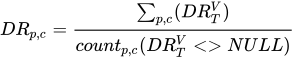
- Formula
- Singular/delivery and singular/on Time
- Singular case definition
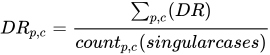
- Formula 2
- Result
- References
- External links
Following the nomenclature of the DR-DP-Matrix, three main approaches to measure DR can be distinguished:
- (equivalent to confirmed line item performance, or CLIP)


- Type of measurement: volume (V)/singular(S)
- Type of view: on time (T)/ delivery (D)