Related Research Articles

Aung San Suu Kyi, sometimes abbreviated to Suu Kyi, is a Burmese politician, diplomat, author, and a 1991 Nobel Peace Prize laureate who served as State Counsellor of Myanmar and Minister of Foreign Affairs from 2016 to 2021. She has served as the general secretary of the National League for Democracy (NLD) since the party's founding in 1988, and was registered as its chairperson while it was a legal party from 2011 to 2023. She played a vital role in Myanmar's transition from military junta to partial democracy in the 2010s.

Myanmar operates de jure as a unitary assembly-independent republic under its 2008 constitution. On 1 February 2021, Myanmar's military took over the government in a coup, causing ongoing anti-coup protests.

José Manuel Ramos-Horta is an East Timorese politician currently serving as president of East Timor since May 2022. He previously served as president from 20 May 2007 to 20 May 2012. Previously he was Minister of Foreign Affairs from 2002 to 2006 and Prime Minister from 2006 to 2007. He is a co-recipient of the 1996 Nobel Peace Prize, along with Carlos Filipe Ximenes Belo, for working "towards a just and peaceful solution to the conflict in East Timor".
The National League for Democracy is a deregistered liberal democratic political party in Myanmar (Burma). It became the country's ruling party after a landslide victory in the 2015 general election but was overthrown in a military coup d'état in early 2021 following another landslide election victory in 2020.
Otpor was a political organization in Serbia from 1998 until 2004.
There exist a number of perspectives on the relationship of Islam and democracy among Islamic political theorists, the general Muslim public, and Western authors. Today, a number of Muslim-majority countries are Islamic yet secular democracies.

The National Coalition Government of the Union of Burma was an administration which claimed to be the government in exile of Burma (Myanmar). It had its headquarters in Rockville, Maryland, United States. It was formally established in December 1990, with Sein Win as its first prime minister. It was dissolved in September 2012.
The Irrawaddy is a news website by the Irrawaddy Publishing Group (IPG), founded in 1990 by Burmese exiles living in Thailand. From its inception, The Irrawaddy has taken an independent stance on Burmese politics. As a publication produced by former Burmese activists who fled violent crackdowns on anti-military protests in 1988, it has always been closely associated with the pro-democracy movement, although it remains unaffiliated with any of the political groups that have emerged since the 8888 Uprising.
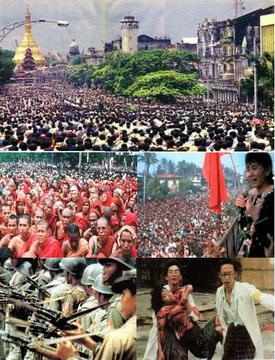
The 8888 Uprising, also known as the People Power Uprising and the 1988 Uprising, was a series of nationwide protests, marches, and riots in Burma that peaked in August 1988. Key events occurred on 8 August 1988 and therefore it is commonly known as the "8888 Uprising". The protests began as a student movement and were organised largely by university students at the Rangoon Arts and Sciences University and the Rangoon Institute of Technology (RIT).

The 2006 Thai coup d'état took place on 19 September 2006, when the Royal Thai Army staged a coup d'état against the elected caretaker government of Prime Minister Thaksin Shinawatra. The coup d'état, which was Thailand's first non-constitutional change of government in fifteen years since the 1991 Thai coup d'état, followed a year-long political crisis involving Thaksin, his allies, and political opponents and occurred less than a month before nationwide House elections were scheduled to be held. It has been widely reported in Thailand and elsewhere that General Prem Tinsulanonda, key person in military-monarchy nexus, Chairman of the Privy Council, was the mastermind of the coup. The military cancelled the scheduled 15 October elections, abrogated the 1997 constitution, dissolved parliament and constitutional court, banned protests and all political activities, suppressed and censored the media, declared martial law nationwide, and arrested cabinet members.

The Internet in Myanmar has been available since 2000 when the first Internet connections were established. Beginning in September 2011, historically-pervasive levels of Internet censorship in Burma were significantly reduced. Prior to September 2011, the military government worked aggressively to limit and control Internet access through software-based censorship, infrastructure and technical constraints, and laws and regulations with large fines and lengthy prison sentences for violators. In 2015, internet usage significantly increased to 12.6% with the introduction of faster mobile 3G internet by transnational telecommunication companies Telenor Myanmar and Ooredoo Myanmar, later joined by national Myanmar Post and Telecommunications (MPT). While the Internet situation in Myanmar has undergone change since its introduction in 2010 and reduction of censorship in 2011, laws such as the 2013 Telecommunications Law continue to restrict citizens from total freedom online. Despite restrictions, internet penetration continues to grow across the country.
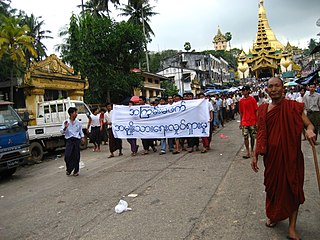
The Saffron Revolution was a series of economic and political protests and demonstrations that took place during August, September, and October 2007 in Myanmar. The protests were triggered by the decision of the national military government to remove subsidies on the sales prices of fuel. The national government is the only supplier of fuels and the removal of the price subsidy immediately caused diesel and petrol prices to increase by 66–100% and the price of compressed natural gas for buses to increase 500% in less than a week.
International reaction to the 2007 Burmese anti-government protests ranges from support of the protestors through neutrality to support of the State Peace and Development Council, the ruling junta. While most countries supported the protests and urged the Myanmar's State Peace and Development Council ruling military Junta to implement far-reaching reforms, several key countries, such as the People's Republic of China and India maintained commitment to the notion of noninterference. A number of protests against the Burmese Government's crackdown have been held worldwide.
This article details the chronology of events in the 2007 Burmese anti-government protests.
General elections were held in Myanmar on 7 November 2010, in accordance with the new constitution, which was approved in a referendum held in May 2008. The election date was announced by the State Peace and Development Council (SPDC) on 13 August.

The National Democratic Force (NDF) is a political party in Myanmar (Burma). It was founded by former members of the National League for Democracy (NLD) who disagreed with the party leadership's decision to boycott the 2010 general election.

The Arakan League for Democracy is a political party active in Rakhine State, Myanmar (Burma).
Myanmar's roadmap to democracy, announced by General Khin Nyunt on 30 August 2003 in state media, provided a seven-step process in restoring democracy in the country. Endorsed by the State Peace and Development Council, it essentially describes the reassembly of the National Convention (အမျိုးသားညီလာခံ) in Nyaunghnapin, Hmawbi Township, Yangon Division to write a constitution, hold a national referendum to approve the constitution, hold a general election to elect members to the Hluttaw, and finally hold parliamentary sessions.

The Democracy and Human Rights Party is a political party in Myanmar representing the Rohingya of northern Rakhine State.

The Chin National League for Democracy (CNLD) is a political party in Myanmar seeking to represent the interests of the Chin people.
References
- ↑ BBC Former student activists debate approach towards democracy 22 February 2007 Archived March 25, 2007, at the Wayback Machine
- ↑ World Movement for Democracy Burma Democratic Force Formed in Malaysia March 2007 Archived May 12, 2008, at the Wayback Machine
 | This article about an organisation in Myanmar is a stub. You can help Wikipedia by expanding it. |