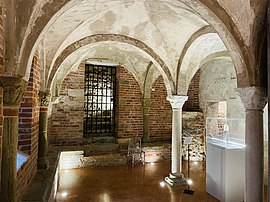
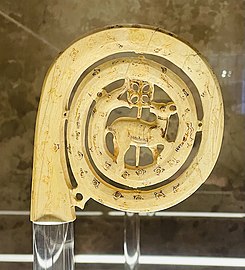
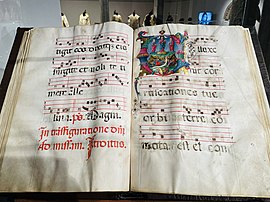
Pavia is a town and comune of south-western Lombardy, in Northern Italy, 35 kilometres south of Milan on the lower Ticino near its confluence with the Po. It has a population of c. 73,086. The city was the capital of the Ostrogothic Kingdom from 540 to 553, of the Kingdom of the Lombards from 572 to 774, of the Kingdom of Italy from 774 to 1024 and seat of the Visconti court from 1365 to 1413.

Todi is a town and comune (municipality) of the province of Perugia in central Italy. It is perched on a tall two-crested hill overlooking the east bank of the river Tiber, commanding distant views in every direction. It was founded in antiquity by the Umbri, at the border with Etruria; the gens Ulpia of Roman emperor Trajan came from Todi.

Nonantola Abbey, dedicated to Saint Sylvester, is a former Benedictine monastery and prelature nullius in the commune of Nonantola, c. 10 km north-east of Modena, in the Emilia Romagna region of Italy. The abbey church remains as a basilica and is the co-cathedral of the diocese of Modena-Nonantola.

One of the first streams of Romanesque architecture in Europe from the 10th century and the beginning of 11th century is called First Romanesque or Lombard Romanesque. It took place in the region of Lombardy and spread into Catalonia and into the south of France. Its principal decoration for the exterior, bands of ornamental blind arches are called Lombard bands. It was characterized by thick walls and lack of sculpture in facades, and with interiors profusely painted with frescoes.
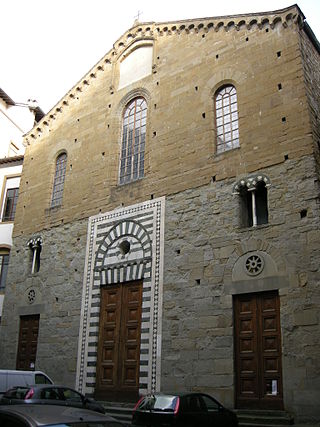
Santo Stefano al Ponte is a Romanesque-style, Roman Catholic church, located in the Piazza of the same name, just off the Via Por Santa Maria, near the Ponte Vecchio, in Florence, region of Tuscany, Italy. The church is presently used as a concert hall.

The Basilica of San Michele Maggiore is a Roman Catholic church in Pavia, region of Lombardy, Italy. The building, dating to the 11-12th centuries, is a well-preserved example of the Lombard-Romanesque style.
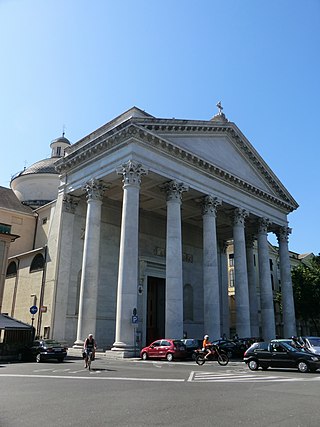
The Diocese of Chiavari is a Latin diocese of the Catholic Church in Liguria, northern Italy. It was created on 3 December 1892 by Pope Leo XIII in the Bull Romani Pontifices. It is a suffragan of the Archdiocese of Genoa.

Pavia Cathedral is a church in Pavia, Italy, the largest in the city and seat of the Diocese of Pavia. The construction was begun in the 15th century on the site of two pre-existing Romanesque, "twin" cathedrals. The cathedral houses the remains of St. Sirus, first Bishop of Pavia, and a thorn purported to be from the Crown of Thorns worn by Christ. The marble facing of the exterior was never completed.

The Civic Museums of Pavia are a number of museums in Pavia, Lombardy, northern Italy. They are housed in the Castello Visconteo, or Visconti Castle, built in 1360 by Galeazzo II Visconti, soon after taking the city, a free city-state until then. The credited architect is Bartolino da Novara. The castle used to be the main residence of the Visconti family, while the political capital of the state was Milan. North of the castle a wide park was enclosed, also including the Certosa of Pavia, founded 1396 according to a vow of Gian Galeazzo Visconti, meant to be a sort of private chapel of the Visconti dynasty. The Battle of Pavia (1525), climax of the Italian Wars, took place inside the castle park.

Lombard architecture refers to the architecture of the Kingdom of the Lombards, which lasted from 568 to 774 and which was commissioned by Lombard kings and dukes.
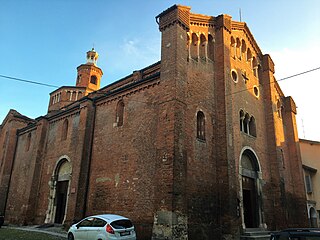
San Teodoro is a Romanesque-style Roman Catholic church in the town center of Pavia, Italy.
The Diocesan Museum of Amalfi is an art museum housed in the 9th century Basilica del Crocifisso di Amalfi in Amalfi. It displays many of the treasures of the Roman Catholic Archdiocese of Amalfi-Cava de' Tirreni and is centrally located close to Amalfi Cathedral in Via Salita Episcopio.
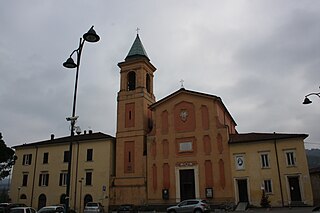
Modigliana Cathedral, otherwise the Church of Santo Stefano Papa, is a Roman Catholic cathedral and the principal church of Modigliana in Emilia-Romagna, Italy. It is dedicated to the sainted Pope Stephen I. An ancient church, it was made the seat of the bishops of Modigliana on the creation of the diocese in 1850, and from 1986 has been a co-cathedral in the Diocese of Faenza-Modigliana.
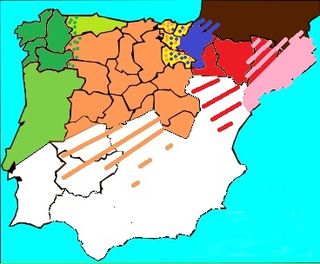
Spanish Romanesque designates the Romanesque art developed in the Hispanic-Christian kingdoms of the Iberian Peninsula in the 11th and 12th centuries. Its stylistic features are essentially common to the European Romanesque although it developed particular characteristics in the different regions of the peninsula. There is no Romanesque art in the southern half of the peninsula because it remained under Muslim rule (Al-Andalus). The examples of Romanesque buildings in the central area of the peninsula are sparse and of the latest period, with virtually no presence south of the Ebro and the Tagus. Most Romanesque buildings can be found in the northern third of the peninsula. Romanesque art was introduced into the peninsula from east to west, so scholars have usually defined regional characteristics accordingly: the "eastern kingdoms" comprising the Pyrenean areas, Catalan Romanesque, Aragonese Romanesque and Navarrese Romanesque, and the "western kingdoms" comprising Castilian-Leonese Romanesque, Asturian Romanesque, Galician Romanesque and Portuguese Romanesque.
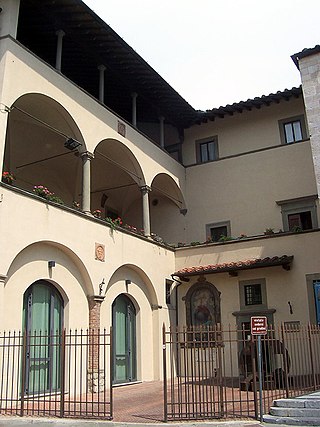
The Cathedral museum of Prato, Italy was founded in 1967 in a few rooms of the Bishop's residence and in 1976 grew to include items from both the Cathedral of Saint Stephen and the diocesan territory.
The Diocesan Museum of Sacred Art (MuDAS) in Arezzo was founded in 1963 but opened regularly to the public only in 1985, and was housed in several rooms above the sacristy of the Cathedral of San Donato. In 2011 it was relocated to the first floor of the bishop's residence. The museum exhibits works of art and liturgical items, from the 12th to the 19th centuries, that come from the cathedral and other churches in the diocesan territory, significant for their religious and cultural significance to Arezzo and the surrounding area. Highlights of the museum include several works of Giorgio Vasari and the Pace di Siena.
The Diocesan museum of Genoa is located in Genova in the region of Liguria. It is found inside the old residence of the canons of the Cathedral of San Lorenzo and is accessible through the cloister of San Lorenzo. The cloister, built in the 12th century, is characterized by two levels of arches resting on double Romanesque columns with leaved capitals. In the 17th century two sides of the building were modified, with the double columns substituted with heavy pilasters in order to support the above two floors constructed for additional space. The museum houses objects from the diocese of Genoa and the surrounding area, including sculptures, paintings, frescoes, illuminated manuscripts, and a series of liturgical items, as well as an archeological area.

The Assisi Diocesan Museum, in the city of Assisi, Italy, was founded in 1941 by bishop Giuseppe Placido Niccolini to preserve the most important works of art of the Assisi Cathedral and of several oratories of Assisi's confraternities. The museum is located underneath the piazza of the cathedral and has a collection consisting of about 300 works of which 100 are on display, exhibited in the museum's nine sections.

The monastery of Santa Maria Teodote, also known as Santa Maria della Pusterla, was one of the oldest and most important female monasteries in Pavia, Lombardy, now Italy. Founded in the seventh century, it stood in the place where the diocesan seminary is located and was suppressed in the eighteenth century.
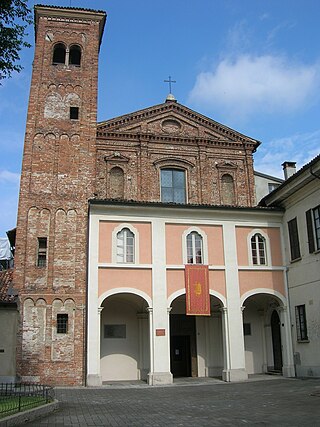
The Church of Santi Gervasio e Protasio is a church in Pavia, in Lombardy.