Related Research Articles

Parking is the act of stopping and disengaging a vehicle and usually leaving it unoccupied. Parking on one or both sides of a road is often permitted, though sometimes with restrictions. Some buildings have parking facilities for use of the buildings' users. Countries and local governments have rules for design and use of parking spaces.
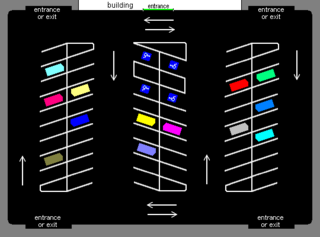
A parking lot or car park, also known as a car lot, is a cleared area intended for parking vehicles. The term usually refers to an area dedicated only for parking, with a durable or semi-durable surface. In most jurisdictions where cars are the dominant mode of transportation, parking lots are a major feature of cities and suburban areas. Shopping malls, sports stadiums, and other similar venues often have immense parking lots.

A park and ride, also known as incentive parking or a commuter lot, is a parking lot with public transport connections that allows commuters and other people heading to city centres to leave their vehicles and transfer to a bus, rail system, or carpool for the remainder of the journey. The vehicle is left in the parking lot during the day and retrieved when the owner returns. Park and rides are generally located in the suburbs of metropolitan areas or on the outer edges of large cities. A park and ride that only offers parking for meeting a carpool and not connections to public transport may also be called a park and pool.
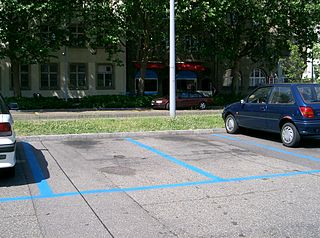
A parking space, parking place or parking spot is a location that is designated for parking, either paved or unpaved. It can be in a parking garage, in a parking lot or on a city street. The space may be delineated by road surface markings. The automobile fits inside the space, either by parallel parking, perpendicular parking or angled parking.

Outdoor advertising or out-of-home (OOH) advertising includes public billboards, wallscapes, and posters seen while "on the go". OOH advertising formats fall into four main categories: billboards, street furniture, transit, and alternative.

A multistorey car park or parking garage, also called a multistorey, parking building, parking structure, parkade (Canadian), parking ramp, parking deck, or indoor parking, is a building designed for car, motorcycle, and bicycle parking in which parking takes place on more than one floor or level. The first known multistorey facility was built in London in 1901 and the first underground parking was built in Barcelona in 1904. The term multistorey is almost never used in the United States, because almost all parking structures have multiple parking levels. Parking structures may be heated if they are enclosed.
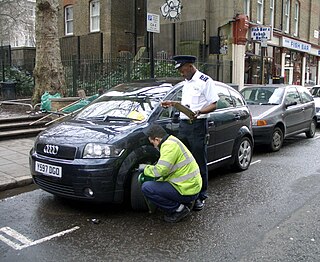
Decriminalised parking enforcement (DPE) is the name given in the United Kingdom to the civil enforcement of car parking regulations, carried out by civil enforcement officers, operating on behalf of a local authority. The Road Traffic Act 1991 (c. 40) provided for the decriminalisation of parking-related contraventions committed within controlled parking zones (CPZ) administered by local councils across the UK. The CPZs under the control of the local councils are also referred to as yellow routes and they can be easily identified with yellow lines marked on the roads with relevant time plates. Councils employ parking attendants to enforce their CPZs directly.

A disabled parking permit, also known as a disabled badge, disabled placard, handicapped permit, handicapped placard, handicapped tag, and "Blue Badge" in the European Union, is a permit that is displayed upon parking a vehicle. It gives the operator of a vehicle permission to special privileges regarding the parking of that vehicle. These privileges include parking in a space reserved for persons with disabilities, or, in some situations, permission to park in a time-limited space for a longer time, or to park at a meter without payment.
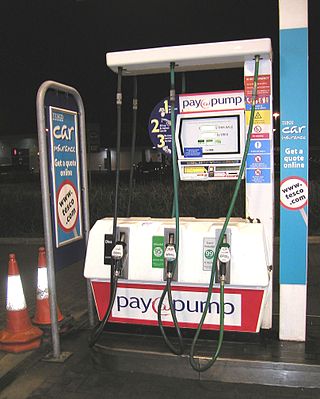
The 2007 United Kingdom petrol contamination problem arose on 28 February 2007, when motorists in South East England reported that their cars were breaking down. This was caused by silicon contaminated unleaded petrol, sold by several supermarkets, that damaged the lambda sensors in engine management systems.

Parking guidance and information (PGI) systems, or car park guidance systems, present drivers with dynamic information on parking within controlled areas. The systems combine traffic monitoring, communication, processing and variable message sign technologies to provide the service.
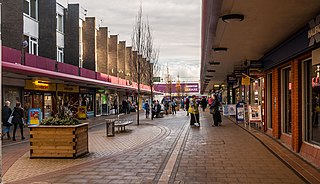
Swinton Square, formerly known as Swinton Shopping Centre, is a shopping centre located between Chorley Road (A6) and Swinton Hall Road in Swinton, near Manchester, England.

Pay-by-phone parking is a system of paying for car parking via a mobile app or mobile network operator. It is an alternative to the traditional ways to pay for parking of parking meter or pay and display machines. SMS pay-by-phone parking was first introduced by Vipnet. Since its introduction in Croatian capital Zagreb in 2001 under the name M-parking, the number of registered users has steadily increased. By 2004, the Croatian M-parking scheme was the largest in Europe. Today, pay-by-phone parking is used by millions of people all around the world.

Disabled Motoring UK is a non-governmental organisation founded in the UK in 1922 and was recently known as Mobilise. It is a campaigning charity for disabled drivers, passengers, and blue badge holders in the United Kingdom. Disabled Motoring UK lobbies the government and businesses to improve parking, access, and refuelling services for disabled people. Disabled Motoring UK does not just campaign for motorists but also supports scooter and wheelchair users, as well as the families and carers of disabled people.

Cycling infrastructure is all infrastructure cyclists are allowed to use. Bikeways include bike paths, bike lanes, cycle tracks, rail trails and, where permitted, sidewalks. Roads used by motorists are also cycling infrastructure, except where cyclists are barred such as many freeways/motorways. It includes amenities such as bike racks for parking, shelters, service centers and specialized traffic signs and signals. The more cycling infrastructure, the more people get about by bicycle.

Big W was a British retail chain owned by the Kingfisher Group in the United Kingdom, which operated between 1998 and 2004. Big W stores were large format out-of-town megastores that featured products from all of Kingfisher's main retail chains at the time, consisting of Comet, B&Q, Superdrug and Woolworths.
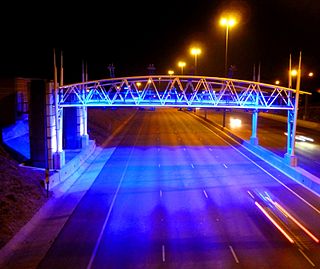
e-toll consisted of the electronic toll collection (ETC) processes employed by South Africa's roads agency SANRAL on selected toll roads or toll lanes in the Gauteng province, subject to the Sanral Act of 1998. SANRAL derives its income both from toll income and the national fiscus, while initial capital outlay for large projects are funded by open market bond issues. In total SANRAL manages 13,000 km of non-toll roads in South Africa, besides the majority of its toll roads, including 187 km of Gauteng's freeways which were subject to e-toll.

PMD Technologies is a developer of CMOS semiconductor 3D time-of-flight (ToF) components and a provider of engineering support in the field of digital 3D imaging. The company is named after the Photonic Mixer Device (PMD) technology used in its products to detect 3D data in real time. The corporate headquarters of the company is located in Siegen, Germany.

EG Group Limited is a British operator of filling stations, convenience stores and food service providers across Europe, the United States and Australia. It was founded in Blackburn in 2001 by brothers Mohsin and Zuber Issa, initially as Euro Garages.

In the United States, reserved spaces are mandated by the Americans with Disabilities Act Accessibility Guidelines.
Mohsin Issa CBE and Zuber Issa CBE are British billionaire brothers and businessmen who founded Euro Garages in 2001, a Blackburn-based operator of filling stations, convenience stores and food service providers across Europe, the United States and Australia. In October 2020, as part of a consortium with TDR Capital, the brothers became majority stakeholders in the British supermarket chain Asda. From August 2021 to September 2024, Mohsin served as Asda's chief executive.
References
- ↑ "Spacehog will shame selfish parkers". Dorset Echo. 2003-07-09. Retrieved 2024-03-23.
- ↑ "Cars, Badges, Parking". gofree.indigo.ie. Retrieved 2024-03-23.
- ↑ Bates, Leibling, John, David. "Spaced out: Perspectives in parking policy" (PDF). RAC Foundation. Retrieved 23 March 2024.
{{cite web}}: CS1 maint: multiple names: authors list (link) - ↑ "Asda's Disabled Parking Farce (Asda Statement)". asdadisabledparking.tripod.com. Retrieved 2024-03-23.
- ↑ BusinessLive (2005-08-23). "Spacehog looks after parking". Business Live. Retrieved 2024-03-23.
{{cite web}}:|last=has generic name (help)
 | This technology-related article is a stub. You can help Wikipedia by expanding it. |