Related Research Articles

The Liberal Party was one of the two major political parties in the United Kingdom, along with the Conservative Party, in the 19th and early 20th centuries. Beginning as an alliance of Whigs, free trade–supporting Peelites, and reformist Radicals in the 1850s, by the end of the 19th century, it had formed four governments under William Gladstone. Despite being divided over the issue of Irish Home Rule, the party returned to government in 1905 and won a landslide victory in the 1906 general election. Under prime ministers Henry Campbell-Bannerman (1905–1908) and H. H. Asquith (1908–1916), the Liberal Party passed reforms that created a basic welfare state. Although Asquith was the party leader, its dominant figure was David Lloyd George.

The House of Lords is the upper house of the Parliament of the United Kingdom. Like the lower house, the House of Commons, it meets in the Palace of Westminster in London, England. One of the oldest institutions in the world, its origins lie in the early 11th century and the emergence of bicameralism in the 13th century.

The Parliament of the United Kingdom of Great Britain and Northern Ireland is the supreme legislative body of the United Kingdom, and may also legislate for the Crown Dependencies and the British Overseas Territories. It meets at the Palace of Westminster in London. Parliament possesses legislative supremacy and thereby holds ultimate power over all other political bodies in the United Kingdom and the Overseas Territories. While Parliament is bicameral, it has three parts: the sovereign, the House of Lords, and the House of Commons. The three parts acting together to legislate may be described as the King-in-Parliament. The Crown normally acts on the advice of the prime minister, and the powers of the House of Lords are limited to only delaying legislation.
The Parliament Acts 1911 and 1949 are two Acts of the Parliament of the United Kingdom, which form part of the constitution of the United Kingdom. Section 2(2) of the Parliament Act 1949 provides that the two Acts are to be construed as one.

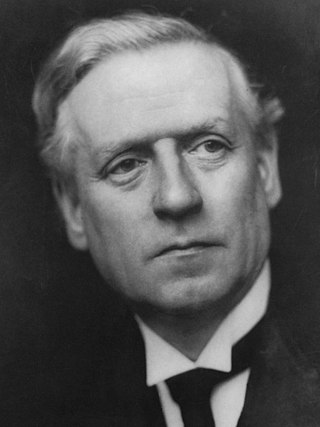
Herbert Henry Asquith, 1st Earl of Oxford and Asquith was a British statesman and liberal politician who was Prime Minister of the United Kingdom from 1908 to 1916. He was the last Liberal Party prime minister to command a majority government, and the most recent Liberal to have served as Leader of the Opposition. He played a major role in the design and passage of major liberal legislation and a reduction of the power of the House of Lords. In August 1914, Asquith took Great Britain and the British Empire into the First World War. During 1915, his government was vigorously attacked for a shortage of munitions and the failure of the Gallipoli Campaign. He formed a coalition government with other parties but failed to satisfy critics, was forced to resign in December 1916 and never regained power.

Andrew Bonar Law was a British statesman and Conservative politician who was Prime Minister of the United Kingdom from October 1922 to May 1923.
The House of Lords Act 1999 is an act of the Parliament of the United Kingdom that reformed the House of Lords, one of the chambers of Parliament. The Act was given royal assent on 11 November 1999. For centuries, the House of Lords had included several hundred members who inherited their seats ; the Act removed such a right. However, as part of a compromise, the Act allowed ninety-two hereditary peers to remain in the House. Another ten were created life peers to enable them to remain in the House.
The December 1910 United Kingdom general election was held from 3 to 19 December. It was the last general election to be held over several days and the last to be held before the First World War.
The Salisbury Convention is a constitutional convention in the United Kingdom under which the House of Lords should not oppose the second or third reading of any government legislation promised in its election manifesto. The origins of the convention date back to the late 19th century, at which time the Conservatives held a majority in the House of Lords and, with the support of the third Marquess of Salisbury, developed the "Referendal Theory", which applied solely to Liberal legislation, under which the House of Lords could obstruct legislation until it had received majority approval at a general election. This was changed following the landslide Labour Party victory in the 1945 general election, which produced a Labour government seen as having a popular mandate for significant reform, while once again there was a Conservative majority in the House of Lords. The fifth Marquess of Salisbury announced that the Lords "would not seek to thwart the main lines of Labour's legislation provided it derived from the party's manifesto for the previous election". From this point, manifesto bills were only to be adjusted by the Lords; however, on non-manifesto bills, the Lords were able to act as they had before.

The Leader of His Majesty's Most Loyal Opposition, more commonly referred to as the Leader of the Opposition, is the person who leads the Official Opposition in the United Kingdom. The position is seen as the shadow head of government of the United Kingdom and thus the shadow prime minister of the United Kingdom.
The Government of Ireland Act 1914, also known as the Home Rule Act, and before enactment as the Third Home Rule Bill, was an Act passed by the Parliament of the United Kingdom intended to provide home rule for Ireland. It was the third such bill introduced by a Liberal government during a 28-year period in response to agitation for Irish Home Rule.
The Parliament Act 1911 is an act of the Parliament of the United Kingdom. It is constitutionally important and partly governs the relationship between the House of Commons and the House of Lords, the two Houses of Parliament. The Parliament Act 1949 provides that the Parliament Act 1911 and the Parliament Act 1949 are to be construed together "as one" in their effects and that the two acts may be cited together as the Parliament Acts 1911 and 1949.
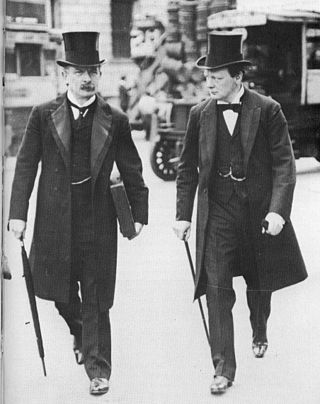
The 1909/1910 People's Budget was a proposal of the Liberal government that introduced unprecedented taxes on the lands and incomes of Britain's wealthy to fund new social welfare programmes. It passed the House of Commons in 1909 but was blocked by the House of Lords for a year and became law in April 1910.

The Redistribution of Seats Act 1885 was an Act of the Parliament of the United Kingdom. It was a piece of electoral reform legislation that redistributed the seats in the House of Commons, introducing the concept of equally populated constituencies, a concept in the broader global context termed equal apportionment, in an attempt to equalise representation across the UK. It mandated the abolition of constituencies below a certain population threshold. It was associated with, but not part of, the Representation of the People Act 1884.
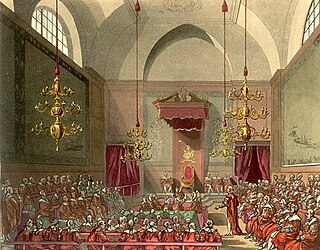
The reform of the House of Lords, the upper house of the Parliament of the United Kingdom, has been a topic of discussion in UK politics for more than a century. Multiple governments have attempted reform, beginning with the introduction of the Parliament Act 1911 by the incumbent Liberal Government. When the Labour Party came to power in the 1997 general election, the Blair government passed the House of Lords Act 1999. On 7 November 2001 the government undertook a public consultation. This helped to create a public debate on the issue of Lords reform, with 1,101 consultation responses and numerous debates in Parliament and the media. However, no consensus on the future of the upper chamber emerged.
Conciliation bills were proposed legislation which would extend the right of women to vote in the United Kingdom of Great Britain and Ireland to just over a million wealthy, property-owning women. After the January 1910 election, an all-party Conciliation party, consisting of 36 members of parliament and chaired by Lord Lytton, proposed the new Parliamentary Franchise (Women) Bill. Three Conciliation bills were put before the House of Commons, one each year in 1910, 1911 and in 1912, but all failed.

Black Friday was a suffragette demonstration in London on 18 November 1910, in which 300 women marched to the Houses of Parliament as part of their campaign to secure voting rights for women. The day earned its name from the violence meted out to protesters, some of it sexual, by the Metropolitan Police and male bystanders.

The Home Rule movement was a movement that campaigned for self-government for Ireland within the United Kingdom of Great Britain and Ireland. It was the dominant political movement of Irish nationalism from 1870 to the end of World War I.
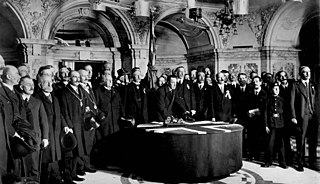
The Home Rule Crisis was a political and military crisis in the United Kingdom of Great Britain and Ireland that followed the introduction of the Third Home Rule Bill in the House of Commons of the United Kingdom in 1912.
The issue of Ireland has been a major one in British politics, intermittently so for centuries. Britain's attempts to control and administer the island, or parts thereof, have had significant consequences for British politics, especially in the 19th and 20th centuries. Although nominally autonomous until the end of the 18th century, Ireland became part of the United Kingdom of Great Britain and Ireland in 1801.
References
- ↑ "Letter to Lord Willoughby de Broke". www.parliament.uk. Retrieved 26 January 2014.
- ↑ Dennis, Alfred L. P. (August 1912). "The Parliament Act of 1911, II". The American Political Science Review. 6 (3): 386–408. doi:10.2307/1944526. JSTOR 1944526. S2CID 147091660.
- Phillips, Gregory D., The Diehards - Aristocratic Society and Politics in Edwardian England, Harvard University Press and London, England, 1979. ISBN 0-674-20555-3