
The politics of Finland take place within the framework of a parliamentary representative democracy. Finland is a republic whose head of state is President Alexander Stubb, who leads the nation's foreign policy and is the supreme commander of the Finnish Defence Forces. Finland's head of government is Prime Minister Petteri Orpo, who leads the nation's executive branch, called the Finnish Government. Legislative power is vested in the Parliament of Finland, and the Government has limited rights to amend or extend legislation. The Constitution of Finland vests power to both the President and Government: the President has veto power over parliamentary decisions, although this power can be overruled by a majority vote in the Parliament.
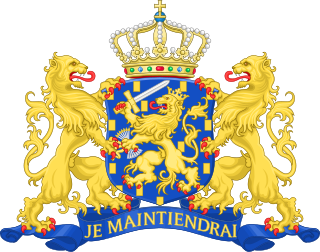
The Constitution of the Kingdom of the Netherlands of 24 August 1815 is one of two fundamental documents governing the Kingdom of the Netherlands as well as the fundamental law of the Netherlands proper. The Kingdom of the Netherlands also includes Aruba, Curaçao and Sint Maarten: there is an overarching instrument of the entire kingdom that has constitution characteristics: the Charter for the Kingdom of the Netherlands. Sint Maarten is the only country in the Kingdom of the Netherlands that has a constitutional court to govern the Sint Maarten legislature.
A motion or vote of no confidence is a motion and corresponding vote thereon in a deliberative assembly as to whether an officer is deemed fit to continue to occupy their office. The no-confidence vote is a defining constitutional element of a parliamentary system, in which the executive's mandate rests upon the continued support of the majority in the legislature. Systems differ in whether such a motion may be directed against the prime minister, against individual cabinet ministers, against the cabinet as a whole, or some combination of the above.

The premier of Ontario is the head of government of Ontario. Under the Westminster system, the premier governs with the confidence of a majority the elected Legislative Assembly; as such, the premier typically sits as a member of Provincial Parliament (MPP) and leads the largest party or a coalition of parties. As first minister, the premier selects ministers to form the Executive Council, and serves as its chair. Constitutionally, the Crown exercises executive power on the advice of the Executive Council, which is collectively responsible to the legislature.
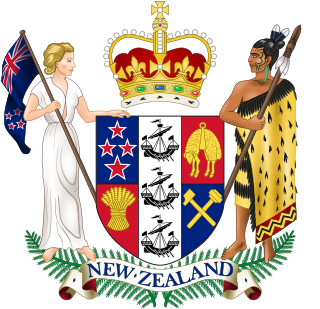
The Cabinet of New Zealand is the New Zealand Government's body of senior ministers, accountable to the New Zealand Parliament. Cabinet meetings, chaired by the prime minister, occur once a week; in them, vital issues are discussed and government policy is formulated. Cabinet is also composed of a number of committees focused on specific areas of governance and policy. Though not established by any statute, Cabinet wields significant power within the New Zealand political system, with nearly all government bills it introduces in Parliament being enacted.

The Parliament of Malaysia is the national legislature of Malaysia, based on the Westminster system. The bicameral parliament consists of the Dewan Rakyat and the Dewan Negara. The Yang di-Pertuan Agong (King), as the head of state, is the third component of Parliament.

The Dewan Rakyat is the lower house of the bicameral Parliament, the federal legislature of Malaysia. The chamber and its powers are established by Article 44 of the Constitution of Malaysia. The Dewan Rakyat sits in the Houses of Parliament in Kuala Lumpur, along with the Dewan Negara, the upper house.

The Cabinet of Australia, also known as the Federal Cabinet, is the chief decision-making body of the Australian government. The Cabinet is selected by the prime minister and is composed of senior government ministers who administer the executive departments and ministries of the federal government.
The cabinet of the Netherlands is the main executive body of the Netherlands. The current cabinet of the Netherlands is the Schoof cabinet, which has been in power since 2 July 2024. It is headed by Prime Minister Dick Schoof.
The Union Council of Ministers, also called Union Cabinet is the principal executive organ of the Government of India, which functions as the senior decision-making body of the executive branch. It is chaired by the prime minister and consists of the heads of each of the executive government ministries. Currently, the council is headed by prime minister Narendra Modi and consists of 29 members, including the prime minister. The council is subject to the Parliament of India.
Cabinet collective responsibility, also known as collective ministerial responsibility, is a constitutional convention in parliamentary systems and a cornerstone of the Westminster system system of government, that members of the cabinet must publicly support all governmental decisions made in Cabinet, even if they do not privately agree with them. This support includes voting for the government in the legislature. This convention formed in the 19th century in the United Kingdom. Some political parties, most commonly communist, apply a similar convention of democratic centralism to their central committee.
In Westminster-style governments, individual ministerial responsibility is a constitutional convention that a cabinet minister bears the ultimate responsibility for the actions of their ministry or department. Individual ministerial responsibility is not the same as cabinet collective responsibility, which states members of the cabinet must approve publicly of its collective decisions or resign. This means that a Parliamentary motion for a vote of no confidence is not in order should the actions of an organ of government fail in the proper discharge of its responsibilities. Where there is ministerial responsibility, the accountable minister is expected to take the blame and ultimately resign, but the majority or coalition within parliament of which the minister is part, is not held to be answerable for that minister's failure.

The Finnish Government is the executive branch and cabinet of Finland, which directs the politics of Finland and is the main source of legislation proposed to the Parliament. The Government has collective ministerial responsibility and represents Finland in the Council of the European Union. In the incumbent Orpo Cabinet, the Government comprises 19 ministers leading 12 ministries.

The Cabinet of Singapore forms the executive branch of the Government of Singapore together with the President. It is led by the Prime Minister who is the head of government. The prime minister is a Member of Parliament (MP) appointed by the president who in the president's judgment is likely to command the confidence of the majority of the Members of Parliament (MPs). The other Ministers in the Cabinet are Members of Parliament appointed by the president acting in accordance with the advice of the prime minister. Ministers are prohibited from holding any office of profit and from actively engaging in any commercial enterprise.

The Constitution of the Republic of Singapore is the supreme law of Singapore. A written constitution, the text which took effect on 9 August 1965 is derived from the Constitution of the State of Singapore 1963, provisions of the Federal Constitution of Malaysia made applicable to Singapore by the Republic of Singapore Independence Act 1965, and the Republic of Singapore Independence Act itself. The text of the Constitution is one of the legally binding sources of constitutional law in Singapore, the others being judicial interpretations of the Constitution, and certain other statutes. Non-binding sources are influences on constitutional law such as soft law, constitutional conventions, and public international law.
The Government of France, officially the Government of the French Republic, exercises executive power in France. It is composed of the prime minister, who is the head of government, as well as both senior and junior ministers.
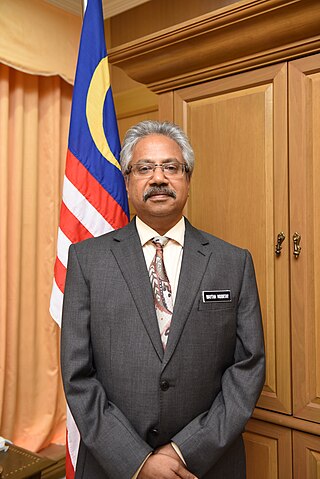
Waytha Moorthy Ponnusamy, sometimes spelled Waythamoorthy, is a Malaysian politician and lawyer who served as the Minister in the Prime Minister's Department in charge of National Unity and Social Wellbeing in the Pakatan Harapan (PH) administration under Prime Minister Mahathir Mohamad from July 2018 to the collapse of the PH administration in February 2020, Deputy Minister in the Prime Minister's Department from May 2013 to his resignation in February 2014 and Senator from June 2013 to his resignation in February 2014 and again from his appointment to the Cabinet in July 2018 to July 2021. He has served as the 1st and founding President of the Malaysian Advancement Party (MAP) since July 2019. He is also known as a former key leader of the Hindu Rights Action Force (HINDRAF).

The government of the United Kingdom is the central executive authority of the United Kingdom of Great Britain and Northern Ireland. The government is led by the prime minister who selects all the other ministers. The country has had a Labour government since 2024. The prime minister Keir Starmer and his most senior ministers belong to the supreme decision-making committee, known as the Cabinet.

A cabinet in governing is a group of people with the constitutional or legal task to rule a country or state, or advise a head of state, usually from the executive branch. Their members are known as ministers and secretaries and they are often appointed by the head of state or prime minister. Cabinets are typically the body responsible for the day-to-day management of the government and response to sudden events, whereas the legislative and judicial branches work in a measured pace, in sessions according to lengthy procedures.
The Separation of powers in Singapore is governed by Constitution of the Republic of Singapore, which splits the power to govern the country between three branches of government – the parliament, which makes laws; the executive, which executes them; and the judiciary, which enforces them. Each branch, while wielding legitimate power and being protected from external influences, is subject to a system of checks and balances by the other branches to prevent abuse of power. This Westminster constitutional model was inherited from the British during Singapore's colonial years.


