Related Research Articles
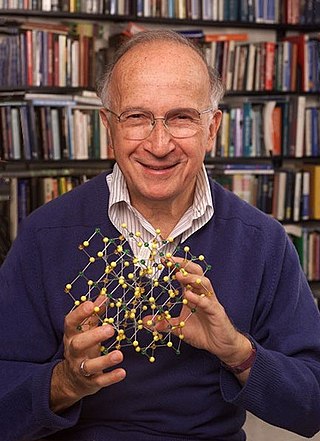
Roald Hoffmann is a Polish-American theoretical chemist who won the 1981 Nobel Prize in Chemistry. He has also published plays and poetry. He is the Frank H. T. Rhodes Professor of Humane Letters, emeritus, at Cornell University, in Ithaca, New York.
A national academy is an organizational body, usually operating with state financial support and approval, that co-ordinates scholarly research activities and standards for academic disciplines, and serve as public policy advisors, research institutes, think tanks, and public administration consultants for governments or on issues of public importance, most frequently in the sciences but also in the humanities. Typically the country's learned societies in individual disciplines will liaise with or be coordinated by the national academy. National academies play an important organisational role in academic exchanges and collaborations between countries.

The American Chemical Society (ACS) is a scientific society based in the United States that supports scientific inquiry in the field of chemistry. Founded in 1876 at New York University, the ACS currently has more than 155,000 members at all degree levels and in all fields of chemistry, chemical engineering, and related fields. It is one of the world's largest scientific societies by membership. The ACS is a 501(c)(3) non-profit organization and holds a congressional charter under Title 36 of the United States Code. Its headquarters are located in Washington, D.C., and it has a large concentration of staff in Columbus, Ohio.
Total synthesis is the complete chemical synthesis of a complex molecule, often a natural product, from simple, commercially-available precursors. It usually refers to a process not involving the aid of biological processes, which distinguishes it from semisynthesis. Syntheses may sometimes conclude at a precursor with further known synthetic pathways to a target molecule, in which case it is known as a formal synthesis. Total synthesis target molecules can be natural products, medicinally-important active ingredients, known intermediates, or molecules of theoretical interest. Total synthesis targets can also be organometallic or inorganic, though these are rarely encountered. Total synthesis projects often require a wide diversity of reactions and reagents, and subsequently requires broad chemical knowledge and training to be successful.
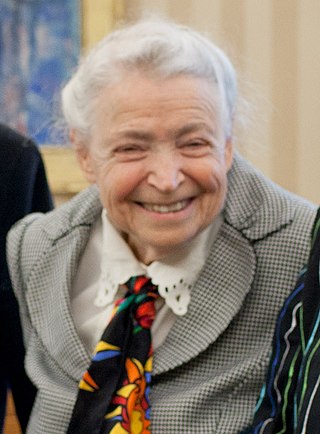
Mildred Dresselhaus, known as the "Queen of Carbon Science", was an American physicist, materials scientist, and nanotechnologist. She was an institute professor and professor of both physics and electrical engineering at the Massachusetts Institute of Technology. She also served as the president of the American Physical Society, the chair of the American Association for the Advancement of Science, as well as the director of science in the US Department of Energy under the Bill Clinton Government. Dresselhaus won numerous awards including the Presidential Medal of Freedom, the National Medal of Science, the Enrico Fermi Award, the Kavli Prize and the Vannevar Bush Award.

Armand Paul Alivisatos is an American chemist and academic administrator who has served as the 14th president of the University of Chicago since September 2021. He is a pioneer in nanomaterials development and an authority on the fabrication of nanocrystals and their use in biomedical and renewable energy applications. He was ranked fifth among the world's top 100 chemists for the period 2000–2010 in the list released by Thomson Reuters.

The Journal of Organic Chemistry, colloquially known as JOC, is a peer-reviewed scientific journal for original contributions of fundamental research in all branches of theory and practice in organic and bioorganic chemistry. It is published by the publishing arm of the American Chemical Society, with 24 issues per year. According to the Journal Citation Reports, the journal had a 2017 impact factor of 4.805 and it is the journal that received the most cites in the field of organic chemistry. According to Web of Knowledge, eleven papers from the journal have received more than 1,000 citations, with the most cited paper having received 7,967 citations. The current editor-in-chief is Scott J. Miller from Yale University.

ACS Combinatorial Science, formerly Journal of Combinatorial Chemistry (1999-2010), was a peer-reviewed scientific journal, published since 1999 by the American Chemical Society. ACS Combinatorial Science publishes articles, reviews, perspectives, accounts and reports in the field of Combinatorial Chemistry.
The ACS Style is a set of standards for writing documents relating to chemistry, including a standard method of citation in academic publications, developed by the American Chemical Society (ACS).
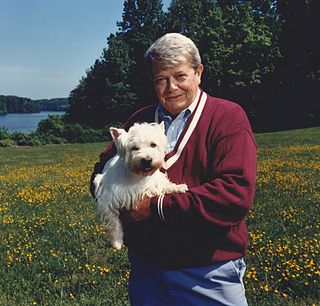
Howard Ensign Simmons Jr. was an American chemist with DuPont who discovered the Simmons–Smith reaction.

Biomacromolecules is a peer-reviewed scientific journal published since 2000 by the American Chemical Society. It is abstracted and indexed in Chemical Abstracts Service, Scopus, EBSCOhost, PubMed, and Science Citation Index Expanded.
The award, sponsored by The Camille and Henry Dreyfus Foundation, was instituted in 1993 with the intention of recognizing "significant accomplishments by individuals who have stimulated or fostered the interest of women in chemistry, promoting their professional development as chemists or chemical engineers." Recipients receive $5,000, a certificate, up to $1,500 for travel expenses, and a grant of $10,000. The deadline for nomination is 1 November every year.
Melanie Sarah Sanford is an American chemist, currently the Moses Gomberg Distinguished University Professor of Chemistry and Arthur F. Thurnau Professor of Chemistry at the University of Michigan. She is a Fellow for the American Association for the Advancement of Science, and was elected a member of the National Academy of Sciences and the American Academy of Arts and Sciences in 2016. She has served as an executive editor of the Journal of the American Chemical Society since 2021, having been an associate editor of the since 2014.

ACS Macro Letters is a peer-reviewed scientific journal published by the American Chemical Society. As of 2017, ACS Macro Letters has the highest impact factor of any journal in the field of polymer science (6.131). With the launch of ACS Macro Letters, all Communications to the Editor that were formerly published in Macromolecules will be published as Letters in ACS Macro Letters. Researchers are advised turn to ACS Macro Letters for reports of early, urgent results in polymer science and to Macromolecules for more detailed discussions of comprehensive research findings.
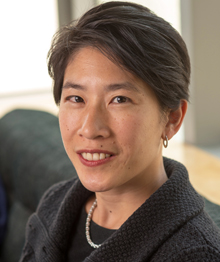
Teri W. Odom is an American chemist and materials scientist. She is the chair of the chemistry department, the Joan Husting Madden and William H. Madden, Jr. Professor of Chemistry, and a professor of materials science and engineering at Northwestern University. She is affiliated with the university's International Institute for Nanotechnology, Chemistry of Life Processes Institute, Northwestern Initiative for Manufacturing Science and Innovation, Interdisciplinary Biological Sciences Graduate Program, and department of applied physics.
Kourosh Kalantar-zadeh is an Australian scientist involved in research in the fields of materials sciences, electronics, and transducers. He is best known for his works on two-dimensional semiconductors, ingestible sensors and liquid metals. He led his group to the invention of an ingestible chemical sensor: human gas sensing capsule.
Karl Frederick Freed is an American theoretical chemist recognized for his research in polymer physics. Freed has spent his academic career in the department of chemistry and the James Frank Institute at the University of Chicago, where he is the Henry G. Gale Distinguished Service Professor emeritus. He is a member of the American Academy of Arts and Sciences, a Fellow of the American Physical Society, and was awarded the Polymer Physics Prize of the American Physical Society in 2014 and the Award in Pure Chemistry by the American Chemical Society in 1976.
Gabriela S. Schlau-Cohen is a Thomas D. and Virginia W. Cabot Career Development Associate Professor at MIT in the Department of Chemistry.
José Luis Jiménez-Palacios is a Spanish–American chemist and engineer. As a professor of chemistry at the University of Colorado Boulder, Jimenez contributed to the establishment of the Aerodyne Aerosol Mass Spectrometer, an instrument for real-time analysis of aerosol size and composition.
References
- ↑ "Doug Worsnop". aaas.org. Retrieved April 24, 2017.
- ↑ "Douglas Worsnop". aerodyne.com. Retrieved April 24, 2017.
- ↑ Societas Scientiarum Fennica SPHINX Yearbook 2019-2020. Helsinki, Finland: The Finnish Society of Sciences and Letters. 2020. p. 228. ISBN 978-951-653-453-7.
- ↑ https://cen.acs.org/articles/95/i1/ACS-Award-Creative-Advances-Environmental.html
 | This biographical article about a climatologist or meteorologist is a stub. You can help Wikipedia by expanding it. |
   | This article about an American scientist is a stub. You can help Wikipedia by expanding it. |