
Apparent magnitude is a measure of the brightness of a star or other astronomical object. An object's apparent magnitude depends on its intrinsic luminosity, its distance, and any extinction of the object's light caused by interstellar dust along the line of sight to the observer.
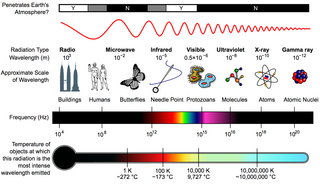
The electromagnetic spectrum is the spectrum of electromagnetic radiation, ranging over a domain of frequencies and their respective wavelengths and photon energies.

Infrared is electromagnetic radiation (EMR) in the spectral band between microwaves and visible light. It is invisible to the human eye. IR is generally understood to encompass wavelengths from around 750 nm to 1000 μm.

In physics, a redshift is an increase in the wavelength, and corresponding decrease in the frequency and photon energy, of electromagnetic radiation. The opposite change, a decrease in wavelength and simultaneous increase in frequency and energy, is known as a blueshift, or negative redshift. The terms derive from the colours red and blue which form the extremes of the visible light spectrum. The main causes of electromagnetic redshift in astronomy and cosmology are the relative motions of radiation sources, which give rise to the relativistic Doppler effect, and gravitational potentials, which gravitationally redshift escaping radiation. All sufficiently distant light sources show cosmological redshift corresponding to recession speeds proportional to their distances from Earth, a fact known as Hubble's law that implies the universe is expanding.

Compton scattering is the quantum theory of high frequency photons scattering following an interaction with a charged particle, usually an electron. Specifically, when the photon hits electrons, it releases loosely bound electrons from the outer valence shells of atoms or molecules.

Seyfert galaxies are one of the two largest groups of active galaxies, along with quasars. They have quasar-like nuclei with very high surface brightnesses whose spectra reveal strong, high-ionisation emission lines, but unlike quasars, their host galaxies are clearly detectable.

Photometry, from Greek photo- ("light") and -metry ("measure"), is a technique used in astronomy that is concerned with measuring the flux or intensity of light radiated by astronomical objects. This light is measured through a telescope using a photometer, often made using electronic devices such as a CCD photometer or a photoelectric photometer that converts light into an electric current by the photoelectric effect. When calibrated against standard stars of known intensity and colour, photometers can measure the brightness or apparent magnitude of celestial objects.

The Hubble Deep Field (HDF) is an image of a small region in the constellation Ursa Major, constructed from a series of observations by the Hubble Space Telescope. It covers an area about 2.6 arcminutes on a side, about one 24-millionth of the whole sky, which is equivalent in angular size to a tennis ball at a distance of 100 metres. The image was assembled from 342 separate exposures taken with the Space Telescope's Wide Field and Planetary Camera 2 over ten consecutive days between December 18 and 28, 1995.
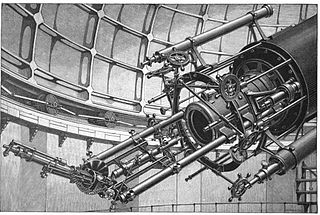
Astronomical spectroscopy is the study of astronomy using the techniques of spectroscopy to measure the spectrum of electromagnetic radiation, including visible light, ultraviolet, X-ray, infrared and radio waves that radiate from stars and other celestial objects. A stellar spectrum can reveal many properties of stars, such as their chemical composition, temperature, density, mass, distance and luminosity. Spectroscopy can show the velocity of motion towards or away from the observer by measuring the Doppler shift. Spectroscopy is also used to study the physical properties of many other types of celestial objects such as planets, nebulae, galaxies, and active galactic nuclei.

Observational astronomy is a division of astronomy that is concerned with recording data about the observable universe, in contrast with theoretical astronomy, which is mainly concerned with calculating the measurable implications of physical models. It is the practice and study of observing celestial objects with the use of telescopes and other astronomical instruments.

The Hubble Ultra-Deep Field (HUDF) is a deep-field image of a small region of space in the constellation Fornax, containing an estimated 10,000 galaxies. The original data for the image was collected by the Hubble Space Telescope from September 2003 to January 2004. It includes light from galaxies that existed about 13 billion years ago, some 400 to 800 million years after the Big Bang.
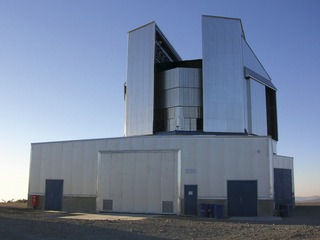
The VISTA is a wide-field reflecting telescope with a 4.1 metre mirror, located at the Paranal Observatory in Chile. It is operated by the European Southern Observatory and started science operations in December 2009. VISTA was conceived and developed by a consortium of universities in the United Kingdom led by Queen Mary University of London and became an in-kind contribution to ESO as part of the UK's accession agreement, with the subscription paid by the UK Science and Technology Facilities Council (STFC).
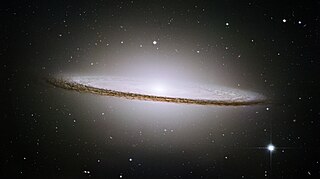
The Sombrero Galaxy is a peculiar galaxy of unclear classification in the constellation borders of Virgo and Corvus, being about 9.55 megaparsecs from the Milky Way galaxy. It is a member of the Virgo II Groups, a series of galaxies and galaxy clusters strung out from the southern edge of the Virgo Supercluster. It has an isophotal diameter of approximately 29.09 to 32.32 kiloparsecs, making it slightly bigger in size than the Milky Way.
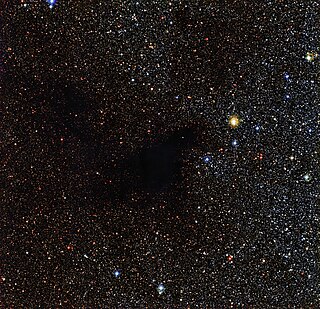
In astronomy, extinction is the absorption and scattering of electromagnetic radiation by dust and gas between an emitting astronomical object and the observer. Interstellar extinction was first documented as such in 1930 by Robert Julius Trumpler. However, its effects had been noted in 1847 by Friedrich Georg Wilhelm von Struve, and its effect on the colors of stars had been observed by a number of individuals who did not connect it with the general presence of galactic dust. For stars lying near the plane of the Milky Way which are within a few thousand parsecs of the Earth, extinction in the visual band of frequencies is roughly 1.8 magnitudes per kiloparsec.
In astronomy, a photometric system is a set of well-defined passbands, with a known sensitivity to incident radiation. The sensitivity usually depends on the optical system, detectors and filters used. For each photometric system a set of primary standard stars is provided.
A color–color diagram is a means of comparing the colors of an astronomical object at different wavelengths. Astronomers typically observe at narrow bands around certain wavelengths, and objects observed will have different brightnesses in each band. The difference in brightness between two bands is referred to as color. On color–color diagrams, the color defined by two wavelength bands is plotted on the horizontal axis, and the color defined by another brightness difference will be plotted on the vertical axis.

GRB 970508 was a gamma-ray burst (GRB) detected on May 8, 1997, at 21:42 UTC; it is historically important as the second GRB with a detected afterglow at other wavelengths, the first to have a direct redshift measurement of the afterglow, and the first to be detected at radio wavelengths.
Lyman-break galaxies are star-forming galaxies at high redshift that are selected using the differing appearance of the galaxy in several imaging filters due to the position of the Lyman limit. The technique has primarily been used to select galaxies at redshifts of z = 3–4 using ultraviolet and optical filters, but progress in ultraviolet astronomy and in infrared astronomy has allowed the use of this technique at lower and higher redshifts using ultraviolet and near-infrared filters.

UDFy-38135539 is the Hubble Ultra Deep Field (UDF) identifier for a galaxy which was calculated as of October 2010 to have a light travel time of 13.1 billion years with a present proper distance of around 30 billion light-years.
This is a list of infrared topics.

