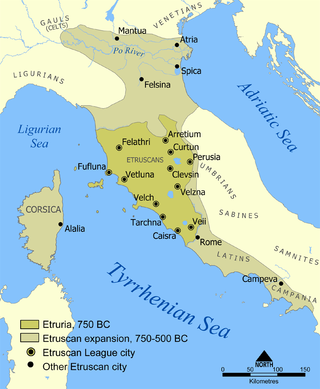
Etruria was a region of Central Italy delimited by the rivers Arno and Tiber, an area that covered what is now most of Tuscany, northern Lazio, and north-western Umbria.

A grand duchy is a country or territory whose official head of state or ruler is a monarch bearing the title of grand duke or grand duchess.
This article deals with the history of Tuscany.

The Duchy of Modena and Reggio was an Italian state created in 1452 located in Northwestern Italy, in the present day region of Emilia-Romagna. It was ruled since its establishment by the noble House of Este, and since 1814 by the Austria-Este branch of the family. The Este dynasty was a great sponsor of the arts, making the Duchy a cultural reference during the Renaissance and Baroque periods.

The Duca della Repubblica Fiorentina, rendered in English as Duke of the Florentine Republic or Duke of the Republic of Florence, was a title created in 1532 by Pope Clement VII for the Medici family, which ruled the Republic of Florence. There were effectively only two dukes of the Republic of Florence, Alessandro de' Medici and Cosimo de' Medici, the second duke being elevated to Grand Duke of Tuscany, causing the Florentine title to become subordinate to the greater Tuscan title.

The United Provinces of Central Italy, also known as the Confederation of Central Italy or General Government of Central Italy, was a short-lived military government established by the Kingdom of Piedmont-Sardinia. It was formed by a union of the former Grand Duchy of Tuscany, Duchy of Parma, Duchy of Modena, and the Papal Legations, after the Second Italian War of Independence.
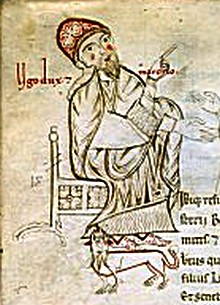
Hugh, called the Great, was the Margrave of Tuscany from 969 until his death in 1001, and the Duke of Spoleto and Margrave of Camerino from 989 to 996. He was known for his restoration of the state apparatus in Tuscany after decades of neglect from various Margraves, whose main interests lay elsewhere. Hugh was also noted for his support of the new Ottonian dynasty, and has been praised for his justice by the contemporary theologian Peter Damian in his De principis officio. Hugh's rule has also been remembered for its close cooperation with the Papal States in the resolution of territorial disputes and his generosity in gifting marchesal (public) lands for the foundation of monasteries of the Catholic Church.

The Duchy of Florence was an Italian principality that was centred on the city of Florence, in Tuscany, Italy. The duchy was founded after Pope Clement VII, himself a Medici, appointed his relative Alessandro de' Medici as Duke of the Florentine Republic, thereby transforming the Republic of Florence into a hereditary monarchy.

The March of Tuscany was a march of the Kingdom of Italy and the Holy Roman Empire during the Middle Ages. Located in northwestern central Italy, it bordered the Papal States to the south, the Ligurian Sea to the west and Lombardy to the north. It comprised a collection of counties, largely in the valley of the Arno River, originally centered on Lucca.
Tuscany is one of the 20 regions of Italy.
Emilia is a historical region of northern Italy, which approximately corresponds to the western and the north-eastern portions of the modern region of Emilia-Romagna, with the area of Romagna forming the remainder of the modern region.
The Duchy of Tuscia, initially known as the Duchy of Lucca, was a Lombard duchy in Central Italy, which included much of today's Tuscany. After the occupation of the territories belonging to the Byzantines, the Lombards founded this flourishing duchy which, among other centres, also included Florence. The capital of the duchy was Lucca, which was located along the Via Francigena, being also the city where the duke resided.
Between 1851 and 1860, the Grand Duchy of Tuscany, an independent Italian state until 1859 when it joined the United Provinces of Central Italy, produced two postage stamp issues which are among the most prized classic stamp issues of the world, and include the most valuable Italian stamp.
Langobardia or Longobardia may refer to:
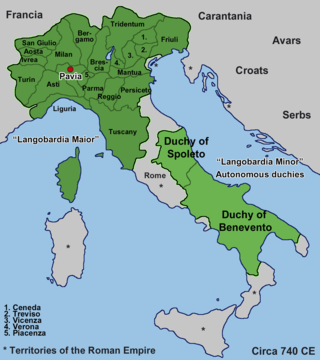
Langobardia Major was the name that, in the Early Middle Ages, was given to the domains of the Lombard Kingdom in Northern Italy. It comprised Lombardy proper with its capital Pavia, the Duchies of Friuli and Trent as well as the Tuscany region. In the south, it was bordered by the Patrimonium Sancti Petri, which would become the Papal States following the 754 Donation of Pepin, stretching from the Tyrrhenian to the Adriatic Sea. The Lombard territories further to the south were called Langobardia Minor, consisting of the Duchies of Spoleto and Benevento.
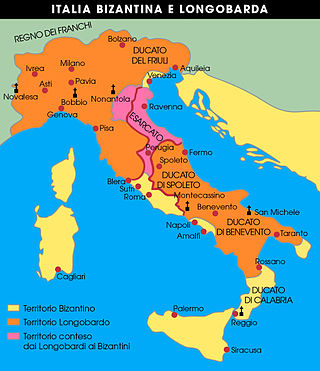
The Duchy of Perugia was a duchy in the Italian part of the Byzantine Empire. Its civil and military administration was overseen by a duke (dux) appointed by and under the authority originally of the Praetorian Prefect of Italy (554–584) and later of the Exarch of Ravenna (584–751). Its chief city and namesake was Perugia (Perusia), located at its centre. It was a band of territory connecting the Duchy of the Pentapolis to its northeast with the Duchy of Rome to its southwest, and separating the duchies of Tuscia and Spoleto, both parts of the Lombard Kingdom of Italy. It was of great strategic significance to the Byzantines since it provided communication between Rome, the city of the Popes, and Ravenna, the capital of the Exarchate. Since it cut off the Duke of Spoleto from his nominal overlord, the king ruling from Pavia, it also disturbed the Lombard kingdom, which was a constant thorn in the Byzantines' side. This strategic importance meant that many Lombard and Byzantine armies passed through it.

The flag of Tuscany is the official flag of the region of Tuscany, Italy. The flag depicts a silver Pegasus rampant on a white field between two horizontal red bands. The flag first appeared as a gonfalon on 20 May 1975 along with accompanying text Regione Toscana above the Pegasus. It was officially adopted as the flag of Tuscany on 3 February 1995.
