
Chester Castle is in the city of Chester, Cheshire, England. It is sited at the southwest extremity of the area bounded by the city walls. The castle stands on an eminence overlooking the River Dee. In the castle complex are the remaining parts of the medieval castle together with the neoclassical buildings designed by Thomas Harrison which were built between 1788 and 1813. Parts of the neoclassical buildings are used today as Crown Courts and as a military museum. The museum and the medieval remains are a tourist attraction.

Philip Hardwick was an English architect, particularly associated with railway stations and warehouses in London and elsewhere. Hardwick is probably best known for London's demolished Euston Arch and its twin station, the original Birmingham Curzon Street, which stands today as the oldest railway terminus building in the world.

The Royal Courts of Justice, commonly called the Law Courts, is a court building in Westminster which houses the High Court and Court of Appeal of England and Wales. The High Court also sits on circuit and in other major cities. Designed by George Edmund Street, who died before it was completed, it is a large grey stone edifice in the Victorian Gothic style built in the 1870s and opened by Queen Victoria in 1882. It is one of the largest courts in Europe. It is a Grade I listed building.
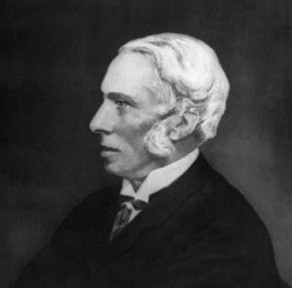
Richard Norman Shaw RA, also known as Norman Shaw, was a British architect who worked from the 1870s to the 1900s, known for his country houses and for commercial buildings. He is considered to be among the greatest of British architects; his influence on architectural style was strongest in the 1880s and 1890s.
Thomas Rickman was an English architect and architectural antiquary who was a major figure in the Gothic Revival. He is particularly remembered for his Attempt to Discriminate the Styles of English Architecture (1817), which established the basic chronological classification and terminology that are still in widespread use for the different styles of English medieval ecclesiastical architecture.

Streamline Moderne is an international style of Art Deco architecture and design that emerged in the 1930s. Inspired by aerodynamic design, it emphasized curving forms, long horizontal lines, and sometimes nautical elements. In industrial design, it was used in railroad locomotives, telephones, toasters, buses, appliances, and other devices to give the impression of sleekness and modernity.
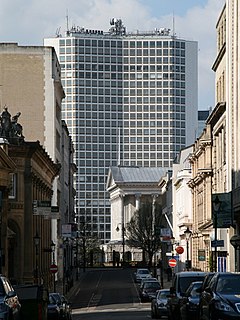
Although Birmingham in England has existed as a settlement for over a thousand years, today's city is overwhelmingly a product of the 18th, 19th, and 20th centuries, with little surviving from its early history. As it has expanded, it has acquired a variety of architectural styles. Buildings of most modern architectural styles in the United Kingdom are located in Birmingham. In recent years, Birmingham was one of the first cities to exhibit the blobitecture style with the construction of the Selfridges store at the Bullring Shopping Centre.
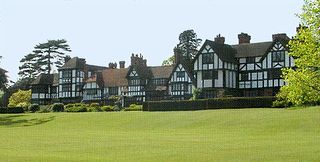
Tudor Revival architecture first manifested itself in domestic architecture in the United Kingdom in the latter half of the 19th century. Based on revival of aspects that were perceived as Tudor architecture, in reality it usually took the style of English vernacular architecture of the Middle Ages that had survived into the Tudor period. The style later became an influence elsewhere, especially the British colonies. For example, in New Zealand, the architect Francis Petre adapted the style for the local climate. In Singapore, then a British colony, architects such as R. A. J. Bidwell pioneered what became known as the Black and White House. The earliest examples of the style originate with the works of such eminent architects as Norman Shaw and George Devey, in what at the time was considered Neo-Tudor design.

Donald Hanks McMorran RA FRIBA FSA was an English architect who is known today for his sensitive continuation of the neo-Georgian and classical tradition in the period after the Second World War. His buildings include halls of residence at the University of Nottingham, Wood Street Police Station in the City of London, public housing schemes around London, the South Block extension to the Old Bailey and civic buildings in Exeter and Bury St Edmunds.

George Gaze Pace, was an English architect who specialised in ecclesiastical works.

John Foulston was an English architect who was a pupil of Thomas Hardwick and set up a practice in London in 1796. In 1810 he won a competition to design the Royal Hotel and Theatre group of buildings in Plymouth, Devon, and after relocating he remained Plymouth's leading architect for twenty-five years.

Edward Salomons (1828–1906) was an English architect based in Manchester, active in the late 19th century. He is known for his architecture in the Gothic Revival and Italianate styles.

Cecil Aubrey Masey was an English theatre and cinema architect, born on 28 December 1880 in Lambeth, London. Masey was a pupil of Bertie Crewe - with whom he worked on the Empire music hall in Edmonton of 1908 - and from 1909, he went into partnership with architect Roy Young.
Clayton & Black were a firm of architects and surveyors from Brighton, part of the English city of Brighton and Hove. In a career spanning the Victorian, Edwardian and interwar eras, they were responsible for designing and constructing an eclectic range of buildings in the growing town of Brighton and its neighbour Hove. Their work encompassed new residential, commercial, industrial and civic buildings, shopping arcades, churches, schools, cinemas and pubs, and alterations to hotels and other buildings. Later reconstituted as Clayton, Black & Daviel, the company designed some churches in the postwar period.
Joseph Stretch Crowther was an English architect who practised in Manchester. His buildings are mainly located in Manchester, Cheshire and Cumbria.
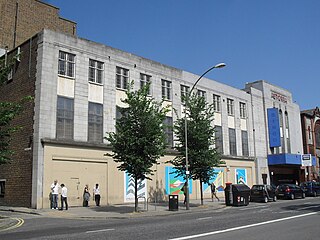
The Astoria Theatre was a former cinema in Brighton, part of the English coastal city of Brighton and Hove. Built in 1933 in the Art Deco style for a local entertainment magnate who opened one of Brighton's first cinemas many years earlier, it was the first and most important expansion of the Astoria brand outside London. It initially struggled against the town's other "super-cinemas", but enjoyed a period of success in the 1950s and 1960s before rapid decline set in, culminating in its closure in 1977.

Heathcote is a Neoclassical style villa in Ilkley, West Yorkshire, England. Designed by architect Edwin Lutyens, it was his first comprehensive use of that style, making it the precursor of his later public buildings in Edwardian Baroque style and those of New Delhi. It was completed in 1908.
Thomas Simpson (1825–1908) was a British architect associated with the seaside town of Brighton. As architect to the Brighton and Preston School Board and the equivalent institution in neighbouring Hove, he designed "a distinguished group of board schools" during the late 19th century, when the provision of mass education was greatly extended. Many of these schools survive and some have listed status. He also worked on five Nonconformist chapels for various Christian denominations, using a wide variety of materials and architectural styles. He was the father of Sir John William Simpson and Gilbert Murray Simpson, who both became architects.

The Regal Cinema is a former cinema building in an Egyptian Revival architectural style in High Street, Uxbridge, in the London Borough of Hillingdon. It became the ABC Regal, then Discothèque Royale, and is now a branch of the Liquid nightclub chain.

Frederic Chancellor, was an English architect and surveyor who spent much of his career in the city of Chelmsford, Essex, and its surrounding areas. His works included private houses, municipal buildings, churches, parsonages, banks and schools. It was during his later career that he concentrated on ecclesiastical buildings for which he became best known. Around 730 buildings have been attributed to him, 570 of which are in Essex.
