Related Research Articles
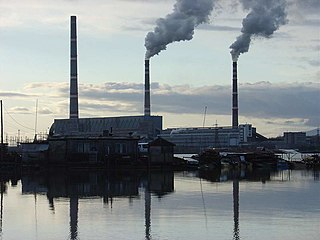
A carbon tax is a tax levied on the carbon emissions required to produce goods and services. Carbon taxes are intended to make visible the "hidden" social costs of carbon emissions, which are otherwise felt only in indirect ways like more severe weather events. In this way, they are designed to reduce carbon dioxide (CO
2) emissions by increasing prices of the fossil fuels that emit them when burned. This both decreases demand for goods and services that produce high emissions and incentivizes making them less carbon-intensive. In its simplest form, a carbon tax covers only CO2 emissions; however, it could also cover other greenhouse gases, such as methane or nitrous oxide, by taxing such emissions based on their CO2-equivalent global warming potential. When a hydrocarbon fuel such as coal, petroleum, or natural gas is burned, most or all of its carbon is converted to CO
2. Greenhouse gas emissions cause climate change, which damages the environment and human health. This negative externality can be reduced by taxing carbon content at any point in the product cycle. Carbon taxes are thus a type of Pigovian tax.
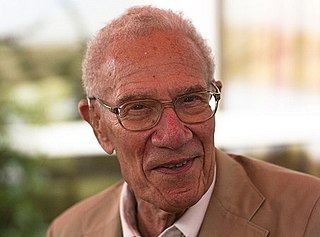
Robert Merton Solow, GCIH is an American economist whose work on the theory of economic growth culminated in the exogenous growth model named after him. He is currently Emeritus Institute Professor of Economics at the Massachusetts Institute of Technology, where he has been a professor since 1949. He was awarded the John Bates Clark Medal in 1961, the Nobel Memorial Prize in Economic Sciences in 1987, and the Presidential Medal of Freedom in 2014. Four of his PhD students, George Akerlof, Joseph Stiglitz, Peter Diamond and William Nordhaus later received Nobel Memorial Prizes in Economic Sciences in their own right.

Roger A. Pielke Jr. is an American political scientist and professor, and was the director of the Sports Governance Center within the Department of Athletics at the Center for Science and Technology Policy Research at the University of Colorado Boulder.

Nicholas Herbert Stern, Baron Stern of Brentford, is a British economist, banker, and academic. He is the IG Patel Professor of Economics and Government and Chair of the Grantham Research Institute on Climate Change and the Environment at the London School of Economics (LSE), and 2010 Professor of Collège de France. He was President of the British Academy from 2013 to 2017, and was elected Fellow of the Royal Society in 2014.
Ted Halstead was an American author, policy entrepreneur, and public speaker who founded four non-profit think tanks and advocacy organizations: the Climate Leadership Council, Americans for Carbon Dividends, New America, and Redefining Progress. His areas of expertise included climate policy, economic policy, environmental policy, healthcare, and political reform.

Paul Michael Romer is an American economist and policy entrepreneur who is a University Professor in Economics at New York University. Romer is best known as the former Chief Economist of the World Bank and for co-receiving the 2018 Nobel Memorial Prize in Economic Sciences for his work in endogenous growth theory. He also coined the term "mathiness," which he describes as misuse of mathematics in economic research.

William Dawbney Nordhaus is an American economist, a Sterling Professor of Economics at Yale University, best known for his work in economic modeling and climate change, and one of the 2 recipients of the 2018 Nobel Memorial Prize in Economic Sciences. Nordhaus received the prize "for integrating climate change into long-run macroeconomic analysis".
The Stern Review on the Economics of Climate Change is a 700-page report released for the Government of the United Kingdom on 30 October 2006 by economist Nicholas Stern, chair of the Grantham Research Institute on Climate Change and the Environment at the London School of Economics (LSE) and also chair of the Centre for Climate Change Economics and Policy (CCCEP) at Leeds University and LSE. The report discusses the effect of global warming on the world economy. Although not the first economic report on climate change, it is significant as the largest and most widely known and discussed report of its kind.
Patrick David Henderson was a British economist. He was the chief economist at the Economics and Statistics Department at the OECD during 1984–1992. Before that he worked as an academic economist in Britain, first at Oxford and later at University College London ; as a British civil servant ; and as a staff member of the World Bank (1969–1975). In 1985 he gave the BBC Reith Lectures, which were published in the book Innocence and Design: The Influence of Economic Ideas on Policy.

Carbon pricing, also known as cap and trade (CAT) or emissions trading scheme (ETS), is a method for nations to reduce global warming. The cost is applied to greenhouse gas emissions in order to encourage polluters to reduce the combustion of coal, oil and gas – the main driver of climate change. The method is widely agreed and considered to be efficient. Carbon pricing seeks to address the economic problem that emissions of CO2 and other greenhouse gases (GHG) are a negative externality – a detrimental product that is not charged for by any market.

The Kaya identity is a mathematical identity stating that the total emission level of the greenhouse gas carbon dioxide can be expressed as the product of four factors: human population, GDP per capita, energy intensity, and carbon intensity. It is a concrete form of the more general I = PAT equation relating factors that determine the level of human impact on climate. Although the terms in the Kaya identity would in theory cancel out, it is useful in practice to calculate emissions in terms of more readily available data, namely population, GDP per capita, energy per unit GDP, and emissions per unit energy. It furthermore highlights the elements of the global economy on which one could act to reduce emissions, notably the energy intensity per unit GDP and the emissions per unit energy.
Stephen DeCanio is a Professor of economics, emeritus, at the University of California, Santa Barbara. His current research deals with the impact of artificial intelligence on society, the economy, and culture. His recent research has also addressed the consequences of computational limits for economics and social theory more generally. He has published books and articles in the fields of global environmental protection and energy economics, the theory of the firm, and economic history. He studied mathematics as an undergraduate at the University of California, Berkeley and received his Ph.D in economics from the Massachusetts Institute of Technology in 1972. After teaching at Tufts University (1970–72) and Yale University (1972-78), he joined the faculty at UCSB in 1978. From 1986 to '87 he was the Senior Staff Economist at the President's Council of Economic Advisors. He was also a member of the United Nations Environment Programme Economic Options Panel, which reviewed the economic aspects of the Montreal Protocol on Substances that Deplete the Ozone Layer.
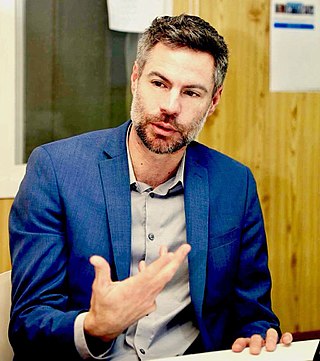
Michael D. Shellenberger is an American author, journalist, activist, and former public relations professional whose writing has focused on the environment, climate change, nuclear power, and political responses to homelessness, drug addiction and mental illness. He is a co-founder of the Breakthrough Institute and the California Peace Coalition. He is also the founder of Environmental Progress.
The green national product is an economic metric that seeks to include environmental features such as environmental degradation and resource depletion with a country's national product.

The economics of climate change mitigation is the part of the economics of climate change related to climate change mitigation, that is actions that are designed to limit the amount of long-term climate change. Mitigation may be achieved through the reduction of greenhouse gas (GHG) emissions and the enhancement of sinks that absorb GHGs, for example forests.
This article is about certain views on the Kyoto Protocol to the United Nations Framework Convention on Climate Change.
Ted Nordhaus is an American author and the director of research at The Breakthrough Institute. He has co-edited and written a number of books, including Break Through: From the Death of Environmentalism to the Politics of Possibility (2007) and An Ecomodernist Manifesto (2015) with collaborator Michael Shellenberger.
The Breakthrough Institute is an environmental research center located in Oakland, California. Founded in 2007 by Michael Shellenberger and Ted Nordhaus, The institute is aligned with ecomodernist philosophy. The institute advocates for an embrace of modernization, technological development, and increasing U.S. economic growth, usually through a combination of nuclear power and urbanization.
The Dynamic Integrated Climate-Economy model, referred to as the DICE model or Dice model, is a neoclassical integrated assessment model developed by 2018 Nobel Laureate William Nordhaus that integrates in the neoclassical economics, carbon cycle, climate science, and estimated impacts allowing the weighing of subjectively guessed costs and subjectively guessed benefits of taking steps to slow climate change. Nordhaus also developed the RICE model, a variant of the DICE model that was updated and developed alongside the DICE model. Researchers who collaborated with Nordhaus to develop the model include David Popp, Zili Yang, and Joseph Boyer.
Suzi Clare Kerr is a New Zealand economist. She joined Environmental Defense Fund in 2019 as its chief economist.
References
- 1 2 Passell, Peter (13 February 1997). "Yawn. A global-warming alert. But this one has solutions". No. Business Day. The New York Times. Retrieved 30 April 2016.
- 1 2 3 4 5 6 7 "The Economists' Statement on Climate Change". Redefining Progress. Archived from the original on 4 March 2016. Retrieved 30 April 2016.
- 1 2 3 The Library of Congress, THOMAS. "Committee Reports 105th Congress (1997-1998), Senate Report 105-054". The Library of Congress, THOMAS. The Library of Congress. Retrieved 30 April 2016.[ permanent dead link ]
- ↑ "Ted Halstead". New America. Retrieved 2 June 2016.
- 1 2 Morin, Richard; Deane, Claudia (Dec 10, 2001). "Big Thinker: Ted Halstead's New America Foundation Has It All: Money, Brains and Buzz". The Washington Post. No. p C.01.
- ↑ "About Redefining Progress". Redefining Progress. Archived from the original on 4 April 2016. Retrieved 30 April 2016.
- ↑ DeCanio, Stephen (October 1997). "The Economics of Climate Change" (PDF). Redefining Progress. Archived from the original (PDF) on 17 October 2015. Retrieved 30 April 2016.
- ↑ Krugman, Paul. "Earth in the Balance Sheet: Economists go for the green". No. 17 April 1997. Slate. Retrieved 30 April 2016.