
Edmond Du Sommerard (27 April 1817, Paris - 6 February 1885, Paris) was a French museum conservator.
Edmond Du Sommerard (27 April 1817, Paris - 6 February 1885, Paris) was a French museum conservator.
His father, Alexandre Du Sommerard, created what became the Musée de Cluny, and he served as its first curator. [1] As the Commissoner General of expositions from 1871 to 1878, he developed the museum's collection of works from the Middle Ages and Renaissance, increasing it from about 1,400 pieces to over 10,000. His most notable addition was a famous series of six tapestries, known as The Lady and the Unicorn .
He completed his father's work, Arts au moyen âge, en ce qui concerne principalement le Palais romain de Paris, l’Hôtel de Cluny, issu de ses ruines, et les objets d’art de la collection classée dans cet hôtel, which had been left unfinished when he died. On his own, he wrote a Catalogue et description des objets d’art de l’antiquité, du moyen âge et de la Renaissance, exposés au Musée.
He was a member of the Institut de France. In 1882, he was elected to the Académie des Beaux-Arts, where he took Seat #6 in the "Unattached" section; succeeding Charles Blanc (deceased).

The Musée de Cluny, officially Musée de Cluny-Musée National du Moyen Âge, is a museum of medieval art in Paris. It is located in the 5th arrondissement of Paris, bordered by square Samuel-Paty to the south, boulevard Saint-Michel to the west, boulevard Saint-Germain to the north, and rue Saint-Jacques to the east.
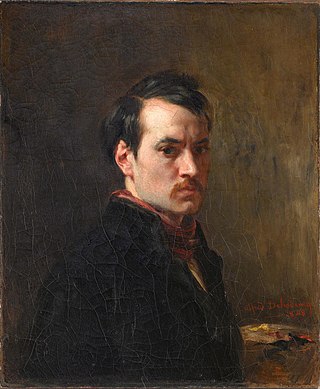
Alfred Dehodencq is a French Orientalist painter known for his vivid oil paintings of Andalusian and North African scenes.

The Musée national des Monuments Français is today a museum of plaster casts of French monuments located in the Palais de Chaillot, 1, place du Trocadéro et du 11 Novembre, Paris, France. It now forms part of the Cité de l'Architecture et du Patrimoine, and is open daily except Tuesday. An admission fee is charged.

Alexandre Du Sommerard was a French archaeologist and art collector.

The Musée de la Chartreuse is an art museum in a former Carthusian monastery in Douai, France. It is the 'musée des Beaux-Arts' for the city.
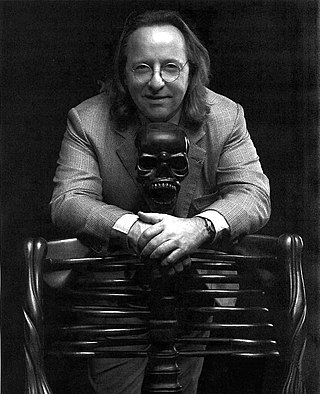
Bill G.B. Pallot is an art historian, art expert, collector and lecturer at the Sorbonne University . He was honored with the French distinction of Ordre des Arts et des Lettres Chevalier (1997) and he is now Officier in the same distinction (2011). In 2016, he was indicted for making and selling false eighteenth century furniture, some of which were sold to the Palace of Versailles.
Luc Benoist born Luc Didier Marie Benoist-Lucy (1893–1980) was a French essayist and art historian. He published many books about art history. His interests were centered on spirituality and symbolism.

Fernand Sabatté was a French painter and sculptor who is best known for his architectural painting and portrait work, as well as salvaging church monuments and bombed out churches in the zone rouge during World War I.
Gustave Achille Gaston Migeon was a French historian of the arts of the world.

Camille Enlart was a French archaeologist and art historian. His areas of special interest were the Middle Ages and photography.
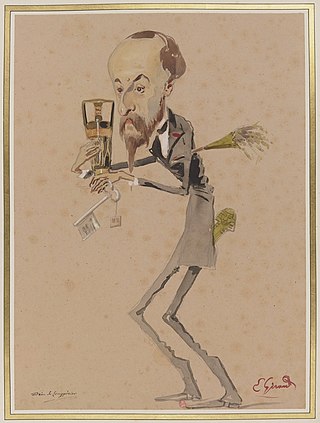
Henry Adrien Prévost de Longpérier was a 19th-century French numismatist, archaeologist and curator.
Émile Molinier was a 19th-century French curator and art historian.
Paul Dissard (1852–1926) was a French art historian, a specialist of Gallo-Roman culture. An epigrapher and curator at the Museum of Fine Arts of Lyon, he contributed with Auguste Allmer to change a fledgling science by confronting archaeological evidence and providing a reference documentation.

Auguste-Xavier Leprince was a French artist and painter who attained celebrity at the age of seventeen. His patrons included the Duchesse de Berry, Charles X, and Alexandre du Sommerard. He was also a teacher; in his twenties he established his own atelier in Paris, with pupils including his two younger brothers, Robert-Léopold and Pierre-Gustave, as well as Eugène Lepoittevin and Nicolas Alexandre Barbier. His meteoric career came to an abrupt end and his "brilliant promise was cut short by his premature death at the age of twenty-seven."
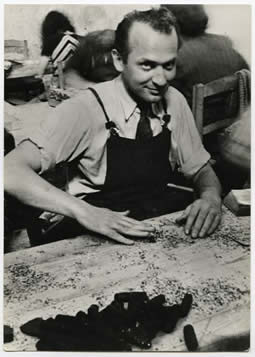
Jacques Hérold was a prominent surrealist painter born in Piatra Neamț, Romania.

Alain Erlande-Brandenburg was a French art historian and honorary general curator for heritage, a specialist on Gothic and Romanesque art.
Charles-Caius Renoux was a French painter, lithographer, and illustrator. He first achieved success with paintings of medieval churches, particularly the ruins of cloisters and monasteries destroyed during the French Revolution, works for which he is still best known. Renoux also painted landscapes, large-scale battle scenes, and historical subjects, works which uniquely prepared him for the final phase of his career, the creation of spectacular dioramas, the “moving pictures” of the era. He also taught at the École des Beaux-Arts in Paris; his notable students included Narcisse Berchère and Hector Hanoteau.
Antonin Personnaz was a French art collector and early colour photographer.

Xavier Dectot, born on June 8, 1973 in Pithiviers, is a French museum curator and art historian.

Alexandre-Albert Lenoir was a French art historian, archaeologist, and writer; best known for creating what is now known as the Musée de Cluny.
 Media related to Edmond Du Sommerard at Wikimedia Commons
| International | |
|---|---|
| National | |
| Other | |
   | This article about a French historian or genealogist is a stub. You can help Wikipedia by expanding it. |
