
An electrician is a tradesperson specializing in electrical wiring of buildings, transmission lines, stationary machines, and related equipment. Electricians may be employed in the installation of new electrical components or the maintenance and repair of existing electrical infrastructure. Electricians may also specialize in wiring ships, airplanes, and other mobile platforms, as well as data and cable lines.

The UL enterprise is a global private safety company headquartered in Northbrook, Illinois, composed of three organizations, UL Research Institutes, UL Standards & Engagement and UL Solutions.

A smoke detector is a device that senses smoke, typically as an indicator of fire. Smoke detectors/Alarms are usually housed in plastic enclosures, typically shaped like a disk about 125 millimetres (5 in) in diameter and 25 millimetres (1 in) thick, but shape and size vary. Smoke can be detected either optically (photoelectric) or by physical process (ionization). Detectors may use one or both sensing methods. Sensitive alarms can be used to detect and deter smoking in banned areas. Smoke detectors in large commercial and industrial buildings are usually connected to a central fire alarm system.
Electrical wiring in North America follows the regulations and standards applicable at the installation location. It is also designed to provide proper function, and is also influenced by history and traditions of the location installation.

The National Electrical Code (NEC), or NFPA 70, is a regionally adoptable standard for the safe installation of electrical wiring and equipment in the United States. It is part of the National Fire Code series published by the National Fire Protection Association (NFPA), a private trade association. Despite the use of the term "national," it is not a federal law. It is typically adopted by states and municipalities in an effort to standardize their enforcement of safe electrical practices. In some cases, the NEC is amended, altered and may even be rejected in lieu of regional regulations as voted on by local governing bodies.

In electronics and electrical engineering, a fuse is an electrical safety device that operates to provide overcurrent protection of an electrical circuit. Its essential component is a metal wire or strip that melts when too much current flows through it, thereby stopping or interrupting the current. It is a sacrificial device; once a fuse has operated, it is an open circuit, and must be replaced or rewired, depending on its type.

An arc-fault circuit interrupter (AFCI) or arc-fault detection device (AFDD) is a circuit breaker that breaks the circuit when it detects the electric arcs that are a signature of loose connections in home wiring. Loose connections, which can develop over time, can sometimes become hot enough to ignite house fires. An AFCI selectively distinguishes between a harmless arc, and a potentially dangerous arc.
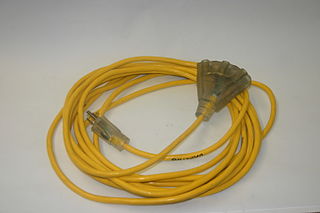
An extension cord (US), extension cable, power extender, drop cord, or extension lead (UK) is a length of flexible electrical power cable (flex) with a plug on one end and one or more sockets on the other end. The term usually refers to mains extensions but is also used to refer to extensions for other types of cabling. If the plug and power outlet are of different types, the term "adapter cord" may be used. Most extension cords range from around 2 to 30 feet in length although they are made up to 300 feet (91.44 m) in length.
A firestop or fire-stopping is a form of passive fire protection that is used to seal around openings and between joints in a fire-resistance-rated wall or floor assembly. Firestops are designed to maintain the fire-resistance rating of a wall or floor assembly intended to impede the spread of fire and smoke.

An arc flash is the light and heat produced as part of an arc fault, a type of electrical explosion or discharge that results from a connection through air to ground or another voltage phase in an electrical system.
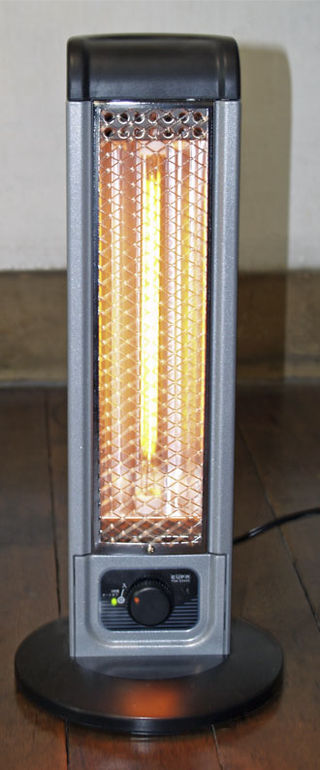
A space heater is a device used to heat a single, small- to medium-sized area. This type of heater can be contrasted with central heating, which distributes heat to multiple areas.
William Henry Merrill was an American electrical engineer who founded Underwriters Laboratories (UL) in 1894.
In electrical engineering, low voltage is a relative term, the definition varying by context. Different definitions are used in electric power transmission and distribution, compared with electronics design. Electrical safety codes define "low voltage" circuits that are exempt from the protection required at higher voltages. These definitions vary by country and specific codes or regulations.
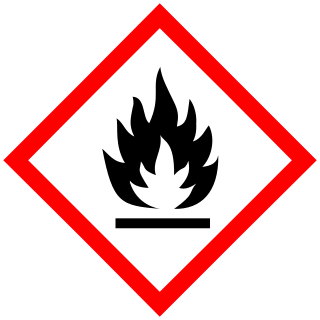
A combustible material is a material that can burn in air under certain conditions. A material is flammable if it ignites easily at ambient temperatures. In other words, a combustible material ignites with some effort and a flammable material catches fire immediately on exposure to flame.
Nationally Recognized Testing Laboratory is the term used by the United States Occupational Safety and Health Administration to identify third-party organizations that have the necessary qualifications to perform safety testing and certification of products covered within OSHA and each organization's scopes. The testing and certification are conducted in accordance with U.S. consensus-based product safety test standards developed or issued by U.S. standards organizations
Smoke dampers are passive fire protection products used in air conditioning and ventilation ductwork or installed in physical smoke barriers.
The Fire Sprinkler Incentive Act (FSIA) is the name of a piece of legislation that has been introduced in both the House and the Senate since 2003. The legislation would amend the 1986 Internal Revenue Code by classifying fire sprinkler retrofits as either a Section 179 depreciation deduction or a fifteen-year property for purposes of depreciation. Currently the tax depreciation time for commercial property is 39 years and 27.5 for residential.

Stab-Lok is a brand name of electrical circuit breakers that were manufactured primarily by Federal Pacific Electric from 1950 to 1980. In June 1980, Reliance Electric, which had purchased FPE, reported to the United States Consumer Product Safety Commission that "many FPE circuit breakers did not fully comply with Underwriters Laboratories, Inc. (UL) requirements. Commission testing confirmed that these breakers fail certain UL calibration test requirements." In 2018 it was reported that Stab-Lok breakers and panels, made by FPE and other companies, were still in use, and it was recommended that they be removed as a potential fire hazard.
Electrical safety is a system of organizational measures and technical means to prevent harmful and dangerous effects on workers from electric current, arcing, electromagnetic fields and static electricity.
Standards for alarm systems, installation and monitoring, are standards critical for ensuring safety, reliability, and interoperability. Various standards organizations, both international and regional, develop these guidelines and best practices. Globally recognized bodies such as ISO and IEC provide comprehensive frameworks applicable worldwide, while regional standards may cater to specific local requirements, enhancing the applicability and effectiveness of alarm systems in different environments.

