Related Research Articles
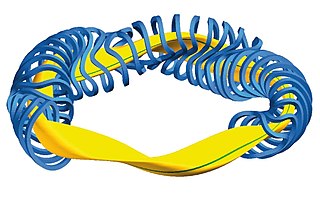
A stellarator is a plasma device that relies primarily on external magnets to confine a plasma. Scientists researching magnetic confinement fusion aim to use stellarator devices as a vessel for nuclear fusion reactions. The name refers to the possibility of harnessing the power source of the stars, such as the Sun. It is one of the earliest fusion power devices, along with the z-pinch and magnetic mirror.
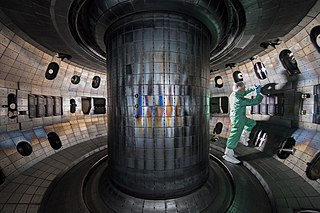
A tokamak is a device which uses a powerful magnetic field to confine plasma in the shape of a torus. The tokamak is one of several types of magnetic confinement devices being developed to produce controlled thermonuclear fusion power. As of 2016, it was the leading candidate for a practical fusion reactor. The word "tokamak" is derived from a Russian acronym meaning "toroidal chamber with magnetic coils".

In spacecraft propulsion, a Hall-effect thruster (HET) is a type of ion thruster in which the propellant is accelerated by an electric field. Hall-effect thrusters are sometimes referred to as Hall thrusters or Hall-current thrusters. Hall-effect thrusters use a magnetic field to limit the electrons' axial motion and then use them to ionize propellant, efficiently accelerate the ions to produce thrust, and neutralize the ions in the plume. The Hall-effect thruster is classed as a moderate specific impulse space propulsion technology and has benefited from considerable theoretical and experimental research since the 1960s.

Fusion power is a proposed form of power generation that would generate electricity by using heat from nuclear fusion reactions. In a fusion process, two lighter atomic nuclei combine to form a heavier nucleus, while releasing energy. Devices designed to harness this energy are known as fusion reactors. Research into fusion reactors began in the 1940s, but as of 2023, no device has reached net power.

Nuclear pulse propulsion or external pulsed plasma propulsion is a hypothetical method of spacecraft propulsion that uses nuclear explosions for thrust. It originated as Project Orion with support from DARPA, after a suggestion by Stanislaw Ulam in 1947. Newer designs using inertial confinement fusion have been the baseline for most later designs, including Project Daedalus and Project Longshot.

Inertial electrostatic confinement, or IEC, is a class of fusion power devices that use electric fields to confine the plasma rather than the more common approach using magnetic fields found in magnetic confinement fusion (MCF) designs. Most IEC devices directly accelerate their fuel to fusion conditions, thereby avoiding energy losses seen during the longer heating stages of MCF devices. In theory, this makes them more suitable for using alternative aneutronic fusion fuels, which offer a number of major practical benefits and makes IEC devices one of the more widely studied approaches to fusion.
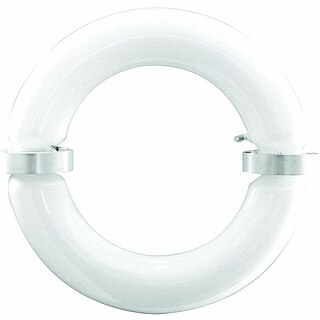
The induction lamp, electrodeless lamp, or electrodeless induction lamp is a gas-discharge lamp in which an electric or magnetic field transfers the power required to generate light from outside the lamp envelope to the gas inside. This is in contrast to a typical gas discharge lamp that uses internal electrodes connected to the power supply by conductors that pass through the lamp envelope. Eliminating the internal electrodes provides two advantages:
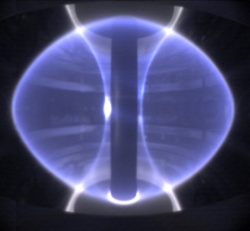
Magnetic confinement fusion (MCF) is an approach to generate thermonuclear fusion power that uses magnetic fields to confine fusion fuel in the form of a plasma. Magnetic confinement is one of two major branches of controlled fusion research, along with inertial confinement fusion.
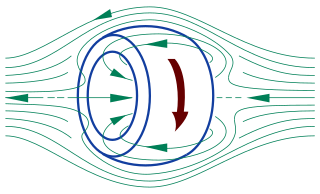
A field-reversed configuration (FRC) is a type of plasma device studied as a means of producing nuclear fusion. It confines a plasma on closed magnetic field lines without a central penetration. In an FRC, the plasma has the form of a self-stable torus, similar to a smoke ring.

A spheromak is an arrangement of plasma formed into a toroidal shape similar to a smoke ring. The spheromak contains large internal electric currents and their associated magnetic fields arranged so the magnetohydrodynamic forces within the spheromak are nearly balanced, resulting in long-lived (microsecond) confinement times without external fields. Spheromaks belong to a type of plasma configuration referred to as the compact toroids. A spheromak can be made and sustained using magnetic flux injection, leading to a dynomak.
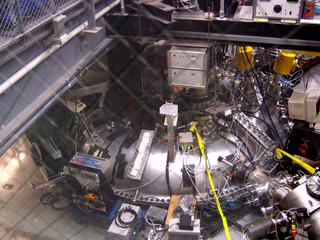
The Madison Symmetric Torus (MST) is a reversed field pinch (RFP) physics experiment with applications to both fusion energy research and astrophysical plasmas.

ZETA, short for Zero Energy Thermonuclear Assembly, was a major experiment in the early history of fusion power research. Based on the pinch plasma confinement technique, and built at the Atomic Energy Research Establishment in the United Kingdom, ZETA was larger and more powerful than any fusion machine in the world at that time. Its goal was to produce large numbers of fusion reactions, although it was not large enough to produce net energy.

Alcator C-Mod was a tokamak that operated between 1991 and 2016 at the Massachusetts Institute of Technology (MIT) Plasma Science and Fusion Center (PSFC). Notable for its high toroidal magnetic field, Alcator C-Mod holds the world record for volume averaged plasma pressure in a magnetically confined fusion device. Until its shutdown in 2016, it was one of the major fusion research facilities in the United States.
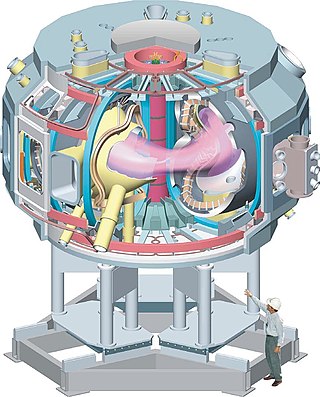
The National Compact Stellarator Experiment, NCSX in short, was a magnetic fusion energy experiment based on the stellarator design being constructed at the Princeton Plasma Physics Laboratory (PPPL).
The polywell is a design for a fusion reactor based on two ideas: heating ions by concentrating (-) charge to accelerate the ions and trapping a diamagnetic plasma inside a cusp field.

Plasma is one of four fundamental states of matter, characterized by the presence of a significant portion of charged particles in any combination of ions or electrons. It is the most abundant form of ordinary matter in the universe, mostly in stars, but also dominating the rarefied intracluster medium and intergalactic medium. Plasma can be artificially generated by heating a neutral gas or subjecting it to a strong electromagnetic field.

In a toroidal fusion power reactor, the magnetic fields confining the plasma are formed in a helical shape, winding around the interior of the reactor. The safety factor, labeled q or q(r), is the ratio of the times a particular magnetic field line travels around a toroidal confinement area's "long way" (toroidally) to the "short way" (poloidally).
TAE Technologies, formerly Tri Alpha Energy, is an American company based in Foothill Ranch, California developing aneutronic fusion power. The company's design relies on an advanced beam-driven field-reversed configuration (FRC), which combines features from accelerator physics and other fusion concepts in a unique fashion, and is optimized for hydrogen-boron fuel, also known as proton-boron and p-B11. It regularly publishes theoretical and experimental results in academic journals with hundreds of publications and posters at scientific conferences and in a research library hosting these articles on its website. TAE has developed five generations of original fusion platforms with a sixth currently in development. It aims to manufacture a prototype commercial fusion reactor by 2030.
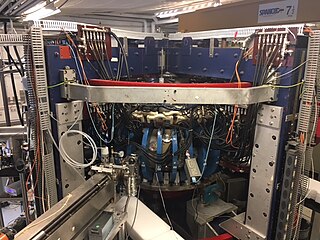
The Hybrid Illinois Device for Research and Applications (HIDRA) is a medium-sized toroidal magnetic fusion device housed in the Nuclear Radiation Laboratory and operated by the Center for Plasma-Material Interactions (CPMI) within the Department of Nuclear, Plasma and Radiological Engineering at the University of Illinois at Urbana–Champaign, United States. HIDRA had its first plasma at the end of April 2016 and started experimental campaigns by December of that year. HIDRA is the former WEGA classical stellarator that was operated at the Max Planck Institute for Plasma Physics in Greifswald Germany from 2001 to 2013.

The Princeton field-reversed configuration (PFRC) is a series of experiments in plasma physics, an experimental program to evaluate a configuration for a fusion power reactor, at the Princeton Plasma Physics Laboratory (PPPL). The experiment probes the dynamics of long-pulse, collisionless, low s-parameter field-reversed configurations (FRCs) formed with odd-parity rotating magnetic fields. FRCs are the evolution of the Greek engineer's Nicholas C. Christofilos original idea of E-layers which he developed for the Astron fusion reactor. The PFRC program aims to experimentally verify the physics predictions that such configurations are globally stable and have transport levels comparable with classical magnetic diffusion. It also aims to apply this technology to the Direct Fusion Drive concept for spacecraft propulsion.
References
- Jean-Luc Cambier and David A. Micheletti. Theoretical Analysis of the Electron Spiral Toroid Concept NASA/CR-2000-210654.
- C. Chen, R. Pakter, and D. C. Seward. Equilibrium and stability properties of self-organized electron spiral toroids. Physics of Plasmas Vol 8(10) pp. 4441–4449. October 2001.
