Related Research Articles
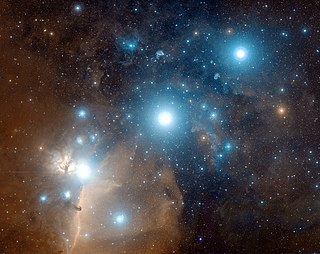
Astrophotography, also known as astronomical imaging, is the photography or imaging of astronomical objects, celestial events, or areas of the night sky. The first photograph of an astronomical object was taken in 1840, but it was not until the late 19th century that advances in technology allowed for detailed stellar photography. Besides being able to record the details of extended objects such as the Moon, Sun, and planets, modern astrophotography has the ability to image objects invisible to the human eye such as dim stars, nebulae, and galaxies. This is done by long time exposure since both film and digital cameras can accumulate and sum photons over these long periods of time.
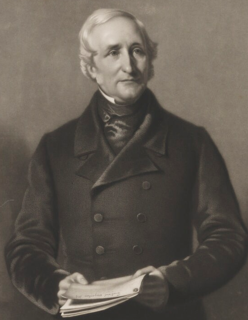
Sir Edward Sabine was an Irish astronomer, geophysicist, ornithologist, explorer, soldier and the 30th president of the Royal Society.
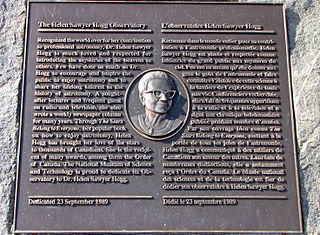
Helen Battles Sawyer Hogg was an American-Canadian astronomer who pioneered research into globular clusters and variable stars. She was the first female president of several astronomical organizations and a notable woman of science in a time when many universities would not award scientific degrees to women. Her scientific advocacy and journalism included astronomy columns in the Toronto Star and the Journal of the Royal Astronomical Society of Canada. She was considered a "great scientist and a gracious person" over a career of sixty years.

Eleanor Margaret Burbidge, FRS (née Peachey; 12 August 1919 – 5 April 2020) was a British-American observational astronomer and astrophysicist. In the 1950s, she was one of the founders of stellar nucleosynthesis and was first author of the influential B2FH paper. During the 1960s and 70s she worked on galaxy rotation curves and quasars, discovering the most distant astronomical object then known. In the 1980s and 90s she helped develop and utilise the Faint Object Spectrograph on the Hubble Space Telescope. Burbidge was well known for her work opposing discrimination against women in astronomy.

Fred Lawrence Whipple was an American astronomer, who worked at the Harvard College Observatory for more than 70 years. Amongst his achievements were asteroid and comet discoveries, the "dirty snowball" hypothesis of comets, and the invention of the Whipple shield.

Maria Mitchell was an American astronomer, librarian, naturalist, and educator. In 1847, she discovered a comet named 1847 VI that was later known as "Miss Mitchell's Comet" in her honor. She won a gold medal prize for her discovery, which was presented to her by King Christian VIII of Denmark in 1848. Mitchell was the first internationally known woman to work as both a professional astronomer and a professor of astronomy after accepting a position at Vassar College in 1865. She was also the first woman elected Fellow of the American Academy of Arts and Sciences and the American Association for the Advancement of Science.

The Harvard College Observatory (HCO) is an institution managing a complex of buildings and multiple instruments used for astronomical research by the Harvard University Department of Astronomy. It is located in Cambridge, Massachusetts, United States, and was founded in 1839. With the Smithsonian Astrophysical Observatory, it forms part of the Harvard–Smithsonian Center for Astrophysics.

The Astronomical Society of the Pacific (ASP) is an American scientific and educational organization, founded in San Francisco on February 7, 1889. Its name derives from its origins on the Pacific Coast, but today it has members all over the country and the world. It has the legal status of a nonprofit organization.
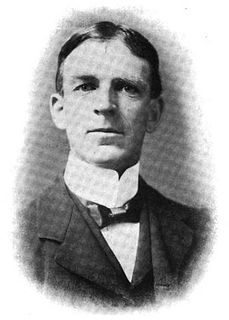
William Wallace Campbell was an American astronomer, and director of Lick Observatory from 1901 to 1930. He specialized in spectroscopy. He was the tenth president of the University of California from 1923 to 1930.
Manuel John Johnson, FRS was a British astronomer.
Francis John Welsh Whipple was an English mathematician and meteorologist. From 1925 to 1939, he was superintendent of the Kew Observatory.

Armagh Observatory is an astronomical research institute in Armagh, Northern Ireland. Around 25 astronomers are based at the observatory, studying stellar astrophysics, the Sun, Solar System astronomy and Earth's climate.

Isaac Roberts FRS was a Welsh engineer and businessman best known for his work as an amateur astronomer, pioneering the field of astrophotography of nebulae. He was a member of the Liverpool Astronomical Society in England and was a fellow of the Royal Geological Society. Roberts was also awarded the Gold Medal of the Royal Astronomical Society in 1895.

The Center for Astrophysics | Harvard & Smithsonian (CfA) is an astrophysics research institute jointly operated by the Harvard College Observatory and Smithsonian Astrophysical Observatory. Founded in 1973 and headquartered in Cambridge, Massachusetts, the CfA leads a broad program of research in astronomy, astrophysics, Earth and space sciences, as well as science education. The CfA either leads or participates in the development and operations of more than fifteen ground- and space-based astronomical research observatories across the electromagnetic spectrum, including the forthcoming Giant Magellan Telescope (GMT) and the Chandra X-ray Observatory, one of NASA's Great Observatories.

The Fred Lawrence Whipple Observatory is an American astronomical observatory owned and operated by the Smithsonian Astrophysical Observatory (SAO); it is their largest field installation outside of their main site in Cambridge, Massachusetts. It is located near Amado, Arizona on the summit, a ridge and at the foot of Mount Hopkins.
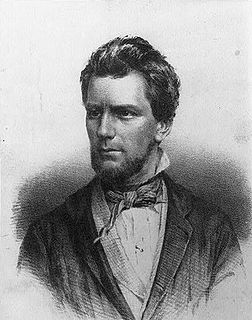
John Adams Whipple was an American inventor and early photographer. He was the first in the United States to manufacture the chemicals used for daguerreotypes. He pioneered astronomical and night photography. He was a prize-winner for his extraordinary early photographs of the moon and he was the first to produce images of stars other than the sun. Among those was the star Vega and the Mizar-Alcor stellar sextuple system, which was thought to be a double star until 2009.

Dorothea Klumpke Roberts was an American astronomer. She was Director of the Bureau of Measurements at the Paris Observatory and was made a Chevalier de la Légion d'Honneur.

The King's Observatory is a Grade I listed building in Richmond, London. Now a private dwelling, it formerly housed an astronomical and terrestrial magnetic observatory founded by King George III. The architect was Sir William Chambers; his design of the King's Observatory influenced the architecture of two Irish observatories – Armagh Observatory and Dunsink Observatory near Dublin.
Robert Stewart Whipple was a businessman in the British scientific instrument trade, a collector of science books and scientific instruments, and an author on their history. He amassed a unique collection of antique scientific instruments that he later donated to found the Whipple Museum of the History of Science in Cambridge in 1944.

Mary Anna Draper, also known as Mary Anna Palmer Draper, was an American, known for her work with her husband, Henry Draper, with astronomical photography and research. She helped found the Mount Wilson Observatory and created an award for astronomical research, the Henry Draper Medal of the National Academy of Sciences.
References
- 1 2 3 4 Macdonald, Lee (9 March 2017). "'Work peculiarly fitting to a lady': Elizabeth Beckley and the early years of solar photography". conscicom.org. Retrieved 6 May 2019.
- 1 2 3 Ptolemy, Photography and Pyjamas. Science Museum website.
- ↑ Who Was Who 1941-1950. Bloomsbury Publishing, London. 1980. ISBN 0-7136-2131-1. Entry of Francis John Welsh Whipple.
   | This article about a British astronomer is a stub. You can help Wikipedia by expanding it. |
  | This article about a British photographer is a stub. You can help Wikipedia by expanding it. |