
The Emily Jackson Children's Hip Hospital was a hospital in Sevenoaks, Kent, England. The building now contains the Emily Jackson Care Home.
The Emily Jackson Children's Hip Hospital was a hospital in Sevenoaks, Kent, England. The building now contains the Emily Jackson Care Home.
The hospital was established by Emily Jackson (1846–1916) [1] [2] [3] in 1871 in a small cottage on the Vine in Sevenoaks. [4] [2]
In 1876 it was moved to Park Lane, Sevenoaks and became the Vine Hip Hospital. [4] The hospital was extended between 1880–1892 to incorporate a dispensary, dining room and new ward. [4] By 1897 the hospital had 25 patients, and had outgrown its premises. In 1900, Jackson raised over £10,000 and purchased land in Eardley Road, Sevenoaks on which to build a larger, 45 bed hospital. [3] Her brother, the notable architect Thomas Graham Jackson, designed the new building. Emily Jackson was matron of the hospital, which cared for children with tuberculosis of the hip. In 1948 following the advent of the NHS the hospital was merged with Cheyne Hospital for Children in Chelsea, London and was renamed the Cheyne and Sevenoaks Hip Hospital. With the advent of more effective treatments for TB, the hospital became redundant, and in 1958 the hospital was closed and ran by Sevenoaks Hospital as a wing for 'geriatric' / elderly patients. [4] [3] This finally closed in 1988, and it was reopened as a private nursing home called the Emily Jackson Care Home. [5]

Sevenoaks is a town in Kent with a population of 29,506 situated south-east of London, England. Also classified as a civil parish, Sevenoaks is served by a commuter main line railway into London. Sevenoaks is 21 miles (34 km) from Charing Cross, the traditional centre of London. It is the principal town of the Sevenoaks district, followed by Swanley and Edenbridge.

Moorfields Eye Hospital is a specialist National Health Service (NHS) eye hospital in Finsbury in the London Borough of Islington in London, England run by Moorfields Eye Hospital NHS Foundation Trust. Together with the UCL Institute of Ophthalmology, which is adjacent to the hospital, it is the oldest and largest centre for ophthalmic treatment, teaching and research in Europe.

The Royal Prince Alfred Hospital is a large teaching hospital in Sydney, Australia, located on Missenden Road in Camperdown. It is a teaching hospital of the Central Clinical School of the Sydney Medical School at the University of Sydney and is situated in proximity to the Blackburn Building of the university's main campus. RPAH is the largest hospital in the Sydney Local Health District, with approximately 1200 beds. Following a $350 million redevelopment, the perinatal hospital King George V Memorial Hospital has been incorporated into it.

The Royal College of Nursing (RCN) is a registered trade union and professional body in the United Kingdom for those in the profession of nursing. It was founded in 1916 as the College of Nursing, receiving its royal charter in 1928. Queen Elizabeth II was the patron until her death in 2022. The majority of members are registered nurses; however student nurses and healthcare assistants are also members. There is also a category of membership, at a reduced cost, for retired people.

Sir Thomas Graham Jackson, 1st Baronet was one of the most distinguished British architects of his generation. He is best remembered for his work at Oxford, including the Oxford Military College at Cowley, the university's Examination Schools, most of Hertford College, much of Brasenose College, ranges at Trinity College and Somerville College, the City of Oxford High School for Boys, and the Acland Nursing Home.

The Royal National Orthopaedic Hospital (RNOH) is a specialist orthopaedic hospital located in Stanmore in the London Borough of Harrow, run by the Royal National Orthopaedic Hospital NHS Trust. It provides the most comprehensive range of neuro-musculoskeletal health care in the UK, including acute spinal injury, complex bone tumour treatment, orthopaedic medicine and specialist rehabilitation for chronic back pain. The RNOH is a major teaching centre and around 20% of orthopaedic surgeons in the UK receive training there.

Matron is the job title of a very senior or the chief nurse in several countries, including the United Kingdom, and other Commonwealth countries and former colonies.

The Queen Elizabeth Hospital for Children was based in Bethnal Green in the London Borough of Tower Hamlets, London. In 1996, the hospital became part of The Royal Hospitals NHS Trust, later renamed Barts and The London NHS Trust. In 1998, the services previously carried out by the hospital were transferred to the Royal London Hospital.
Nursing in the United Kingdom is the largest health care profession in the country. It has evolved from assisting doctors to encompass a variety of professional roles. Over 700,000 nurses practice, working in settings such as hospitals, health centres, nursing homes, hospices, communities, military, prisons, and academia. Most are employed by the National Health Service (NHS).

Westminster Hospital was a hospital in London, England, founded in 1719. In 1834 a medical school attached to the hospital was formally founded. In 1939 a newly built hospital and medical school opened in Horseferry Road, Westminster. In 1994 the hospital closed, and its resources were moved to the new Chelsea and Westminster Hospital at the old St Stephen's Hospital site in Fulham Road.

Nursing is a health care profession that "integrates the art and science of caring and focuses on the protection, promotion, and optimization of health and human functioning; prevention of illness and injury; facilitation of healing; and alleviation of suffering through compassionate presence". Nurses practice in many specialties with varying levels of certification and responsibility. Nurses comprise the largest component of most healthcare environments. Shortages of qualified nurses are found in many countries.

The Adelaide Hospital was a general and teaching hospital in Peter Street, Dublin, Ireland. It was absorbed into the Tallaght Hospital in June 1998.

The Hospital of St. Cross is a National Health Service hospital on Barby Road, in Rugby, Warwickshire, England, managed by the University Hospitals Coventry and Warwickshire NHS Trust. It is on the south edge of Rugby above a steep slope running down to the Sow Brook valley.

The Royal Orthopaedic Hospital (ROH) is a National Health Service specialist orthopaedic hospital situated in Northfield, Birmingham, England. The ROH specialises in bone and joint problems.

Pilgrim Hospital is a hospital in the east of Lincolnshire on the A16, north of the town of Boston near the mini-roundabout with the A52. It is situated virtually on the Greenwich Meridian and adjacent to Boston High School. The fenland area of Lincolnshire is covered by this hospital, being the county's second largest hospital after Lincoln County Hospital. It is managed by United Lincolnshire Hospitals NHS Trust.
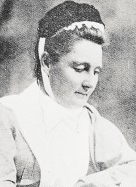
Sibylla Emily Maude, known as Nurse Maude, was the founder of district nursing in New Zealand. She was loved for her selfless work for the poor, walking many miles each day in every kind of weather to treat those who could afford no medical help.
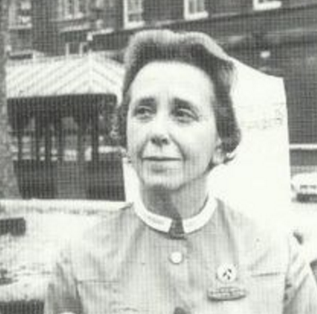
Winifred Emily Hector FRCN was an English nurse and textbook author. She played a significant part in introducing modern curriculum and teaching methods to British nursing education.

Daphne Steele was a Guyanese nurse, who in 1964 became the first Black Matron in the National Health Service.

The Miller General Hospital was a hospital in Greenwich, London from 1884 until 1974. It was developed adjacent to an earlier dispensary, and was the first British hospital designed with circular wards, and one of the first to have an X-ray department.
Charlotte Kratz MBE, FRCN, PhD was a trained nurse from the United Kingdom known for her pioneering community health work.
{{cite book}}: CS1 maint: multiple names: authors list (link)  | This United Kingdom hospital article is a stub. You can help Wikipedia by expanding it. |