Related Research Articles

The Straits Times is a Singaporean daily English-language newspaper owned by the SPH Media Trust. First established on 15 July 1845, it is the most-widely circulated newspaper in the country and has a significant regional audience. The newspaper is published in the broadsheet format and online, the latter of which was launched in 1994. It is regarded as the newspaper of record for Singapore.

Sook Ching was a mass killing that occurred from 18 February to 4 March 1942 in Singapore after it fell to the Japanese. It was a systematic purge and massacre of 'anti-Japanese' elements in Singapore, with the Singaporean Chinese particularly targeted by the Japanese military during the occupation. However, Japanese soldiers engaged in indiscriminate killing, and did not try to identify who was 'anti-Japanese.' Singapore was a crucial strategic point in World War II. From 8 February to 15 February, the Japanese fought for control of the city. The combined British and Commonwealth forces surrendered in a stunning defeat to the outnumbered Japanese on 15 February which led to its fall. The loss of Singapore was and still is Britain's largest surrender in history.
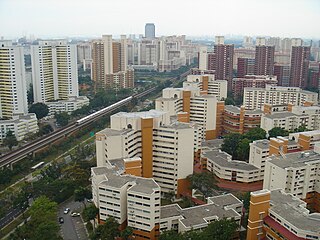
Bukit Batok, often abbreviated as Bt Batok, is a planning area and matured residential town located along the eastern boundary of the West Region of Singapore. Bukit Batok statistically ranks in as the 25th largest, the 12th most populous and the 11th most densely populated planning area in the Republic. It is bordered by six other planning areas - Choa Chu Kang to the North, northeast and northwest, Cashew to the northeast and east, Clementi to the south, Bukit Timah to the southeast, Jurong East to the southwest and Tengah to the west.
Eurasian Singaporeans are Singaporeans of mixed European and Asian descent. Their Asian ancestry trace from Colonial India to other colonies while their European ancestry trace back to western Europe primarily, although Eurasian settlers to Singapore in the 19th century came largely from other European colonies. These included British Malaya and British Sarawak, part of the former British Raj India, of the former Portuguese India and Chittagong, the Dutch East Indies and French Indochina. When the European maritime powers colonised Asian countries, such as Colonial India, Ceylon, Malaya, Singapore, Indonesia and Indochina, from the 16th to 20th centuries, they brought into being a new group of commingled ethnicities known historically as Eurasians.

Syonan, officially Syonan Island, was the name for Singapore when it was occupied and ruled by the Empire of Japan, following the fall and surrender of British military forces on 15 February 1942 during World War II.

Lim Boon Keng was a Peranakan physician who advocated social and educational reforms in Singapore in the early 20th-century. He also served as the president of Xiamen University in China between 1921 and 1937.

Bahau is the principal town of Jempol District, Negeri Sembilan, Malaysia.

The Former Ford Factory is located along Upper Bukit Timah Road at Bukit Timah in Singapore. It is the place where the British Army forces surrendered to Imperial Japanese Army forces on 15 February 1942 after the Battle of Singapore. The Old Ford Motor Factory had since been gazetted as a National Monument in 2006, and converted into an exhibition gallery and archive named Memories at Old Ford Factory. The permanent exhibition gallery showcases life in Singapore under Japanese wartime rule, and the exhibition is one of the continuation of final battles from Pasir Panjang and at Fort Siloso.

The Catholic Church in Singapore is part of the worldwide Catholic Church, under the spiritual leadership of the Pope in Rome. In 2016, the Catholic Foundation of Singapore reported the Catholic population in Singapore to be over 373,000.
Malaya, then under British administration, was gradually occupied by Japanese forces between 8 December 1941 and the Allied surrender at Singapore on 15 February 1942. The Japanese remained in occupation until their surrender to the Allies in 1945. The first Japanese garrison in Malaya to lay down their arms was in Penang on 2 September 1945 aboard HMS Nelson.

Syonan Jinja was a Shinto shrine at MacRitchie Reservoir, Singapore. Built by the Japanese Imperial Army during the Japanese occupation of Singapore in World War II, the shrine was destroyed directly before British forces re-occupied Singapore.

Mamoru Shinozaki was a journalist for Dentsu and spy for the Ministry of Foreign Affairs in pre-war years, a military executive in Japanese-occupied Singapore, and a businessman and writer in post-war years. He is known for the Shinozaki Case in 1940, and for his testimony in the war crimes trial in 1947 for the Sook Ching massacre.

The Bukit Batok Memorial is located on top of the tranquil Bukit Batok Hill upon which once stood two war memorials built by Australian POWs to commemorate the war dead of the Japanese and the Allies who fought during the decisive Battle of Bukit Timah in Singapore during the Second World War. The two memorials were destroyed after the war and only the road and stairs that used to lead to them mark its legacy today.

The Japanese Cemetery Park is a Japanese cemetery and park in Hougang, Singapore. It is the largest Japanese cemetery in Southeast Asia at 29,359 square metres, consisting of 910 tombstones that contain the remains of members of the Japanese community in Singapore, including young Japanese prostitutes, civilians, soldiers and convicted war criminals executed in Changi Prison. It was gazetted as a memorial park by the Singapore government in 1987.

The Kangchu system was a socio-economic system of organisation and administration developed by Chinese agricultural settlers in Johor during the 19th century. The settlers organised themselves into informal associations, and chose a leader from among themselves.

The Kempeitai East District Branch was the headquarters of the Kempeitai, the Japanese military police, during the Japanese occupation of Singapore from 1942 to 1945. It was located at the old YMCA building, at the present site of Singapore's YMCA Building on Stamford Road. Opened in 1911, the distinctive Art Deco YMCA building was the site of interrogation and torture of many innocent civilians, including the war heroine Elizabeth Choy. After the war, the Singapore government erected several memorials with some at the former massacre sites. In 1995, the former site of the old YMCA building was gazetted by the National Heritage Board as one of the eleven World War II sites of Singapore.

The Malayan Peoples' Anti-Japanese Army (MPAJA) was a communist guerrilla army that resisted the Japanese occupation of Malaya from 1941 to 1945. Composed mainly of ethnic Chinese guerrilla fighters, the MPAJA was the largest anti-Japanese resistance group in Malaya. Founded during the Japanese invasion of Malaya, the MPAJA was conceived as a part of a combined effort by the Malayan Communist Party (MCP) and the British colonial government, alongside various smaller groups to resist the Japanese occupation. Although the MPAJA and the MCP were officially different organisations, many saw the MPAJA as a de facto armed wing of the MCP due to its leadership being staffed by mostly ethnic Chinese communists. Many of the ex-guerrillas of the MPAJA would later form the Malayan National Liberation Army (MNLA) and resist a return to pre-war the normality of British rule of Malaya during the Malayan Emergency (1948–1960).
Chia Boon Leong was a Singaporean footballer who competed for China in the 1948 Summer Olympics and for Singapore at the 1954 Asian Games. He was known as "twinkletoes" in the football scene.
Adrien Devals was a Roman Catholic priest who was the Bishop of Malacca, which also included Singapore. He was among the first group of settlers to arrive in the Bahau settlement, and was later put in charge of administering the settlement’s affairs.
References
- ↑ Lee, Joshua (21 December 2016). "Here's how S'pore's Japanese Occupation survivors endured 3 years of hunger: Part 2". Mothership.sg . Retrieved 1 May 2022.
- 1 2 3 4 5 6 Chia, Joshua. "Endau Settlement". Singapore Infopedia. National Library Board . Retrieved 1 May 2022.
- 1 2 3 4 5 Lee, Geok Boi (2005). The Syonan years : Singapore under Japanese rule 1942-1945. Singapore: National Archives of Singapore. ISBN 9810542909.
- ↑ "Chinese Provide $2,000,000 For Collective Farms". Syonan Shimbun . Singapore. 2 December 1943. Retrieved 3 May 2022.
- ↑ "Endau, Bahau Form Part Of Big 'Grow More Food' Scheme". Syonan Shimbun . Singapore. 15 February 1944. Retrieved 3 May 2022.
- 1 2 Turnbull, Constance Mary (1990). A history of Singapore, 1819-1988. Singapore: Malaysian Branch of the Royal Asiatic Society. ISBN 0195889436.
- 1 2 Murfett, Malcolm (1999). Between Two Oceans: A Military History of Singapore from First Settlement to Final British Withdrawal. Singapore: Oxford University Press. ISBN 0195884825.
- ↑ "Sawmill Being Built At Endau". Syonan Shimbun . Singapore. 15 January 1944. Retrieved 3 May 2022.
- ↑ "Bahau, Endau To Have Cigarette Factories Shortly". Syonan Shimbun . Singapore. 6 March 1944. Retrieved 3 May 2022.