
In computing, a cache is a hardware or software component that stores data so that future requests for that data can be served faster; the data stored in a cache might be the result of an earlier computation or a copy of data stored elsewhere. A cache hit occurs when the requested data can be found in a cache, while a cache miss occurs when it cannot. Cache hits are served by reading data from the cache, which is faster than recomputing a result or reading from a slower data store; thus, the more requests that can be served from the cache, the faster the system performs.
Distributed computing is a field of computer science that studies distributed systems, defined as computer systems whose inter-communicating components are located on different networked computers.

The European Environment Agency (EEA) is the agency of the European Union (EU) which provides independent information on the environment.

A geographic information system (GIS) consists of integrated computer hardware and software that store, manage, analyze, edit, output, and visualize geographic data. Much of this often happens within a spatial database, however, this is not essential to meet the definition of a GIS. In a broader sense, one may consider such a system also to include human users and support staff, procedures and workflows, the body of knowledge of relevant concepts and methods, and institutional organizations.
A distributed database is a database in which data is stored across different physical locations. It may be stored in multiple computers located in the same physical location ; or maybe dispersed over a network of interconnected computers. Unlike parallel systems, in which the processors are tightly coupled and constitute a single database system, a distributed database system consists of loosely coupled sites that share no physical components.

Parallel computing is a type of computation in which many calculations or processes are carried out simultaneously. Large problems can often be divided into smaller ones, which can then be solved at the same time. There are several different forms of parallel computing: bit-level, instruction-level, data, and task parallelism. Parallelism has long been employed in high-performance computing, but has gained broader interest due to the physical constraints preventing frequency scaling. As power consumption by computers has become a concern in recent years, parallel computing has become the dominant paradigm in computer architecture, mainly in the form of multi-core processors.
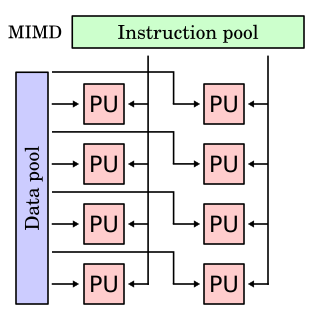
In computing, multiple instruction, multiple data (MIMD) is a technique employed to achieve parallelism. Machines using MIMD have a number of processors that function asynchronously and independently. At any time, different processors may be executing different instructions on different pieces of data.

In computer science, distributed memory refers to a multiprocessor computer system in which each processor has its own private memory. Computational tasks can only operate on local data, and if remote data are required, the computational task must communicate with one or more remote processors. In contrast, a shared memory multiprocessor offers a single memory space used by all processors. Processors do not have to be aware where data resides, except that there may be performance penalties, and that race conditions are to be avoided.
In computer science, distributed shared memory (DSM) is a form of memory architecture where physically separated memories can be addressed as a single shared address space. The term "shared" does not mean that there is a single centralized memory, but that the address space is shared—i.e., the same physical address on two processors refers to the same location in memory. Distributed global address space (DGAS), is a similar term for a wide class of software and hardware implementations, in which each node of a cluster has access to shared memory in addition to each node's private memory.

In cognitive psychology and neuroscience, spatial memory is a form of memory responsible for the recording and recovery of information needed to plan a course to a location and to recall the location of an object or the occurrence of an event. Spatial memory is necessary for orientation in space. Spatial memory can also be divided into egocentric and allocentric spatial memory. A person's spatial memory is required to navigate around a familiar city. A rat's spatial memory is needed to learn the location of food at the end of a maze. In both humans and animals, spatial memories are summarized as a cognitive map.
Wireless sensor networks (WSNs) refer to networks of spatially dispersed and dedicated sensors that monitor and record the physical conditions of the environment and forward the collected data to a central location. WSNs can measure environmental conditions such as temperature, sound, pollution levels, humidity and wind.
Sensor web is a type of sensor network that heavily utilizes the World Wide Web and is especially suited for environmental monitoring. OGC's Sensor Web Enablement (SWE) framework defines a suite of web service interfaces and communication protocols abstracting from the heterogeneity of sensor (network) communication.

Homogeneity and heterogeneity are concepts relating to the uniformity of a substance, process or image. A homogeneous feature is uniform in composition or character ; one that is heterogeneous is distinctly nonuniform in at least one of these qualities.

Spatial analysis is any of the formal techniques which studies entities using their topological, geometric, or geographic properties. Spatial analysis includes a variety of techniques using different analytic approaches, especially spatial statistics. It may be applied in fields as diverse as astronomy, with its studies of the placement of galaxies in the cosmos, or to chip fabrication engineering, with its use of "place and route" algorithms to build complex wiring structures. In a more restricted sense, spatial analysis is geospatial analysis, the technique applied to structures at the human scale, most notably in the analysis of geographic data. It may also be applied to genomics, as in transcriptomics data.
Regional economics is a sub-discipline of economics and is often regarded as one of the fields of the social sciences. It addresses the economic aspect of the regional problems that are spatially analyzable so that theoretical or policy implications can be the derived with respect to regions whose geographical scope ranges from local to global areas.
Digital Earth is the name given to a concept by former US vice president Al Gore in 1998, describing a virtual representation of the Earth that is georeferenced and connected to the world's digital knowledge archives.
Hierarchical temporal memory (HTM) is a biologically constrained machine intelligence technology developed by Numenta. Originally described in the 2004 book On Intelligence by Jeff Hawkins with Sandra Blakeslee, HTM is primarily used today for anomaly detection in streaming data. The technology is based on neuroscience and the physiology and interaction of pyramidal neurons in the neocortex of the mammalian brain.
Distributed GIS refers to GI Systems that do not have all of the system components in the same physical location. This could be the processing, the database, the rendering or the user interface. It represents a special case of distributed computing, with examples of distributed systems including Internet GIS, Web GIS, and Mobile GIS. Distribution of resources provides corporate and enterprise-based models for GIS. Distributed GIS permits a shared services model, including data fusion based on Open Geospatial Consortium (OGC) web services. Distributed GIS technology enables modern online mapping systems, Location-based services (LBS), web-based GIS and numerous map-enabled applications. Other applications include transportation, logistics, utilities, farm / agricultural information systems, real-time environmental information systems and the analysis of the movement of people. In terms of data, the concept has been extended to include volunteered geographical information. Distributed processing allows improvements to the performance of spatial analysis through the use of techniques such as parallel processing.
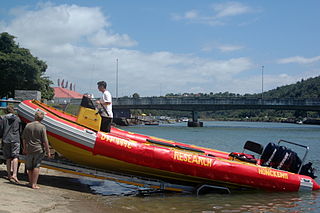
The South African Environmental Observation Network (SAEON) is a science network of people, organisations and, most importantly observation platforms, that perform Long-Term Ecological Research (LTER) in South Africa and its surrounding oceans. The SAEON is of global importance as an innovative approach in ecology to understand environmental change and to determine the impact of anthropogenic forces at multiple scales but it is a remarkably complex challenge to statistically discern between ubiquitous natural variability and exogenous forcing. The SAEON constitutes a national government response to the World Summit on Sustainable Development (Earth Summit 2002) and is a component of the GEO (Group on Earth Observations). The SAEON has become the leader in environmental science and observation in South Africa, but has been criticised for taking a long time to establish, a situation which was inevitable in view of SAEON's multiple stakeholder corps. It has also been raised that the cost of replicated experimental treatments across SAEON sites will be high.

In computer science, shared memory is memory that may be simultaneously accessed by multiple programs with an intent to provide communication among them or avoid redundant copies. Shared memory is an efficient means of passing data between programs. Depending on context, programs may run on a single processor or on multiple separate processors.


