Related Research Articles

Mamikonian, or Mamikonean, was an Armenian aristocratic dynasty which dominated Armenian politics between the 4th and 8th centuries. They were the most notable noble house in Early Christian Armenia after the ruling Arsacid dynasty and held the hereditary positions of sparapet and dayeak, allowing them to play the role of kingmaker for the later Armenian kings. They ruled over extensive territories, including the Armenian regions of Tayk, Taron, Sasun, and Bagrevand, among others. The Mamikonians had a reputation as supporters of the Roman Empire in Armenia against Sasanian Iran, although they also served as viceroys under Persian rule. Their influence over Armenian affairs began to decline at the end of the 6th century and suffered a final, decisive blow after a failed rebellion against Arab rule over Armenia in 774/75.
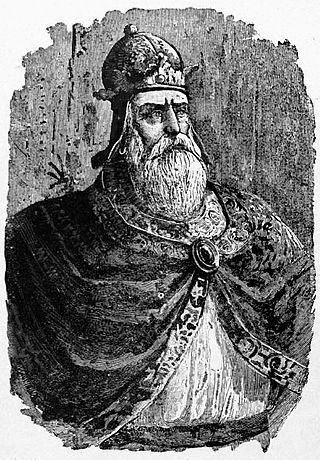
Tiridates III, also known as Tiridates the Great or Tiridates IV, was the Armenian Arsacid king from c. 298 to c. 330. In the early 4th century, Tiridates proclaimed Christianity as the state religion of Armenia, making the Armenian kingdom the first state to officially embrace Christianity.
Tiridates is a word of Iranian origin. It may refer to:

Artabanus II, incorrectly known in older scholarship as Artabanus III, was King of Kings of the Parthian Empire from 12 to 38/41 AD, with a one-year interruption. He was the nephew and successor of Vonones I. His father has been variously identified as a Dahae or Atropatid prince, whilst his mother was a daughter of the Parthian King of Kings Phraates IV.
The Arsacid dynasty, called the Arshakuni (Արշակունի) in Armenian, ruled the Kingdom of Armenia from 12 to 428 AD. The dynasty was a branch of the Arsacid dynasty of Parthia. Arsacid kings reigned intermittently throughout the chaotic years following the fall of the Artaxiad dynasty until 62, when Tiridates I, brother of Parthian King Vologases I, secured Arsacid rule in Armenia as a client king of Rome. However, he did not succeed in establishing his line on the throne, and various princes of different Arsacid lineages ruled until the accession of Vologases II, who succeeded in establishing his own line on the Armenian throne, which ruled the kingdom until its abolishment by the Sasanian Empire in 428.

Tiridates I was King of Armenia beginning in 53 AD and the founder of the Arsacid dynasty of Armenia. The dates of his birth and death are unknown. His early reign was marked by a brief interruption towards the end of the year 54 and a much longer one from 58 to 63. In an agreement to resolve the Roman–Parthian conflict in and over Armenia, Tiridates I was crowned king of Armenia by the Roman emperor Nero in 66; in the future, the king of Armenia was to be a Parthian prince, but his appointment required approval from the Romans. Even though this made Armenia a client kingdom, various contemporary Roman sources thought that Nero had de facto ceded Armenia to the Parthian Empire.
Khosrov III the Small was the king of Arsacid Armenia c. 330–338/339.
Arshak II, also written as Arsaces II, was an Arsacid prince who was King of Armenia from 350 until c. 364/367. Although Arshak's reign opened with a period of peace and stability, it was soon plagued by his conflicts with the Armenian church and nobility, as well as a series of wars between Rome and Persia, during which the Armenian king teetered between the warring sides. Arshak participated in the Roman emperor Julian's ill-fated campaign against Persia; after the consequent Perso-Roman Treaty of 363, Armenia was left to fend for itself against a renewed attack by the Persian king Shapur II. Faced with defections and rebellions among the Armenian nobility, Arshak was lured to Persia for peace negotiations with Shapur, after which he was imprisoned in the Castle of Oblivion in Khuzistan and is said to have committed suicide in captivity. Arshak's reign was followed by the conquest and devastation of Armenia by the Persians, although his son and heir Pap managed to escape and later ascended to the Armenian throne with Roman assistance.

Tiran known also as Tigranes VII, Tigranes or Diran was an Armenian prince who served as a Roman client king of Arsacid Armenia from 339 until 350. He was a contemporary of and is associated with the life of Sarkis the Warrior and his son, Martiros.
Khosrov I was a Parthian prince who served as a Roman client king of Armenia.
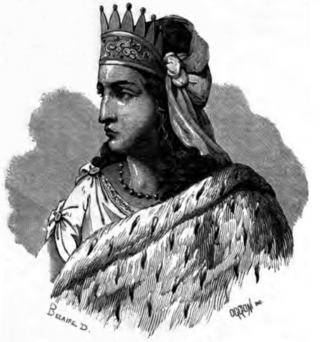
Khosrovidukht also transliterated Xosroviduxt was a princess of the Arsacid dynasty of Armenia, one of the client-kingdoms of the Roman Empire and a branch of the Arsacid dynasty of Parthia.

Ashkhen was the Queen of Armenia and a member of the Arsacid dynasty by marriage to King Tiridates III of Armenia.
Salome was an Armenian princess from the Arsacid dynasty who was married into the Chosroid Dynasty of Iberia. She was a daughter of King Tiridates III of Armenia and Queen Ashkhen. She is known from the early medieval Georgian chronicle Life of Kings. In Georgian tradition, she is referred to as Salome of Ujarma after a castle where she is credited to have erected a cross. She has been canonized by the Armenian and Georgian churches. Local canonisations are recognised throughout the Orthodox Church.
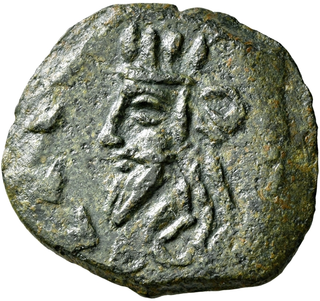
Tiridates II, flourished second half of the 2nd century - died 252), known in Armenian sources as Khosrov, was an Arsacid Prince who served as a Roman Client King of Armenia. Tiridates II was the son and heir of the Armenian King Khosrov I.

Khosrov II, also known as Khosrov the Brave was an Armenian king from the Arsacid dynasty in the mid-third century.
Gnel also known as Gnelus was a Prince from the Arsacid dynasty of Armenia.
Tirit also known as Tirid was a prince from the Arsacid dynasty of Armenia.
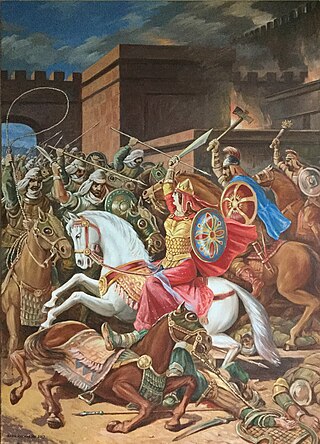
Parandzem was the consort of King Arshak II of Armenia. She was a member of the noble house of Siwni. She was regent of Armenia during the absence of her spouse and son in 368–370, and is famous for her defense of the fortress of Artagers against Persia. She was brutally put to death by the Persians after the fall of Artagers in the winter of 369/70. Her son Pap was soon after restored to the throne with Roman assistance.
Vardandukht, was a Queen consort of Armenia, as the wife of Arsaces III who was the last serving Roman Client King of Arsacid Armenia. Arsaces III reigned from 378 until his death in 387.