Related Research Articles

The Hall of Memory is a war memorial in Centenary Square, Birmingham, England, designed by S. N. Cooke and W. N. Twist. Erected 1922–25 by John Barnsley and Son, it commemorates the 12,320 Birmingham citizens who died in World War I.

UBC Botanical Garden, at the University of British Columbia, was established in 1916 under the directorship of John Davidson, British Columbia's first provincial botanist. It is the oldest botanical garden at a university in Canada.
The National Memorial Arboretum is a British site of national remembrance at Alrewas, near Lichfield, Staffordshire. Its objective is to honour the fallen, recognise service and sacrifice, and foster pride in the British Armed Forces and civilian community.

Charles Sprague Sargent was an American botanist. He was appointed in 1872 as the first director of Harvard University's Arnold Arboretum in Boston, Massachusetts, and held the post until his death. He published several works of botany. The standard botanical author abbreviation Sarg. is applied to plants he identified.

Highdown Gardens are gardens on the western edge of the town of Worthing, close to the village of Ferring and the National Trust archaeological site Highdown Hill, in West Sussex, England. Overlooking the sea from the South Downs, they contain a collection of rare plants and trees, collectively a national collection. The gardens are owned and maintained by Worthing Borough Council with free admission.
The Mizzou Botanic Garden contains thousands of plants within the campus of the University of Missouri in Columbia, Missouri, United States. The Garden includes famous icons, such as Thomas Jefferson's original grave marker and the Columns of Academic Hall, and is open year-round, only asking for a small donation to visit.

The Queen Elizabeth II September 11th Garden is located in Hanover Square in the Financial District of Lower Manhattan, New York City. It commemorates the Commonwealth victims of the September 11, 2001, attack on the World Trade Center. It was officially opened by Queen Elizabeth II on July 6, 2010.
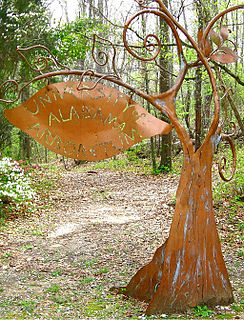
The University of Alabama Arboretum is a 60-acre arboretum located near the intersection of Veterans Memorial Parkway and Pelham Loop Road in Tuscaloosa, Alabama.

Bodnant Garden is a National Trust property near Tal-y-Cafn, Conwy, Wales, overlooking the Conwy Valley towards the Carneddau mountains.
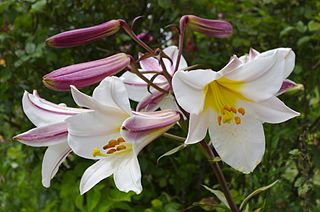
Lilium regale, called the regal lily, royal lily, king's lily, or, in New Zealand, the Christmas lily, is a species of flowering plant in the lily family Liliaceae, with trumpet-shaped flowers. It is native to the western part of Sichuan Province in southwestern China, and cultivated elsewhere as an ornamental. It was introduced to England in 1903 by Ernest Henry Wilson.
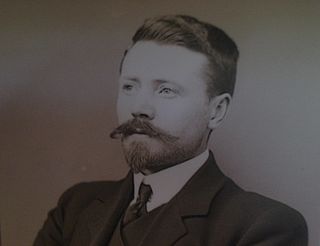
Ernest Henry "Chinese" Wilson, better known as E. H. Wilson, was a notable British plant collector and explorer who introduced a large range of about 2000 Asian plant species to the West; some sixty bear his name.

The University of Rhode Island Botanical Gardens are botanical gardens located on the University of Rhode Island campus in Kingston, Rhode Island. The gardens are open to the public free of charge at all times.
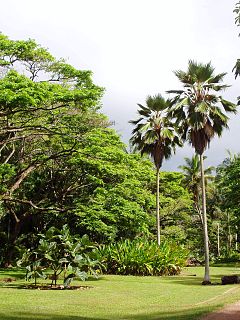
McBryde Garden is a botanical garden located on the south shore of Kauai, Hawaii. It is one of five gardens of the non-profit National Tropical Botanical Garden (NTBG).

The Lady Bird Johnson Wildflower Center at The University of Texas at Austin is the state botanical garden and arboretum of Texas. The center features more than 900 species of native Texas plants in both garden and natural settings and is home to a breadth of educational programs and events. The center is 284 acres and located 10 miles southwest of downtown Austin, Texas just inside the edge of the distinctive Texas hill country. It straddles both Edwards Plateau and Texas Blackland Prairies ecosystems.
The East Texas Arboretum and Botanical Society "ETABS" is an arboretum and collection of botanical gardens and historical buildings located at 1601 Patterson Road, Athens, Texas in the United States. It is open daily, an admission fee is charged. ETABS is a not-for-profit recognized by the IRS as a 501 (c)(3). Memberships are available and donations are welcome.
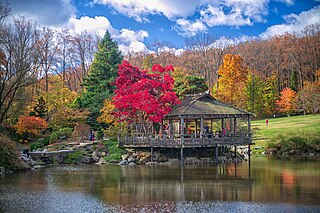
The Brookside Gardens are public gardens located within Wheaton Regional Park, at 1800 Glenallan Avenue, Silver Spring, Maryland. The gardens themselves are open daily without charge. However, certain annual events there are held that may charge a fee. The gardens hosts a "Garden of Lights" exhibit that features a light display during the holiday season.
The Memorial University of Newfoundland Botanical Garden is operated by Memorial University of Newfoundland in St. John's, Newfoundland and Labrador. It is located on Mount Scio Road in the suburbs of St. John's, and was founded in 1971 under the supervision of Dr. Bernard Jackson. Originally named the Oxen Pond Botanic Park, the gardens were opened to the public in 1977 and became a not-for-profit organization in 1994. The garden and nature trails were developed to provide a place where people of all ages and depths of interest can learn about the plants and natural environment of Newfoundland. The official emblem of the garden is the twinflower.

Parthenocissus henryana is a species of flowering plant in the vine family Vitaceae, native to China.

Mary Stevens Park is a public park located in Norton, Stourbridge, West Midlands, UK. Opened to the public in 1931, it attracts 1.3 million visitors per year and is approximately 13.65 hectares.

The Memorial to the First Homosexual Emancipation Movement is a memorial in the neighbourhood of Moabit in Berlin, Germany. Unveiled on 7 September 2017, the memorial is located opposite the Federal Chancellery on the Spree and commemorates the first homosexual movement, which was destroyed in 1933 by the Nazis, and especially the Scientific-Humanitarian Committee founded in 1897 to oppose the criminalization of homosexuality in Germany. The Scientific-Humanitarian Committee's headquarters were located on the other bank of the Spree near the Federal Chancellery. The riverbank where the memorial is located has been named the Magnus-Hirschfeld-Ufer since 2008. The memorial includes an information panel that has been in place since 2011 and discusses the movement with portraits of Anita Augspurg (1857–1943), Karl Heinrich Ulrichs (1825–1895) and Magnus Hirschfeld (1868–1935).
References
- ↑ Ernest Wilson Memorial Garden Archived 2018-02-23 at the Wayback Machine Retrieved 01 May 2015
 | This Gloucestershire location article is a stub. You can help Wikipedia by expanding it. |
 | This article related to a garden in the United Kingdom is a stub. You can help Wikipedia by expanding it. |