
A cruiser is a type of warship. Modern cruisers are generally the largest ships in a fleet after aircraft carriers and amphibious assault ships, and can usually perform several operational roles from search-and-destroy to ocean escort to sea denial.

A scout cruiser was a type of warship of the early 20th century, which were smaller, faster, more lightly armed and armoured than protected cruisers or light cruisers, but larger than contemporary destroyers. Intended for fleet scouting duties and acting as a flotilla leader, a scout cruiser was typically armed with six to ten destroyer-type guns of 3-inch to 4.7-inch calibre, plus two to four torpedo tubes.

A flotilla leader was a warship of late 19th century and early 20th century navies suitable for commanding a flotilla of destroyers or other small warships, typically a small cruiser or a large destroyer. The flotilla leader provided space, equipment and staff for the flotilla commodore, including a wireless room, senior engineering and gunnery officers, and administrative staff to support the officers. Originally, older light or scout cruisers were often used, but in the early 1900s, the rapidly increasing speed of new destroyer designs meant that such vessels could no longer keep pace with their charges. Accordingly, large destroyer designs were produced for use as leaders.

The Alberto di Giussano class of light cruisers were a sub-class of the Condottieri class built before World War II for the Italian Regia Marina, to gain predominance in the Mediterranean Sea. They were designed by general Giuseppe Vian and were named after Condottieri of the Italian Mediaeval and Renaissance periods.

Destroyer leader (DL) was the United States Navy designation for large destroyers from 9 February 1951 through the early years of the Cold War. United States ships with hull classification symbol DL were officially frigates from 1 January 1955 until 1975. The smaller destroyer leaders were reclassified as destroyers and the larger as cruisers by the United States Navy 1975 ship reclassification so destroyer escorts could be reclassified as frigates (FF) in conformance with international usage of the term.
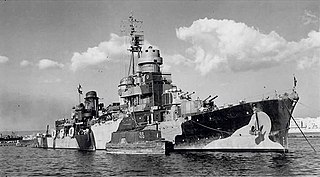
The Capitani Romani class was a class of light cruisers acting as flotilla leaders for the Regia Marina. They were built to outrun and outgun the large new French destroyers of the Le Fantasque and Mogador classes. Twelve hulls were ordered in late 1939, but only four were completed, just three of these before the Italian armistice in 1943. The ships were named after prominent ancient Romans.

Alberto di Giussano was an Italian Giussano-class cruiser, which served in the Regia Marina during World War II. She was launched on 27 April 1930.
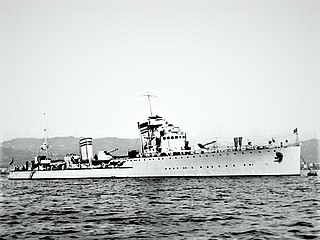
The Navigatori class were a group of Italian destroyers built in 1928–1929 for the Regia Marina, named after Italian explorers. They fought in World War II. Just one vessel, Nicoloso Da Recco, survived the conflict.

The Leone class were a group of destroyers built for the Italian Navy in the early 1920s. Five ships were planned and three completed. All three ships were based at Massawa, Eritrea, during World War II and were sunk during the East African Campaign.

The Vifor class was a group of four destroyers ordered by Romania in 1913 and built in Italy during the First World War. The four ships were however requisitioned by Italy in 1915 and rearmed as scout cruisers (esploratori), subsequently seeing service in World War I. Two were re-purchased by Romania in 1920 and saw service in World War II. The other two were eventually transferred by Italy to the Spanish Nationalists and saw service during the Spanish Civil War.

The Mirabello class were a group of three destroyers(originally scout cruisers) built for the Regia Marina during World War I. Carlo Alberto Racchia was sunk by a mine in the Black Sea during the Allied intervention in the Russian Civil War in 1920. The remaining two ships, obsolescent by 1938, were re-rated as destroyers and participated in World War II. Carlo Mirabello was also lost to a mine while escorting a convoy in 1941. The last surviving ship, Augusto Riboty, was reconfigured as a convoy escort in 1942–1943. The torpedo tubes were removed and depth charges and 20 mm (0.79 in) anti-aircraft guns added. She survived the war and was transferred to the Soviet Union as war reparations in 1946. The ship was scrapped five years later.

The QF 4-inch gun Mk IV was the main gun on most Royal Navy and British Empire destroyers in World War I. It was introduced in 1911 as a faster-loading light gun successor to the BL 4 inch Mk VIII gun. Of the 1,141 produced, 939 were still available in 1939. Mk XII and Mk XXII variants armed many British interwar and World War II submarines.
The Italian destroyers of World War II comprised a mix of old warship designs dating from World War I and some of the most modern of their type in the world. These destroyers also varied in size from enlarged torpedo-boats to esploratori.

SMS Helgoland was a Novara-class scout cruiser built for the Austro-Hungarian Navy right before World War I. Helgoland participated in several raids on the ships defending the Strait of Otranto, including the Battle of the Strait of Otranto in May 1917. She was transferred to Italy in 1920 in accordance with the peace treaties ending World War I and renamed Brindisi. After modifications, the ship was assigned to the squadron responsible for the Eastern Mediterranean until 1924. She spent the next five years based in Libya and Italy before Brindisi was disarmed and turned into a depot ship in 1929. The ship was stricken from the Navy List in 1937 and later broken up.

Nino Bixio was a protected cruiser built by the Italian Regia Marina in the early 1910s. She was the lead ship of the Nino Bixio class, which were built as scouts for the main Italian fleet. She was equipped with a main battery of six 120-millimeter (4.7 in) guns and had a top speed in excess of 26 knots, but her engines proved to be troublesome in service. Nino Bixio saw service during World War I and briefly engaged the Austro-Hungarian cruiser SMS Helgoland in 1915. Her career was cut short in the post-war period due to severe cuts to the Italian naval budget, coupled with her unreliable engines. Nino Bixio was stricken from the naval register in March 1929 and sold for scrap.
Marsala was a protected cruiser built by the Italian Regia Marina in the 1910s. She was the second and final member of the Nino Bixio class, which were built as scouts for the main Italian fleet. She was equipped with a main battery of six 120-millimeter (4.7 in) guns and had a top speed in excess of 26 knots, but her engines proved to be troublesome in service. Marsala spent World War I based at Brindisi; she was involved in the Battle of the Otranto Straits in May 1917, where she briefly engaged Austro-Hungarian cruisers. Marsala's career was cut short in November 1927 when she was stricken from the naval register and sold for scrap, the result of her unreliable engines and drastic cuts to the naval budget.

Quarto was a unique protected cruiser built by the Italian Regia Marina in the 1910s. Her keel was laid in November 1909, she was launched in August 1911, and was completed in March 1913. She was the first Italian cruiser to be equipped with steam turbines, which gave her a top speed of 28 knots. Her high speed was a requirement for the role in which she was designed to serve: a scout for the main Italian fleet.
Scipione Africano was an Italian Capitani Romani-class light cruiser, which served in the Regia Marina during World War II. As she commissioned in the spring of 1943, the majority of her service took place on the side of the Allies - 146 wartime missions after the Armistice of Cassibile versus 15 before. She remained commissioned in the Italian navy after the war, until allocated to France as war reparations by the Paris Peace Treaties of 1947. Scipione Africano was decommissioned from the Marina Militare in August 1948 and subsequently commissioned into the Marine Nationale as Guichen, after briefly being known as S.7.

