
Catalonia is an autonomous community in the northeastern corner of Spain, designated as a nationality by its Statute of Autonomy.
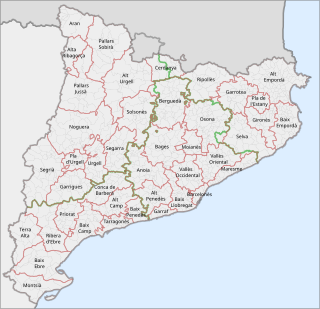
This is a list of the 42 comarques into which Catalonia is divided. A comarca is a group of municipalities, roughly equivalent to a "county" in the U.S.A. or the U.K. However, in the context of Catalonia, the term "county" can be a bit misleading, because in medieval Catalonia, aside from the kings of Aragon, the most important rulers were counts, notably the Counts of Barcelona and of Urgell. Comarques have no particular relation to the "counties" that were ruled by counts.
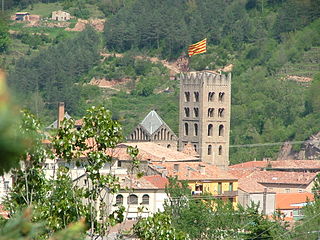
Ripoll is the capital of the comarca of Ripollès, in the province of Girona, Catalonia, Spain. It is located on confluence of the Ter River and its tributary Freser, next to the Pyrenees near the French border. The population was 11,057 in 2009.

Els Segadors is the official national anthem of Catalonia, nationality and autonomous community of Spain.
The Generalitat de Catalunya, or the Government of Catalonia, is the institutional system by which Catalonia politically organizes its self-government. It is formed by the Parliament of Catalonia, the Presidency of the Generalitat de Catalunya, and the Executive Council of Catalonia.
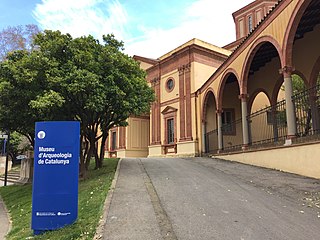
The Archaeology Museum of Catalonia is an archaeological museum with five venues that exposes the most important archaeological collection of Catalonia, focusing on prehistoric times and ancient history. The museum was originally founded in 1932 by the Republican Government of Catalonia. The modern institution was created under the Museums of Catalonia Act in 1990 by the Ministry of Culture of the same Government.

Vilafranca del Penedès, or simply Vilafranca, is the capital of the comarca of the Alt Penedès in Catalonia, Spain. The Spanish spelling of the name, Villafranca del Panadés, is no longer in official use since 1982. It is situated in the Penedès Depression on the left bank of the Foix River, and on the main axis of communication from Barcelona to Tarragona and Valencia, served by a Rodalies Barcelona line 4 and by the AP-7 autopista as well as by the C-243 towards Sant Sadurní d'Anoia, and C-15 roads to Vilanova i la Geltrú and Igualada respectively.

Barberà del Vallès is a municipality in the comarca of the Vallès Occidental, in the province of Barcelona, Spain. It is situated in the valley of the Ripoll river to the south of Sabadell, about 17 kilometers from Barcelona. It's integrated in the Metropolitan Area of Barcelona.

The 1995 Catalan regional election was held on Sunday, 19 November 1995, to elect the 5th Parliament of the autonomous community of Catalonia. All 135 seats in the Parliament were up for election.

The Barcelona–Vallès Line is an unconnected standard gauge railway line linking Barcelona with Sabadell and Terrassa via the Collserola mountain range, in Catalonia, Spain. Its name refers to the Catalan historical region of Vallès, whereby most part of the line runs. Plaça de Catalunya station serves as the Barcelona terminus of the line, where almost all its trains either start or terminate. The line then continues northwards and branches off twice before leaving the city limits. Its main route splits in two in Sant Cugat del Vallès, forming two major branches to Sabadell and Terrassa. It has 40 passenger stations in operation and a total line length of 48.1 kilometres (29.9 mi).

The Library of Catalonia is the Catalan national library, located in Barcelona, Catalonia, Spain. The primary mission of the Library of Catalonia is to collect, preserve, and spread Catalan bibliographic production and that related to the Catalan linguistic area, to look after its conservation, and to spread its bibliographic heritage while maintaining the status of a center for research and consultation.
The 1992 Catalan regional election was held on Sunday, 15 March 1992, to elect the 4th Parliament of the autonomous community of Catalonia. All 135 seats in the Parliament were up for election.

The 1988 Catalan regional election was held on Sunday, 29 May 1988, to elect the 3rd Parliament of the autonomous community of Catalonia. All 135 seats in the Parliament were up for election.

Rodalies de Catalunya is the main commuter and regional rail system in the Spanish autonomous community of Catalonia. It is administered by the Government of Catalonia and operated by the national rail operator Renfe Operadora. The system consists of 17 service lines chiefly centered in the Barcelona area, serving a total of 203 stations throughout Catalonia, with an average number of 1,000 trains running on it every day. In 2016, it had an annual ridership of 117 million.
The Centre Nacional d'Anàlisi Genòmica, Centro Nacional de Análisis Genómico, or simply CNAG, is a genome analysis center in Barcelona that carries out large-scale projects in collaboration with researchers from Catalonia, Spain and the International research community. It has a park of 13 last-generation sequencing systems supported by an outstanding computing infrastructure of 2.6 petabytes of data storage and over 1200 cores of computing, which has enabled the center to build a sequencing capacity of over 800 Gbases/day, the equivalent of completely sequencing eight human genomes every 24 hours. This capacity positions the CNAG as one of the top European centers in terms of sequencing capacity.

The Museum of the Mediterranean is a museum located in Torroella de Montgrí, founded in 2003, in an attempt to become an area for knowledge, reflection and research for the problems and worries that affect citizens in the 21st century. It is housed in Can Quintana, a 16th-century building. It is dedicated to the knowledge and communication of the Mediterranean Sea and uses the natural sounds, human sounds and music to show the reality of the land, the history and the culture of the village of Torroella, connected with the others Mediterranean cultures and towns. It pretends to become a site to think about the nearest territory and the main issues that affect the different Mediterranean nations.
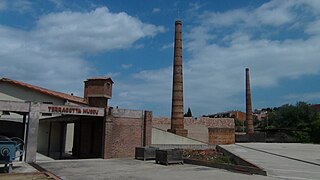
The Terracotta Museum, in La Bisbal d'Empordà, is a museum of pottery and industrial ceramics that was opened in 1991.

The Archaeology Museum of Catalonia in Girona is one of the five venues of the Archaeology Museum of Catalonia, located in the Sant Pere de Galligants Benedictine abbey of Girona since its foundation in 1857. It contains materials found during archaeological excavations at various sites in the province of Girona, dating from prehistory to the Middle Ages.

Anchovy and Salt Museum is a museum in the town of L'Escala, Catalonia, Spain. It was opened in 2006 as an institution dedicated to displaying the cultural heritage of the village. The permanent exhibition shows the history of fishing from the 16th century to the present day, especially the salted anchovy, an industry which, over the centuries, has been driving force of the town and has made it famous around the world.

The Girona City History Museum is a museum in the middle of the Old Town of Girona, in a unique building which used to be the convent of the Capuchin friars of Saint Anthony in 18th century, and which still conserves some surprising remnants of the time, such as the cemetery, cloister and cistern.


