
Pressure measurement is the measurement of an applied force by a fluid on a surface. Pressure is typically measured in units of force per unit of surface area. Many techniques have been developed for the measurement of pressure and vacuum. Instruments used to measure and display pressure mechanically are called pressure gauges,vacuum gauges or compound gauges. The widely used Bourdon gauge is a mechanical device, which both measures and indicates and is probably the best known type of gauge.

A pump is a device that moves fluids, or sometimes slurries, by mechanical action, typically converted from electrical energy into hydraulic or pneumatic energy.

A wind tunnel is "an apparatus for producing a controlled stream of air for conducting aerodynamic experiments". The experiment is conducted in the test section of the wind tunnel and a complete tunnel configuration includes air ducting to and from the test section and a device for keeping the air in motion, such as a fan. Wind tunnel uses include assessing the effects of flight speed on aircraft, ground speed on land vehicles, and wind speed on buildings and bridges. Wind tunnel test sections range in size from less than a foot across, to over 100 feet (30 m), and with air speeds from a light breeze to hypersonic.

The Ames Research Center (ARC), also known as NASA Ames, is a major NASA research center at Moffett Federal Airfield in California's Silicon Valley. It was founded in 1939 as the second National Advisory Committee for Aeronautics (NACA) laboratory. That agency was dissolved and its assets and personnel transferred to the newly created National Aeronautics and Space Administration (NASA) on October 1, 1958. NASA Ames is named in honor of Joseph Sweetman Ames, a physicist and one of the founding members of NACA. At last estimate NASA Ames had over US$3 billion in capital equipment, 2,300 research personnel and a US$860 million annual budget.

A carburetor is a device used by a gasoline internal combustion engine to control and mix air and fuel entering the engine. The primary method of adding fuel to the intake air is through the Venturi tube in the main metering circuit, though various other components are also used to provide extra fuel or air in specific circumstances.

In physics, a shock wave, or shock, is a type of propagating disturbance that moves faster than the local speed of sound in the medium. Like an ordinary wave, a shock wave carries energy and can propagate through a medium, but is characterized by an abrupt, nearly discontinuous, change in pressure, temperature, and density of the medium.

In the signage industry, neon signs are electric signs lighted by long luminous gas-discharge tubes that contain rarefied neon or other gases. They are the most common use for neon lighting, which was first demonstrated in a modern form in December 1910 by Georges Claude at the Paris Motor Show. While they are used worldwide, neon signs were popular in the United States from about the 1920s to 1950s. The installations in Times Square, many originally designed by Douglas Leigh, were famed, and there were nearly 2,000 small shops producing neon signs by 1940. In addition to signage, neon lighting is used frequently by artists and architects, and in plasma display panels and televisions. The signage industry has declined in the past several decades, and cities are now concerned with preserving and restoring their antique neon signs.

A compressor is a mechanical device that increases the pressure of a gas by reducing its volume. An air compressor is a specific type of gas compressor.

Hydropneumatic suspension is a type of motor vehicle suspension system, designed by Paul Magès, invented by Citroën, and fitted to Citroën cars, as well as being used under licence by other car manufacturers. Similar systems are also widely used on modern tanks and other large military vehicles. The suspension was referred to as Suspension oléopneumatique in early literature, pointing to oil and air as its main components.
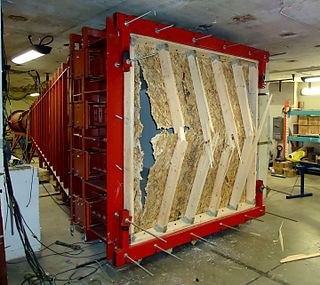
The shock tube is an instrument used to replicate and direct blast waves at a sensor or a model in order to simulate actual explosions and their effects, usually on a smaller scale. Shock tubes can also be used to study aerodynamic flow under a wide range of temperatures and pressures that are difficult to obtain in other types of testing facilities. Shock tubes are also used to investigate compressible flow phenomena and gas phase combustion reactions. More recently, shock tubes have been used in biomedical research to study how biological specimens are affected by blast waves.

The light-gas gun is an apparatus for physics experiments. It is a highly specialized gun designed to generate extremely high velocities. It is usually used to study high-speed impact phenomena, such as the formation of impact craters by meteorites or the erosion of materials by micrometeoroids. Some basic material research relies on projectile impact to create high pressure; such systems are capable of forcing liquid hydrogen into a metallic state.

An air pump is a pump for pushing air. Examples include a bicycle pump, pumps that are used to aerate an aquarium or a pond via an airstone; a gas compressor used to power a pneumatic tool, air horn or pipe organ; a bellows used to encourage a fire; a vacuum cleaner and a vacuum pump. All air pumps contain a part that moves which drives the flow of air. When the air gets moved, an area of low pressure gets created which fills up with more air.
Choked flow is a compressible flow effect. The parameter that becomes "choked" or "limited" is the fluid velocity.

A hypersonic wind tunnel is designed to generate a hypersonic flow field in the working section, thus simulating the typical flow features of this flow regime - including compression shocks and pronounced boundary layer effects, entropy layer and viscous interaction zones and most importantly high total temperatures of the flow. The speed of these tunnels vary from Mach 5 to 15. The power requirement of a wind tunnel increases linearly with its cross section and flow density, but cubically with the test velocity required. Hence installation of a continuous, closed circuit wind tunnel remains a costly affair. The first continuous Mach 7-10 wind tunnel with 1x1 m test section was planned at Kochel am See, Germany during WW II and finally put into operation as 'Tunnel A' in the late 1950s at AEDC Tullahoma, TN, USA for an installed power of 57 MW. In view of these high facility demands, also intermittently operated experimental facilities like blow-down wind tunnels are designed and installed to simulate the hypersonic flow. A hypersonic wind tunnel comprises in flow direction the main components: heater/cooler arrangements, dryer, convergent/divergent nozzle, test section, second throat and diffuser. A blow-down wind tunnel has a low vacuum reservoir at the back end, while a continuously operated, closed circuit wind tunnel has a high power compressor installation instead. Since the temperature drops with the expanding flow, the air inside the test section has the chance of becoming liquefied. For that reason, preheating is particularly critical.
A metering pump moves a precise volume of liquid in a specified time period providing an accurate volumetric flow rate. Delivery of fluids in precise adjustable flow rates is sometimes called metering. The term "metering pump" is based on the application or use rather than the exact kind of pump used, although a couple types of pumps are far more suitable than most other types of pumps.

A thermal expansion valve or thermostatic expansion valve is a component in vapor-compression refrigeration and air conditioning systems that controls the amount of refrigerant released into the evaporator and is intended to regulate the superheat of the refrigerant that flows out of the evaporator to a steady value. Although often described as a "thermostatic" valve, an expansion valve is not able to regulate the evaporator's temperature to a precise value. The evaporator's temperature will vary only with the evaporating pressure, which will have to be regulated through other means.
In aeronautics, expansion and shock tunnels are aerodynamic testing facilities with a specific interest in high speeds and high temperature testing. Shock tunnels use steady flow nozzle expansion whereas expansion tunnels use unsteady expansion with higher enthalpy, or thermal energy. In both cases the gases are compressed and heated until the gases are released, expanding rapidly down the expansion chamber. The tunnels reach speeds from Mach 3 to Mach 30 to create testing conditions that simulate hypersonic to re-entry flight. These tunnels are used by military and government agencies to test hypersonic vehicles that undergo a variety of natural phenomenon that occur during hypersonic flight.
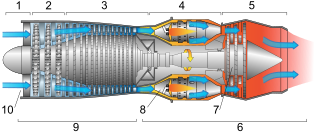
This article briefly describes the components and systems found in jet engines.
A ram accelerator is a device for accelerating projectiles or just a single projectile to extremely high speeds using jet-engine-like propulsion cycles based on ramjet or scramjet combustion processes. It is thought to be possible to achieve non-rocket spacelaunch with this technology.

A media dispenser or a culture media dispenser is a device for repeatedly delivering small fixed volumes of liquid such as a laboratory growth medium like molten agar or caustic or volatile solvents like toluene into a series of receptacles. It is often important that such dispensers operate without biological or chemical contamination, and so must be internally sealed from the environment and designed for easy cleaning and sterilization before use. At a minimum, a media dispenser consists of some kind of pump connected to a length of discharge tubing or a spout. Dispensers used in laboratories are also frequently connected to microcontrollers to regulate the speed and volume of the medium as it leaves the pump.


