The Federal Business Census (FBC) is a survey covering all second and third sector businesses and enterprises throughout Switzerland. The survey is conducted by the Swiss Federal Statistical Office (FSO) with the support of regional statistical offices. The aim of the survey is to collect complete data from all economic production units on economic, social and regional aspects. The BC is used to update the Business and Enterprise Register (BER), and serves as a reference for various statistics.
The BC is a complete survey. Data is collected by means of paper questionnaires, online questionnaires (eSurveys), and profiling (separate collection of data from large (government) administration units and enterprises). Participation in the survey is compulsory.
Data collected includes: locations of businesses, (address), economic activity, and number and names of persons employed by hours of work, sex, and nationality at the communal level (and per hectare for geocoded data).
The census is sanctioned by the Ordinance on the Conduct of Statistical Surveys by the Confederation of 30 June 1993 (RS 431.012.1).[1] The first census took place in 1905. Since then, it has been conducted three times per decade (in all years ending with 1, 5, and 8). Its reference day for any current calendar year is the last working day in September.
A census is the procedure of systematically acquiring, recording, and calculating population information about the members of a given population, usually displayed in the form of statistics. This term is used mostly in connection with national population and housing censuses; other common censuses include censuses of agriculture, traditional culture, business, supplies, and traffic censuses. The United Nations (UN) defines the essential features of population and housing censuses as "individual enumeration, universality within a defined territory, simultaneity and defined periodicity", and recommends that population censuses be taken at least every ten years. UN recommendations also cover census topics to be collected, official definitions, classifications, and other useful information to coordinate international practices.
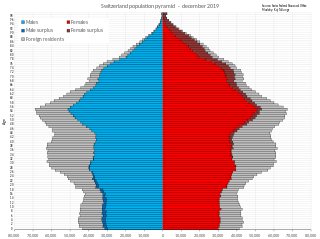
Switzerland has 9 million inhabitants, as of June 2024. Its population quadrupled over the period 1800 to 1990. Population growth was steepest in the period after World War II, it slowed during the 1970s and 1980s but has since increased to 1% during the 2000s.
The United States Census Bureau (USCB), officially the Bureau of the Census, is a principal agency of the U.S. Federal Statistical System, responsible for producing data about the American people and economy. The U.S. Census Bureau is part of the U.S. Department of Commerce and its director is appointed by the President of the United States. Currently, Robert Santos is the Director of the U.S. Census Bureau and Ron S. Jarmin is the Deputy Director.
A census tract, census area, census district or meshblock is a geographic region defined for the purpose of taking a census. Sometimes these coincide with the limits of cities, towns or other administrative areas and several tracts commonly exist within a county. In unincorporated areas of the United States these are often arbitrary, except for coinciding with political lines.
Statistics Canada, formed in 1971, is the agency of the Government of Canada commissioned with producing statistics to help better understand Canada, its population, resources, economy, society, and culture. It is headquartered in Ottawa.
Statistics Belgium is part of the Federal Public Service Economy, SMEs, Self-Employed and Energy. Its legal Dutch name is Algemene Directie Statistiek, and its legal French name is Direction générale Statistique.
The Brazilian Institute of Geography and Statistics is the agency responsible for official collection of statistical, geographic, cartographic, geodetic and environmental information in Brazil. IBGE performs a decennial national census; questionnaires account for information such as age, household income, literacy, education, occupation and hygiene levels.
The American Community Survey (ACS) is an annual demographics survey program conducted by the United States Census Bureau. It regularly gathers information previously contained only in the long form of the decennial census, including ancestry, US citizenship status, educational attainment, income, language proficiency, migration, disability, employment, and housing characteristics. These data are used by many public-sector, private-sector, and not-for-profit stakeholders to allocate funding, track shifting demographics, plan for emergencies, and learn about local communities.
Statistics Canada conducts a national census of population and census of agriculture every five years and releases the data with a two-year lag.
The Ministry of Statistics and Programme Implementation (MoSPI) is a ministry of Government of India concerned with coverage and quality aspects of statistics released. The surveys conducted by the Ministry are based on scientific sampling methods.
Official statistics are statistics published by government agencies or other public bodies such as international organizations as a public good. They provide quantitative or qualitative information on all major areas of citizens' lives, such as economic and social development, living conditions, health, education, and the environment.
Labour Force Surveys are statistical surveys conducted in a number of countries designed to capture data about the labour market. All European Union member states are required to conduct a Labour Force Survey annually. Labour Force Surveys are also carried out in some non-EU countries. They are used to calculate the International Labour Organization (ILO)-defined unemployment rate. The ILO agrees the definitions and concepts employed in Labour Force Surveys.
The Federal Statistical Office (FSO) is a Federal agency of the Swiss Confederation. It is the statistics office of Switzerland, situated in Neuchâtel and attached to the Federal Department of Home Affairs.
The Swiss Federal Statistics Committee (FStatC) is an advisory body for the Federal Council, the Federal Statistical Office and other statistics producers of the Confederation. It includes high-ranking representatives from the cantons and municipalities, from the economy, social partners, the scientific world, the Swiss National Bank as well as from the federal administration. The committee was established with the nomination of its members by the Federal Council on 10 November 1993. Its legal basis is the Federal Statistical Act of 9 October 1992 and the Ordinance of 30 June 1993 on the Conduct of Federal Statistical Surveys.
The Swiss Labour Force Survey (SLFS) - conducted by the Federal Statistical Office in cooperation with an external service provider - is a household survey that has been conducted since 1991. The main goal is to survey the employment structure and employment behaviour of the permanent resident population. Because of the strict application of international definitions in the SLFS, Swiss data can be compared with those of other OECD countries and the countries of the European Union. Since 2010, the SLFS has been conducted on a quarterly basis. The interviews from the third and fourth quarters of 2009 serve as a transition from the old to the new (continuous) SLFS.
The legal basis of official statistics in Switzerland is the Swiss Federal Constitution. Article 65 of the Swiss Federal Constitution sets out the mandate and competencies of official statistics.
The Land Use Statistics of the Federal Statistical Office collect information in 12-year intervals about Switzerland's land use and land cover based on aerial photographs of the Federal Office of Topography (swisstopo). In addition to statistics, the Land Use Statistics also provides basic geodata in hectare resolution for Geographical Information Systems (GIS) of the Confederation, the cantons, research institutes and higher education institutions. Furthermore, it provides inputs for national programmes and indicator systems.
The first Federal population census in Switzerland took place in March 1850 under the direction of Federal Councillor Stefano Franscini. As well as counting the number of inhabitants, respondents were also asked about their sex, age, marital status, occupation and religion. Between 1860 and 2000, a census took place every ten years in December. The only exceptions to this 10-year rhythm were the population census of 1888 and the population census of 1941. The census of 2000 was the last to use traditional methods. Since 2010, the population census has been carried out and analysed annually in a new format by the Federal Statistical Office (FSO). In order to ease the burden on the population, the information is primarily drawn from population registers and supplemented by sample surveys. Only a small proportion of the population are surveyed in writing or by telephone. The first reference day for the new census was 31 December 2010.
The National Consumer Price Index measures the price inflation of key consumer goods for Swiss private households. The average of the population is used as a reference to obtain a "truthful" value. The CPI measures the price trend based on a basket of commodities containing about 1050 goods and services. These are weighted according to their share of the household budget.
This is a list of national population and housing censuses.
This page is based on this Wikipedia article Text is available under the CC BY-SA 4.0 license; additional terms may apply. Images, videos and audio are available under their respective licenses.