In mathematics, a field is a set on which addition, subtraction, multiplication, and division are defined and behave as the corresponding operations on rational and real numbers do. A field is thus a fundamental algebraic structure which is widely used in algebra, number theory, and many other areas of mathematics.
In mathematics, a finite field or Galois field is a field that contains a finite number of elements. As with any field, a finite field is a set on which the operations of multiplication, addition, subtraction and division are defined and satisfy certain basic rules. The most common examples of finite fields are given by the integers mod p when p is a prime number.
In mathematics, in the area of abstract algebra known as Galois theory, the Galois group of a certain type of field extension is a specific group associated with the field extension. The study of field extensions and their relationship to the polynomials that give rise to them via Galois groups is called Galois theory, so named in honor of Évariste Galois who first discovered them.
In mathematics, a profinite group is a topological group that is in a certain sense assembled from a system of finite groups.
In number theory, the ideal class group of an algebraic number field K is the quotient group JK /PK where JK is the group of fractional ideals of the ring of integers of K, and PK is its subgroup of principal ideals. The class group is a measure of the extent to which unique factorization fails in the ring of integers of K. The order of the group, which is finite, is called the class number of K.
In mathematics, class field theory (CFT) is the fundamental branch of algebraic number theory whose goal is to describe all the abelian Galois extensions of local and global fields using objects associated to the ground field.
In mathematics, the étale cohomology groups of an algebraic variety or scheme are algebraic analogues of the usual cohomology groups with finite coefficients of a topological space, introduced by Grothendieck in order to prove the Weil conjectures. Étale cohomology theory can be used to construct ℓ-adic cohomology, which is an example of a Weil cohomology theory in algebraic geometry. This has many applications, such as the proof of the Weil conjectures and the construction of representations of finite groups of Lie type.
In mathematics, a Galois module is a G-module, with G being the Galois group of some extension of fields. The term Galois representation is frequently used when the G-module is a vector space over a field or a free module over a ring in representation theory, but can also be used as a synonym for G-module. The study of Galois modules for extensions of local or global fields and their group cohomology is an important tool in number theory.
In mathematics, an algebraic torus, where a one dimensional torus is typically denoted by , , or , is a type of commutative affine algebraic group commonly found in projective algebraic geometry and toric geometry. Higher dimensional algebraic tori can be modelled as a product of algebraic groups . These groups were named by analogy with the theory of tori in Lie group theory. For example, over the complex numbers the algebraic torus is isomorphic to the group scheme , which is the scheme theoretic analogue of the Lie group . In fact, any -action on a complex vector space can be pulled back to a -action from the inclusion as real manifolds.
Chebotarev's density theorem in algebraic number theory describes statistically the splitting of primes in a given Galois extension K of the field of rational numbers. Generally speaking, a prime integer will factor into several ideal primes in the ring of algebraic integers of K. There are only finitely many patterns of splitting that may occur. Although the full description of the splitting of every prime p in a general Galois extension is a major unsolved problem, the Chebotarev density theorem says that the frequency of the occurrence of a given pattern, for all primes p less than a large integer N, tends to a certain limit as N goes to infinity. It was proved by Nikolai Chebotaryov in his thesis in 1922, published in.
In commutative algebra and field theory, the Frobenius endomorphism is a special endomorphism of commutative rings with prime characteristic p, an important class which includes finite fields. The endomorphism maps every element to its p-th power. In certain contexts it is an automorphism, but this is not true in general.
The Artin reciprocity law, which was established by Emil Artin in a series of papers, is a general theorem in number theory that forms a central part of global class field theory. The term "reciprocity law" refers to a long line of more concrete number theoretic statements which it generalized, from the quadratic reciprocity law and the reciprocity laws of Eisenstein and Kummer to Hilbert's product formula for the norm symbol. Artin's result provided a partial solution to Hilbert's ninth problem.

In mathematics, the absolute Galois groupGK of a field K is the Galois group of Ksep over K, where Ksep is a separable closure of K. Alternatively it is the group of all automorphisms of the algebraic closure of K that fix K. The absolute Galois group is well-defined up to inner automorphism. It is a profinite group.

In number theory and algebraic geometry, the Tate conjecture is a 1963 conjecture of John Tate that would describe the algebraic cycles on a variety in terms of a more computable invariant, the Galois representation on étale cohomology. The conjecture is a central problem in the theory of algebraic cycles. It can be considered an arithmetic analog of the Hodge conjecture.
In mathematics, a thin set in the sense of Serre, named after Jean-Pierre Serre, is a certain kind of subset constructed in algebraic geometry over a given field K, by allowed operations that are in a definite sense 'unlikely'. The two fundamental ones are: solving a polynomial equation that may or may not be the case; solving within K a polynomial that does not always factorise. One is also allowed to take finite unions.
In mathematics, a field is pseudo algebraically closed if it satisfies certain properties which hold for algebraically closed fields. The concept was introduced by James Ax in 1967.
In Galois theory, a branch of mathematics, the embedding problem is a generalization of the inverse Galois problem. Roughly speaking, it asks whether a given Galois extension can be embedded into a Galois extension in such a way that the restriction map between the corresponding Galois groups is given.
In mathematics, the Haran diamond theorem gives a general sufficient condition for a separable extension of a Hilbertian field to be Hilbertian.
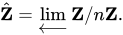
In mathematics, a profinite integer is an element of the ring

Moshe Jarden is an Israeli mathematician, specialist in field arithmetic.