Related Research Articles

The Battle of Clontarf took place on 23 April 1014 at Clontarf, near Dublin, on the east coast of Ireland. It pitted an army led by Brian Boru, High King of Ireland, against a Norse-Irish alliance comprising the forces of Sigtrygg Silkbeard, King of Dublin; Máel Mórda mac Murchada, King of Leinster; and a Viking army from abroad led by Sigurd of Orkney and Brodir of Mann. It lasted from sunrise to sunset, and ended in a rout of the Viking and Leinster armies.
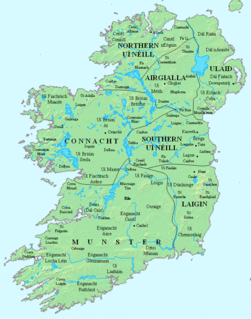
Uí Fhiachrach Aidhne was a kingdom located in what is now the south of County Galway.
Flaithbertach mac Loingsig was a High King of Ireland. He was a member of the Cenél Conaill, a branch of the northern Uí Néill. He was the son of Loingsech mac Óengusso, a previous high king. He ruled from 728 to 734.

O'Flaherty, is an Irish Gaelic clan based most prominently in what is today County Galway. The clan name originated in the 10th century as a derivative of its founder Flaithbheartach mac Eimhin. They descend in the paternal line from the Connachta's Uí Briúin Seóla. They were originally kings of Maigh Seóla and Muintir Murchada and as members of the Uí Briúin were kinsmen of the Ó Conchubhair and Mac Diarmada amongst others. After their king Cathal mac Tigernán lost out to Áed in Gai Bernaig in the 11th century, the family were pushed further west to Iar Connacht, a territory associated with Connemara today. They continued to rule this land until the 16th century.
Conall Gulban was an Irish king and eponymous ancestor of the Cenél Conaill, who founded the kingdom of Tír Chonaill in the 5th century, comprising much of what is now County Donegal in Ulster. He was the son of Niall Noígiallach.

The Kings of Ailech were the over-kings of the medieval Irish province of Ailech in north-western Ireland. It encompassed the territories of the Cenél nEógain and Cenél Conaill. After the battle of Cloítech in 789 its kings have been exclusively from the Cenél nEógain. The royal fort for Ailech was the Grianan of Aileach, a hillfort on top of Greenan Mountain in modern-day County Donegal, Republic of Ireland.
Áed Allán was an 8th-century Irish king of Ailech and High King of Ireland. Áed Allán was the son of Fergal mac Máele Dúin and a member of the Cenél nEógain, a branch of the Northern Uí Néill.

Cormac mac Cuilennáin was an Irish bishop and was king of Munster from 902 until his death at the Battle of Bellaghmoon. He was killed fighting in Leinster, probably attempting to restore the fortunes of the kings of Munster by reimposing authority over that province.
Domhnall ua Néill was High King of Ireland from 956 to 980.
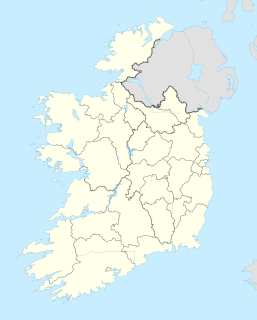
Corcomroe is a barony in County Clare, Ireland. It is the southern half of the Gaelic tuath of Corco Modhruadh.
Ruaidrí ua Canannáin was king of the Cenél Conaill, and according to some sources, High King of Ireland.
Donn Cothaid mac Cathail, King of Connacht, died 773.
Niall mac Eochada, was king of Ulaid from 1016.
Flaithbertach Ua Néill was king of Ailech, a kingdom of north-west Ireland. He abdicated in 1030 and undertook a pilgrimage to Rome, for which reason he was known as Flaithbertach an Trostáin. Following the death of his son Áed in 1033, Flaithbertach left his retirement and resumed the leadership of the Northern Uí Néill.
Áed mac Flaithbertaig, called Áed Muinderg, was a chief of the Cenél Conaill of the northern Uí Néill. He was the son of the high king Flaithbertach mac Loingsig. His byname Muinderg means "red-necked".
Events from the 8th century in Ireland.
The Abbot of Clonard was the monastic head of Clonard Abbey, which is in modern-day County Meath, Ireland. The abbey was founded by Saint Finnian in the early sixth century. After the death of Saint Finnian, the abbots bore the title "Comarbai Finnéin". However, the title was ambiguous, since it may refer to the abbots of Moville, County Down, founded by Finnian nepos Fiatach. The abbots of Clonard were sometimes called 'coarbs of Finnian and Mo Cholmóc'. Until the early twelfth century, a few of the abbots and some others at Clonard Abbey were consecrated bishops, but this did not necessarily mean they were bishops of Clonard, since the diocese of Clonard was not established until the Synod of Rathbreasail in 1111.
The Kings of Ui Fiachrach Muaidhe were the northern branch of Ui Fiachrach, based on the plain of the Muaidhe.
Clan Ewen of Otter, was a Highland clan which once controlled the area around Kilfinan on the Cowal peninsula in Argyll.

The Northern Uí Néill is the name given to several dynasties in north-western medieval Ireland that claimed descent from a common ancestor, Niall of the Nine Hostages. Other dynasties in central and eastern Ireland who also claimed descent from Niall were termed the Southern Uí Néill. The dynasties of the Northern Uí Néill were the Cenél Conaill and Cenél nEógain, named after supposed sons of Niall: Conall and Eógain.
References
- ↑ Hennessy, William Maunsell; MacCarthy, Bartholomew (1893). Annala Uladh: 1057–1131: 1155–1378, ed. by B. MacCarthy. p. 297.
 | This page or section lists people that share the same given name. If an internal link led you here, you may wish to change that link to point directly to the intended article. |