FocusTrack is a database program created specifically for stage lighting applications. The program is designed to allow lighting designers, lighting programmers and lighting electricians to document the way that a show is lit, in order to be able to accurately maintain the look of the lighting over the run of the show, and to be able to re-create the lighting on tour or for future productions of the show in other venues.
Traditionally, the lighting programmer has relied on their memory, the reliability of the lights or the services of an assistant, often called a lighting tracker, to document each position each light is used in. FocusTrack automates this process by importing the lighting console showfile (from Strand 500-series, ETC Eos-family and MA grandMA consoles) to create a list of each position (called a 'focus') used by each light in the show. The programmer can then add a written description of the purpose of each position. To precisely document the light's position on stage, the programmer can use a digital camera to take a picture of each position in turn. FocusTrack can aid in this process by controlling the lighting console, turning each light on in each position as required; it can then import the photographs to give a complete record of the work of the automated lights during the show.
The information can be displayed in a variety of ways according to circumstance, for example showing all of the uses of one light if it was replaced and the replacement needs to be checked, or all of the lights used in each cue state that might need their focuses corrected when setting up a show in a new venue. FocusTrack is designed to work alongside other lighting industry software, such as Lightwright, to manage information about the lighting rig as a whole. It can also analyze how equipment is used in a show, particularly colour scrolls or gobos, in order to allow the lighting rig to be rationalised for future productions.
It has been used on a range of productions around the world.[citation needed]
Stage lighting is the craft of lighting as it applies to the production of theater, dance, opera, and other performance arts. Several different types of stage lighting instruments are used in this discipline. In addition to basic lighting, modern stage lighting can also include special effects, such as lasers and fog machines. People who work on stage lighting are commonly referred to as lighting technicians or lighting designers.
In theatre, a lighting designer works with the director, choreographer, set designer, costume designer, and sound designer to create the lighting, atmosphere, and time of day for the production in response to the text while keeping in mind issues of visibility, safety, and cost. The LD also works closely with the stage manager or show control programming, if show control systems are used in that production. Outside stage lighting, the job of a lighting designer can be much more diverse, and they can be found working on rock and pop tours, corporate launches, art installations, or lighting effects at sporting events.
Electrical lighting technicians (ELT), or simply lighting tech, are involved with rigging stage and location sets and controlling artificial, electric lights for art and entertainment venues or in video, television, or film production.
A technical director (TD) is usually a senior technical person within e.g. a software company, engineering firm, film studio, theatre company or television studio. This person usually has the highest level of skill within a specific technical field.
A lighting control console is an electronic device used in theatrical lighting design to control multiple stage lights at once. They are used throughout the entertainment industry and are normally placed at the front of house (FOH) position or in a control booth.
The light board operator or moving light programmer, is the electrician who operates and/or programs the light board. Depending on the scale and type of production, the board op may be responsible for conventional or automated lighting fixtures, as well as practicals and, in some instances, controlling video as well.
In theatre, the master electrician is responsible for implementing the lighting design for a production drawn up by the lighting designer. This involves overseeing the preparation, hanging, connection and focusing of stage lighting fixtures.
A stagehand is a person who works backstage or behind the scenes in theatres, film, television, or location performance. Their work include setting up the scenery, lights, sound, props, rigging, and special effects for a production.
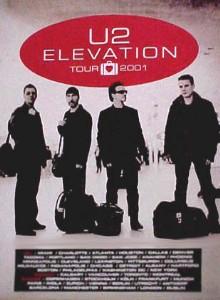
The Elevation Tour was a worldwide concert tour by Irish rock band U2. Staged in support of the group's 2000 album All That You Can't Leave Behind, the tour visited arenas across North America and Europe in 2001. Contrasting with the extravagant, outdoor productions of the band's previous two live ventures, the Zoo TV Tour (1992–1993) and the PopMart Tour (1997–1998), the Elevation Tour saw them return to indoor arenas with a much more stripped-down, intimate stage design. The stage featured a heart-shaped catwalk that encircled many audience members, and festival seating was offered in the United States for the first time in the group's history.
A lighting control system is an intelligent network based lighting control solution that incorporates communication between various system inputs and outputs related to lighting control with the use of one or more central computing devices. Lighting control systems are widely used on both indoor and outdoor lighting of commercial, industrial, and residential spaces. Lighting control systems are sometimes referred to under the term smart lighting. Lighting control systems serve to provide the right amount of light where and when it is needed.
Intelligent lighting refers to lighting that has automated or mechanical abilities beyond those of traditional, stationary illumination. Although the most advanced intelligent lights can produce extraordinarily complex effects, the intelligence lies with the human lighting designer, control system programmer, or the lighting operator, rather than the fixture itself. For this reason, intelligent lighting (ILS) is also known as automated lighting, moving lights, moving heads, or simply movers.
Stage lighting instruments are used in stage lighting to illuminate theatrical productions, concerts, and other performances taking place in live performance venues. They are also used to light television studios and sound stages.
The technical rehearsal or tech rehearsal is a rehearsal that focuses on the technological aspects of the performance, in theatrical, musical, and filmed entertainment.
Theater drapes and stage curtains are large pieces of cloth that are designed to mask backstage areas of a theater from spectators. They are designed for a variety of specific purposes, moving in different ways and constructed from various fabrics. Many are made from black or other darkly colored, light-absorbing material. Theater drapes represent a portion of any production's soft goods, a category comprising any non-wardrobe, cloth-based element of the stage or scenery. Theater curtains are often pocketed at the bottom to hold weighty chain or to accept pipes to remove their fullness and stretch them tight.
A theatrical technician is a person who operates technical equipment and systems in the performing arts and entertainment industry. In contrast to performers, this broad category contains all "unseen" theatrical personnel who practice stagecraft and are responsible for the logistic and production-related aspects of a performance including designers, operators, and supervisors.
In theatre, an electrician is a person who works with the various aspects of lighting. Some of the positions among electricians include the lighting supervisor, master electrician, deck electrician, light board operator, moving light programmer, followspot operator, as well as simply electricians. This group is generally known as the "Electrics" Department or LX Department.
Live sound mixing is the blending of multiple sound sources by an audio engineer using a mixing console or software. Sounds that are mixed include those from instruments and voices which are picked up by microphones and pre-recorded material, such as songs on CD or a digital audio player. Individual sources are typically equalised to adjust the bass and treble response and routed to effect processors to ultimately be amplified and reproduced via a loudspeaker system. The live sound engineer listens and balances the various audio sources in a way that best suits the needs of the event.
Vari-Lite is a brand of automated, variable-colour stage lighting systems. Their intelligent lighting fixtures are commonly used in theatre, concerts, television, film and corporate events.
Stage lighting accessories are components manufactured for conventional (non-automated) stage lighting instruments. Most conventional fixtures are designed to accept a number of different accessories designed to assist in the modification of the output. These accessories are intended to either provide relatively common functionality not originally provided in a fixture, or to extend the versatility of a lighting instrument by introducing features. Other accessories have been designed to overcome limitations or difficulties some fixtures present in specific applications.
Multi-image is the now largely obsolete practice and business of using 35mm slides (diapositives) projected by single or multiple slide projectors onto one or more screens in synchronization with an audio voice-over or music track. Multi-image productions are also known as multi-image slide presentations, slide shows and diaporamas and are a specific form of multimedia or audio-visual production.
This page is based on this Wikipedia article Text is available under the CC BY-SA 4.0 license; additional terms may apply. Images, videos and audio are available under their respective licenses.