
The Ponte Vecchio is a medieval stone closed-spandrel segmental arch bridge over the Arno, in Florence, Italy. The only bridge in Florence spared from destruction during World War II, it is noted for the shops built along it; building shops on such bridges was once a common practice. Butchers, tanners, and farmers initially occupied the shops; the present tenants are jewellers, art dealers, and souvenir sellers. The Ponte Vecchio's two neighbouring bridges are the Ponte Santa Trinita and the Ponte alle Grazie.
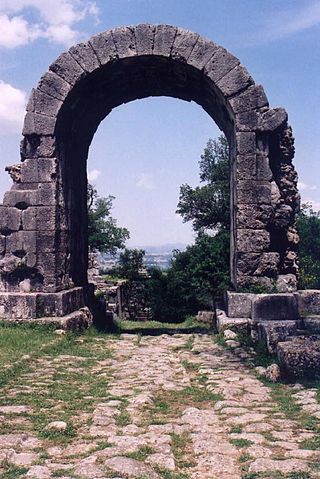
The Via Flaminia was an ancient Roman road leading from Rome over the Apennine Mountains to Ariminum (Rimini) on the coast of the Adriatic Sea, and due to the ruggedness of the mountains was the major option the Romans had for travel between Etruria, Latium, Campania, and the Po Valley. The section running through northern Rome is where Constantine the Great, allegedly, had his famous vision of the Chi Rho, leading to his conversion to Christianity and the Christianization of the Roman Empire.

The Rialto Bridge is the oldest of the four bridges spanning the Grand Canal in Venice, Italy. Connecting the sestieri (districts) of San Marco and San Polo, it has been rebuilt several times since its first construction as a pontoon bridge in 1173, and is now a significant tourist attraction in the city.

The Via Praenestina was an ancient Roman road in central Italy.

Comacchio is a town and comune of Emilia Romagna, Italy, in the province of Ferrara, 48 kilometres (30 mi) from the provincial capital Ferrara. It was founded about two thousand years ago; across its history it was first governed by the Exarchate of Ravenna, then by the Duchy of Ferrara, and eventually returned to be part of the territories of the Papal States. For its landscape and its history, it is considered one of the major centres of the Po delta.

The Pons Fabricius or Ponte dei Quattro Capi, is the oldest extant bridge in Rome, Italy. Built in 62 BC, it spans half of the Tiber River, from the Campus Martius on the east side to Tiber Island in the middle. Quattro Capi refers to the two marble pillars of the two-faced Janus herms on the parapet, which were moved here from the nearby Church of St Gregory in the 14th century.

Ponte Sant'Angelo, originally the Aelian Bridge or Pons Aelius, is a Roman bridge in Rome, Italy, completed in 134 AD by Roman Emperor Hadrian, to span the Tiber from the city centre to his newly constructed mausoleum, now the towering Castel Sant'Angelo. The bridge is faced with travertine marble and spans the Tiber with five arches, three of which are Roman; it was approached by means of a ramp from the river. The bridge is now solely pedestrian and provides a scenic view of Castel Sant'Angelo. It links the rioni of Ponte, and Borgo, to which the bridge administratively belongs.

The Bridge of Tiberius, historically also the Bridge of Augustus or the Bridge of Saint Julian, is a Roman bridge in Rimini, in the region of Emilia-Romagna, northern Italy.

The Castel Vecchio Bridge or Scaliger Bridge is a fortified bridge in Verona, northern Italy, over the Adige River. The segmental arch bridge featured the world's largest span at the time of its construction.

The Ponte della Costituzione is the fourth bridge over the Grand Canal in Venice, Italy. It was designed by Santiago Calatrava, and was moved into place in 2007, amid protest by politicians and the general public. The bridge was installed in 2008 and opened to the public on the night of September 11, 2008. The bridge was known as Quarto Ponte sul Canal Grande before the official name was adopted to celebrate the 60th anniversary of the Italian constitution in 2008. Tourists and locals in Venice now refer to it as the Calatrava Bridge.
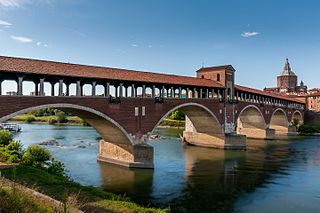
The Ponte Coperto or the Ponte Vecchio is a stone and brick arch bridge over the river Ticino in Pavia, Italy.
The Ponte di Quintodecimo is a Roman stone bridge over the river Tronto next to the village of Quintodecimo, Marche, central Italy.
The Ponte di Pioraco is a Roman bridge in Pioraco, central Italy, presumably erected under emperor Augustus (r. 30 BC–14 AD).
The Ponte San Lorenzo is a Roman bridge over the river Bacchiglione in Padua, Italy. Constructed between 47 and 30 BC, it is one of the very earliest segmental arched bridges in the world. It is also notable for the slenderness of its piers, unsurpassed in antiquity.
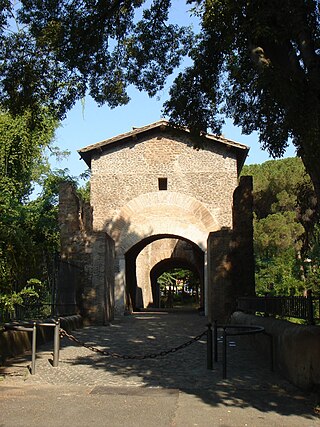
The Ponte Nomentano is a Roman bridge in Rome, Italy, which carried the Via Nomentana over the Aniene. Having lain outside the city limits for most of its history, the picturesque bridge is noted for its medieval bridge tower, which served to protect this important northern approach to Rome.

The Ponte di San Francesco is a medieval segmental arch bridge over the River Aniene in Subiaco, in the Italian region of Lazio. Constructed in 1358, its single span measures 37 metres (121 ft).

The Ponte Salario, also called Ponte Salaro during the Middle Ages, is a road bridge in Rome, Italy, whose origins date back to the Roman period. In antiquity, it lay outside the city limits, 3 km north of the Porta Collina, at the point where the Via Salaria crossed the Aniene, a tributary of the Tiber. The visible side arches are assumed to originate from the first stone structure built during the 1st century BC.

The Bridge of Augustus is a Roman arch bridge in the Italian city Narni in Umbria, built to carry the Flaminian Way over the river Nera. Of the original four spans of the 160-metre-long (520 ft) bridge, only the southernmost remains standing.
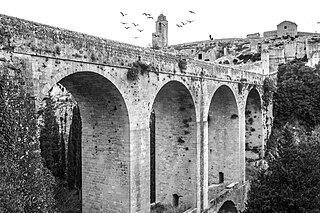
The Ponte Madonna della Stella, also known as the Ponte Acquedotto Madonna della Stella, Ponte Viadotto-Acquedotto Madonna della Stella, or simply il ponte di Gravina, amongst other combinations, is an eighteenth-century bridge and aqueduct over the Gravina in the southern Italian town of Gravina in Puglia.


