Related Research Articles
Heinz Neukirchen was an officer of the Kriegsmarine in World War II,and a Vizeadmiral in the People's Navy (Volksmarine) of the German Democratic Republic as well as President of the East German Directorate of Maritime and Port Industries. He was the author of several maritime books.

Horst Möller is a German contemporary historian. He is Professor of Modern History at the Ludwig Maximilian University of Munich (LMU) and,from 1992 to 2011,Director of the Institut für Zeitgeschichte.

The Peasants Mutual Aid Association was an East German mass organization for peasants and farmers,later also gardeners. It was founded in the 1945–1946 period and was a participant in the National Front. From 1950 to 1963 and again in 1986,it had representation in the Volkskammer.

Günter Kochan was a German composer. He studied with Boris Blacher and was a master student for composition with Hanns Eisler. From 1967 until his retirement in 1991,he worked as professor for musical composition at the Hochschule für Musik "Hanns Eisler". He taught master classes in composition at the Academy of Music and the Academy of Arts,Berlin. He was also secretary of the Music Section of the Academy of Arts from 1972 to 1974 and vice-president of the Association of Composers and Musicologists of the GDR from 1977 to 1982. Kochan is one of eleven laureates to have been awarded the National Prize of the GDR four times. In addition,he received composition prizes in the US and Eastern Europe. He became internationally known in particular for his Symphonies as well as the cantata Die Asche von Birkenau (1965) and his Music for Orchestra No. 2 (1987). His versatile oeuvre included orchestral works,chamber music,choral works,mass songs and film music and is situated between socialist realism and avant-garde.
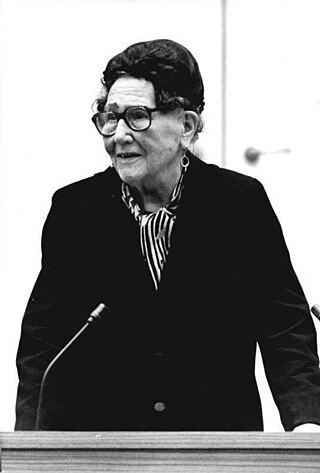
Wilhelmine Schirmer-Pröscher was an East German politician of the Liberal Democratic Party of Germany. She received the Order of Karl Marx in 1984.

Walter Buchheim was an East German politician and Trade unionist.
Friedrich Wehmer was a regional politician in Germany during the Weimar period and a national politician in the German Democratic Republic after the war.
Andreas Herbst is a German historian. His career has been divided between authorship and museum work. He has written extensively on aspects of the German Democratic Republic and since 2001 has worked for the German Resistance Memorial Center in Berlin.

Walter Bartel was a German communist resistance fighter,historian and university professor.
William Borm was a German politician,of the Free Democratic Party (FDP). He was a member of the Bundestag from 1965 to 1972,and a member of the FDP National Executive Committee from 1960 to 1982. Several years after his death,it was revealed that since the late 1950s he had been an agent of the Stasi,the State Security Service of the German Democratic Republic.

Ernst Wulf was an East German farmer and political activist who served as chairman of the Peasants Mutual Aid Association,a mass organization within the National Front,from 1964 to 1979.

Gottfried Drechsel was an East German functionary of the Peasants Mutual Aid Association and politician. He sat in the People's Chamber between 1986 and 1990.

Horst Stechbarth was an East German politician and high-ranking military officer in the National People's Army,holding the rank of Generaloberst. He was the Chief of the NVA's Landstreitkräfte and the ex officio Deputy Minister of Defense of the GDR. He was also a member of the Politbüro of the Central Committee of the ruling Socialist Unity Party of Germany (SED).

State elections were held in the Soviet occupation zone of Germany on 20 October 1946 to elect the state legislatures of Mecklenburg-Vorpommern,Brandenburg,Saxony,Saxony-Anhalt and Thuringia. They were the only elections held in the future territory of East Germany before the establishment of the German Democratic Republic in 1949,and the only free and fair elections in that part of Germany between 1932 and the Peaceful Revolution.

Jean Kurt Forest was a German violinist and violist,Kapellmeister and composer. He began his career as concertmaster in film orchestras conducted by Paul Dessau,then played principal viola in Frankfurt and Hamburg. Drafted to the Wehrmacht in 1942,he defected to the Red Army in 1945 and remained a prisoner of war until 1948. Back in East Berlin,he shaped musical life in the GDR in several positions,before he focused on composition from 1954,composing political songs and operas raising social awareness.
Dieter Hebig is a German archivist and historian.
Wolfgang Lesser was a German composer and music official of the GDR.
The Hanns Eisler Prize was an East-German music award,named after the composer Hanns Eisler. It was awarded by Radio DDR –with advisory participation of the music section of the Akademie der Künste der DDR in Berlin (East) and the Verband der Komponisten und Musikwissenschaftler der DDR (VDK) –and on the occasion of his 70th birthday on 6 July 1968,the first time in the ballroom of the Alten Rathaus. The Hanns Eisler Prize was endowed with 10,000 marks and was one of the most renowned music prizes in the German Democratic Republic.
Erhard (Eberhard) Ragwitz is a German musicologist,composer,and lecturer. From 1986 to 1989,he was the rector of the Hochschule für Musik "Hanns Eisler".
References
- ↑ Die Volkskammer der Deutschen Demokratischen Republik, 4. Wahlperiode, Staatsverlag der DDR Berlin, 1964, p. 682
- ↑ Gabriele Baumgartner, Dieter Hebig (ed.): Biographisches Handbuch der SBZ/DDR. 1945–1990. vol. 2. K. G. Saur Verlag, Munich 1997, ISBN 3-598-11177-0, p. 1043.
- ↑ Gerd-Rüdiger Stephan et al. (ed.): Die Parteien und Organisationen der DDR. Ein Handbuch. Dietz, Berlin 2002, ISBN 3-320-01988-0, p. 1130.
