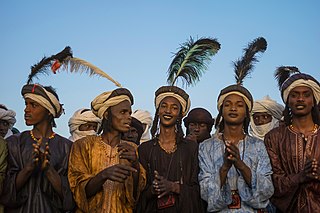
The Fula, Fulani, or Fulɓe people are an ethnic group in Sahara, Sahel and West Africa, widely dispersed across the region. Inhabiting many countries, they live mainly in West Africa and northern parts of Central Africa, South Sudan, Darfur, and regions near the Red Sea coast in Sudan. The approximate number of Fula people is unknown, due to clashing definitions regarding Fula ethnicity. Various estimates put the figure between 25 and 40 million people worldwide.
Hausa–Fulani are people of mixed Hausa and Fulani origin. They are primarily found in the Northern region of Nigeria, most of whom speak a variant of Hausa or Fula or both as their first language. The term Hausa-Fulani is also used mostly as a joint term to refer to both the monoethnic Hausa and Fulani ethnic populations in Northern Nigeria.

Fouta Djallon is a highland region in the center of Guinea, roughly corresponding with Middle Guinea, in West Africa.
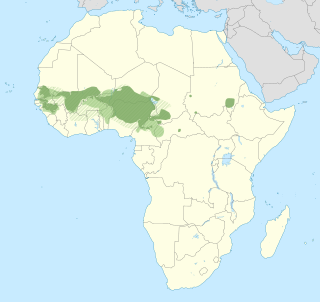
Fula, also known as Fulani or Fulah, is a Senegambian language spoken by around 36.8 million people as a set of various dialects in a continuum that stretches across some 18 countries in West and Central Africa. Along with other related languages such as Serer and Wolof, it belongs to the Atlantic geographic group within Niger–Congo, and more specifically to the Senegambian branch. Unlike most Niger-Congo languages, Fula does not have tones.
Pulaar is a Fula language spoken primarily as a first language by the Fula and Toucouleur peoples in the Senegal River valley area traditionally known as Futa Tooro and further south and east. Pulaar speakers, known as Haalpulaar'en live in Senegal, Mauritania, the Gambia, and western Mali. The two main speakers of Pulaar are the Toucouleur people and the Fulɓe. Pulaar is the second most spoken local language in Senegal, being a first language for around 22% of the population. This correlates with 23.7% of the country in which Pulaar is the population's ethnicity. Pulaar is one of the national languages of Senegal alongside 13 others. It was admitted as an official language of Senegal by Presidential decree in 1971. There are around 28 known dialects of Pulaar, most of which are mutually intelligible with each other. The Pulaar dialects, as well as other West African languages, are usually referenced under the umbrella term ‘Fula’. Pulaar as a language, however, is not usually referenced as ‘Fula’.
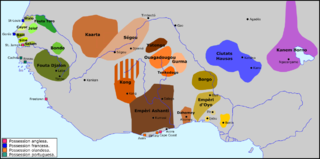
Futa Toro, often simply the Futa, is a semidesert region around the middle run of the Senegal River. This region, along the border of Senegal and Mauritania, is historically significant as the center of several Fulani states, and a source of jihad armies and migrants to the Fouta Djallon.
Lamido is the Anglicisation of a term from the Fula language or Fulfulde, used to refer to a ruler. In the language it is properly laamiiɗo, derived from the verbal root laamu- meaning "leadership", and hence may be translated more specifically as "leader". The title laamiiɗo is higher in rank than laamɗo, which means simply a "leader" or "king". Therefore, "laamiiɗo" means a "great king" or "great leader". It has been used by the traditional leaders of certain Fulani emirates in West Africa, originally as head of confederations of ruling and subordinate states. Its use persists within a number of post-colonial republics.
Ajami or Ajamiyya, which comes from the Arabic root for 'foreign' or 'stranger', is an Arabic-derived script used for writing African languages, particularly Songhai, Mandé, Hausa and Swahili, although many other languages are also written using the script, including Mooré, Pulaar, Wolof, and Yoruba. It is an adaptation of the Arabic script to write sounds not found in Standard Arabic. Rather than adding new letters, modifications usually consist of additional dots or lines added to pre-existing letters.
The Fula language is written primarily in the Latin script, but in some areas is still written in an older Arabic script called the Ajami script or in the recently invented Adlam script.
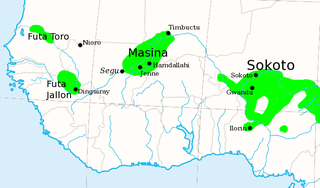
The Fulajihads sometimes called the Fulani revolution were a series of jihads that occurred across West Africa during the 18th and 19th centuries, led largely by the Muslim Fulani people. The jihads and the jihad states came to an end with European colonization.

The languages of Mauritania include the official language, Arabic, three national languages, Pulaar, Soninke and Wolof, and French, a former official language which is still the language of working, education and administration.
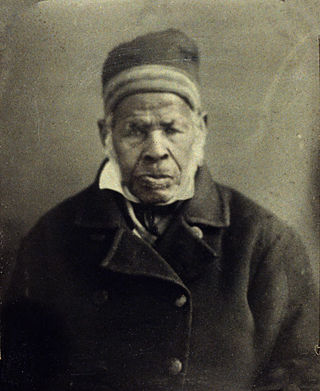
Fula Americans, Fulani Americans or Fulbe Americans are Americans of Fula descent.
The Jobawa are a sub clan of the Fulani ethnic group. Primarily found in the old Eastern Kano, they were the first Fulani clan to make contact with the Hausa people.
David Whitehorn Arnott was a British linguist who was Professor of West African Languages at School of Oriental and African Studies. He is known for his works on Fulani and Tiv.
Adamawa Fulfulde is a variety of the Fula language. It is spoken mainly in Cameroon but also by significant communities residing in Nigeria, Chad, and Sudan by Fulani pastoralists across the Sahel. It is also known as Eastern Fulfulde and by various other names including Boulbe, Dzemay, Fula, Fulfulde, Mbororo, Palata, Peul etc.
Nigerian Fulfulde, also known as Hausa States Fulfulde, Fula, or Fulani is a variety of the Fula language spoken by the Fulani people in Nigeria, particularly in the Northern region of Nigeria. It belongs to the West Atlantic branch of the Niger-Congo language family. Phonologically, Nigerian Fulfulde exhibits a system of vowel harmony and a relatively simple consonant inventory, including stops, fricatives, and nasal sounds.
Borgu Fulfulde, also known as Borgu Fulani, Benin-Togo Fulfulde, Fulbe-Borgu, or Peul is a variety of the Fula language a West Atlantic language part of the Niger-Congo language family, it is spoken primarily in the Borgou Department of Benin, spanning Nigeria, other parts of Benin, as well as Togo and parts of Burkina Faso.
Central-Eastern Niger Fulfulde, also known as Lettugal Niiser Fulfulde is a variety of the Fula language, a Niger–Congo language predominantly spoken in the Central and Eastern regions of Niger, particularly among the Fulani people. The linguistic structure of this language exhibits distinct features, including a Subject-Verb-Object (SVO) word order. Prepositions and postpositions are utilized in the language to convey spatial relationships. Genitives, articles, adjectives, numerals, and relatives follow noun heads, contributing to the overall complexity of sentence structures. The language employs a question-word-final pattern, placing question words at the end of interrogative sentences. Additionally, there is a specific set of affixes, comprising one prefix and nine suffixes, which play a crucial role in marking number and subject in verbs.
Bagirmi Fulfulde also known as Baghirmi Peul or Bagirmi Fula is a variety of the Fula language spoken primarily in the Chari-Baguirmi region of Chad as well as in the Central African Republic. Bagirmi Fulfulde, like other Fula varieties, has a consonant inventory with sounds such as stops, fricatives, and nasals. It typically includes a set of oral and nasalized vowels.

