The Chaldean Catholic Church is an Eastern Catholic particular church in full communion with the Holy See and the rest of the Catholic Church, with the Chaldean Patriarchate having been originally formed out of the Church of the East in 1552. Employing the East Syriac Rite in Syriac language in its liturgy, it is part of Syriac Christianity by heritage. Headquartered in the Cathedral of Mary Mother of Sorrows, Baghdad, Iraq, since 1950, it is headed by the Catholicos-Patriarch Louis Raphaël I Sako. It comprises 640,828 members, mostly Chaldean Christians living in northern Iraq, with smaller numbers in adjacent areas in northeastern Syria, southeastern Turkey and northwestern Iran, a region roughly corresponding to ancient Assyria. There are also many Chaldeans in diaspora in the Western world.

Mar Joseph VI Audo (1790–1878) was the Patriarch of the Chaldean Catholic Church from 1847 to 1878.
Mar Nicholas I Zaya was the patriarch of the Chaldean Catholic Church from 1839 to 1847. He succeeded Yohannan VIII Hormizd, the last of the Mosul patriarchs who traced their descent from Eliya VII (1558–91), and his elevation ended four centuries of hereditary succession in the Eliya line. After Zayʿa's accession the Vatican attempted to reform abuses within the Chaldean Church, but its interference was strenuously resisted by several Chaldean bishops. As a result, Zayʿa's short reign was plagued by one crisis after another. In 1846, after the Vatican conspicuously failed to support him against his recalcitrant bishops, he resigned the patriarchate and retired to his native town of Khosrowa, where he died in 1855. He was succeeded by Joseph VI Audo, one of his most determined opponents.

Mar Yohannan VIII Hormizd (1760–1838) was the last hereditary patriarch of the Eliya line of the Church of the East and the first patriarch of a united Chaldean Church. After succeeding his uncle Eliya XII Denha in 1780 as patriarch of Mosul, he made a Catholic profession of faith and was recognised in 1783 by the Vatican as patriarchal administrator and archbishop of Mosul. His career as patriarchal administrator was controversial, and was marked by a series of conflicts with his own bishops and also with the Vatican. Suspended from his functions in 1812 and again in 1818, he was reinstated by the Vatican in 1828. In 1830, following the death of the Amid patriarchal administrator Augustine Hindi, he was recognised by the Vatican as patriarch of Babylon of the Chaldeans and the Mosul and Amid patriarchates were united under his leadership. This event marked the birth of the since unbroken patriarchal line of the Chaldean Catholic Church. Yohannan Hormizd died in 1838 and his successor Nicholas I Zayʿa was chosen by the Vatican, ending the centuries-old practice of hereditary succession in the Eliya line of the Church of the East.
MarShimun VIII Yohannan Sulaqa was the first Patriarch of the Church of Assyria and Mosul, what was to become the Chaldean Catholic Church, from 1553 to 1555, after it absorbed this Church of the East patriarchate into full communion with the Holy See and the Catholic Church.
Dioceses of the Church of the East, 1318–1552 were metropolitan provinces and dioceses of the Church of the East, during the period from 1318 to 1552. They were far fewer in number than during the period of the Church's greatest expansion in the tenth century. Between 1318 and 1552, the geographical horizons of the Church of the East, which had once stretched from Egypt to China, narrowed drastically. By 1552, with the exception of a number of East Syriac communities in India, the eccesiastical jurisdiction of the Church of the East was confined to its original heartland in northern Mesopotamia.
For much of the nineteenth and twentieth centuries the district of Salmas in northwest Iran was an archdiocese of the Chaldean Catholic Church, now apart of the Chaldean Catholic Archeparchy of Urmyā.

After the schism of 1552 of the Church of the East, the secessions the Chaldean Catholic Church and the Assyrian Church of the East each had around twelve dioceses each by the end of the 19th century.
DINAmadiya was a separate eparchy (diocese) of the Chaldean Catholic Church until it was united with the Chaldean Catholic Eparchy of Zakho in 2013.
Diocese of Berwari was an East Syriac diocese of the Church of the East, existing between the sixteenth and twentieth centuries and covering the region of Berwari.
Aqra, properly ʿAqra, is a diocese of the Chaldean Church founded in the mid-19th century.
Seert was a diocese of the Chaldean Church during the eighteenth, nineteenth and early-twentieth centuries. The diocese was ruined during the First World War.
Mardin was a diocese of the Chaldean Church from the sixteenth to the twentieth century. The diocese lapsed in 1941. Prior to this, it was a diocese of the Assyrian Church of the East, from which the Chaldean Catholic Church originated.
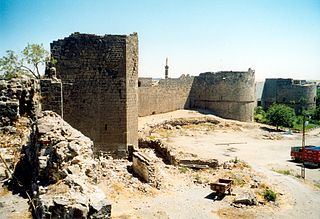
The Diocese of Amid (Diyarbakir) was a diocese or archdiocese of the Chaldean Church from the sixteenth to the twentieth century. From at least the 13th century the city of Amid had been part of the Diocese of Maiperqat of the Church of the East; following the schism of 1552 it became the seat of its own diocese in the Chaldean Church.
Chaldean Catholic Diocese of Zakho is a diocese of the Chaldean Church in the second half of the 19th century and for most of the 20th century. The diocese of Zakho was merged with the Chaldean diocese of ʿAmadiya in 1987. In December 2001, a new bishop was consecrated. In July 2013, Zakho was suppressed to the Diocese of Amadiyah.
The Chaldean Catholic Archeparchy of Kirkuk is an archeparchy of the Chaldean Catholic Church in communion with the Pope in Rome. The archdeparchy was created in the early years of the nineteenth century. Its present ordinary, Archbishop Yousif Thomas Mirkis, was consecrated in 2014.

The Church of the East, also known as the Nestorian Church and the Persian Church, was an Eastern Christian denomination that in 410 organised itself within the Sasanian Empire and in 424 declared its leader independent of other Christian leaders. From the Persian Empire it spread to other parts of Asia in late antiquity and the Middle Ages.
Conventional lists of Patriarchs of the Church of the East include around 130 patriarchs. A number of these patriarchs are legendary, or invented, or have been included in the standard lists on dubious evidence. This article sets out the historical evidence for the patriarchal succession in the Church of the East and its successor churches, the Assyrian Church of the East, the Chaldean Catholic Church, and the Ancient Church of the East.

Shemʿon VII Ishoʿyahb was Patriarch of the Church of the East from 1539 to 1558, with residence in Rabban Hormizd Monastery.
The Schism of 1552 was an important event in the history of the Church of the East. It divided the church into two factions, of which one entered into communion with Rome becoming part of the Catholic Church at this time and the other remained independent until the 19th century. Although the Eliya line, which emerged as a result of this schism, did eventually enter into communion with Rome, various Spiritual Christian sects with their origins in the Church of the East emerged as a result of this schism. Ironically, the Shimon line whose entry into full communion with Rome caused this schism, in fact became independent again by the 17th century. The circumstances of the 1552 schism were controversial at the time and have been disputed ever since.